
Specialty Coatings and Textured Painting in Lombard, Illinois
Standard flat paint covers a wall. Specialty coatings transform one. In Lombard, homeowners and business owners upgrading beyond basic color turn to specialty coatings for texture, depth, durability, and decorative effects that a roller and a gallon of latex simply cannot produce. T&Z Interior and Exterior Painting handles specialty coatings and textured painting for accent walls, feature ceilings, commercial interiors, high-traffic surfaces, and decorative finish projects across Lombard and the surrounding area. Call us for a free consultation and on-site estimate. Custom finish projects require material lead time — booking early gives you the best scheduling window. We’re a licensed Painter with 15+ years of experience, and we select the right product, prep the surface correctly, and apply every specialty finish using the technique it actually requires.
What Specialty Coatings Are — and When Standard Paint Is Not Enough
What specialty coatings actually are:
Specialty coatings are products formulated for performance or appearance beyond what standard interior latex provides. They fall into four broad categories:
- Decorative and textured coatings — products applied to create surface depth, pattern, or visual dimension. Knock-down texture, skip-trowel, venetian plaster, and faux finishes all fall here. The goal is a wall that looks designed, not just painted.
- Protective high-performance coatings — epoxy floor coatings, garage wall sealers, commercial-grade topcoats, and moisture-barrier products for bathrooms and basements. The goal is durability and protection that standard paint can't sustain under real conditions.
- Elastomeric and masonry coatings — thick, flexible exterior coatings for stucco, concrete block, and masonry surfaces. These bridge hairline cracks and resist moisture penetration in ways standard exterior paint cannot.
- Specialty interior finishes — antimicrobial coatings for healthcare or food-service environments, low-VOC coatings for sensitive spaces, and high-hide products for covering dark colors or heavy staining in one coat cycle.
When standard paint is not enough:
Standard paint is the wrong tool when the surface has significant imperfections that need to be concealed rather than revealed. A fresh coat of flat paint on a wall full of patches, repairs, and settling cracks makes every flaw more visible, not less. A heavy-bodied textured coating over the same wall creates a unified surface that reads as intentional.
Standard paint is also not enough when the surface takes abuse that latex can’t withstand — garage floors, commercial kitchen walls, high-humidity bathrooms, and heavy-traffic commercial entries all need coatings formulated for those conditions.
Lombard’s older housing stock makes specialty coatings especially practical here. Homes built in the 1960s through 1980s have decades of patching, settling, and repair on their walls and ceilings. Textured specialty coatings unify these surfaces into a finished, intentional look that would require months of skim-coating and sanding to achieve with standard paint alone.
The 5 Levels of Paint Finish — and Which One Belongs in Each Room
- Level 1 — Flat/Matte Zero sheen. Absorbs light rather than reflecting it. Best at hiding surface imperfections — texture variation, patches, and minor unevenness disappear under flat paint in a way no other finish achieves. The trade-off is washability — flat paint marks easily and doesn't clean well. Best for: ceilings, low-traffic bedrooms, formal dining rooms where walls aren't touched.
- Level 2 — Eggshell Very slight sheen — barely perceptible in normal light. Significantly more washable than flat without looking glossy. The most common finish for main living areas. Best for: living rooms, dining rooms, adult bedrooms, and any room where you want a clean look without high reflectivity.
- Level 3 — Satin Moderate sheen with a soft luster. Noticeably more moisture and scrub resistant than eggshell. Shows surface imperfections more than flat or eggshell — walls need to be in good condition before satin goes on. Best for: kitchens, bathrooms, hallways, laundry rooms, and children's rooms where cleaning matters.
- Level 4 — Semi-Gloss High sheen, hard surface, easy to wipe clean. Amplifies surface flaws significantly — prep quality shows. Best for: trim, baseboards, door casings, interior doors, and cabinet frames. Semi-gloss on walls works in high-moisture areas like bathrooms and is standard in commercial kitchens.
- Level 5 — Gloss Maximum sheen and hardness. The most durable finish level and the most demanding of perfect surface prep — every flaw is visible. Best for: architectural accents, statement features, furniture, cabinet doors, and surfaces where a lacquer-like appearance is the goal.
Where specialty coatings fit: Specialty finishes exist outside this sheen spectrum. A knock-down textured wall isn’t flat, eggshell, or satin — it’s a three-dimensional surface. A venetian plaster accent wall reflects light in ways none of the five levels replicate. A faux concrete finish creates visual weight and texture that sheen level has nothing to do with. Specialty coatings are chosen when the goal is a surface that no standard finish level can produce.
Open-plan homes in Yorkshire Woods and Summit at Yorktown — where the living room, dining area, and kitchen flow together without walls between them — benefit most from a deliberate finish strategy. T&Z advises on sheen transitions between connected spaces so the finish feels cohesive rather than inconsistent room to room.
The Real Advantages of Specialty Coatings Over Standard Paint in Lombard Homes
Visual depth and dimension. Standard paint in any color produces a flat, uniform surface. Specialty coatings — textured finishes, faux effects, layered decorative treatments — add dimension that makes a room feel designed rather than just painted. A skip-trowel wall in a living room, a venetian plaster entry, or a faux concrete accent in a home office all create a visual experience that flat paint in any color cannot replicate.
Surface concealment. This is one of the most practical advantages in older Lombard homes. Walls and ceilings with decades of patching, settling, nail pops, and repair work have uneven surfaces that standard paint highlights rather than hides. Heavy-bodied textured coatings fill and unify these surfaces. The imperfections disappear into the texture rather than showing through as shadows and bumps under flat or eggshell paint.
Superior durability on demanding surfaces. Epoxy and high-performance coatings outlast standard latex by years on garage floors, commercial walls, basement surfaces, and any area that sees chemical exposure, heavy cleaning, or sustained moisture. Standard paint in a garage takes wheel marks, chemical drips, and seasonal moisture and starts failing within a few seasons. Epoxy holds those same conditions for a decade with proper prep.
Moisture resistance in wet areas. Specialty bathroom and kitchen coatings resist humidity, steam, and standing water contact in ways standard interior latex cannot sustain long-term. High-humidity spaces in bathrooms and kitchens — particularly in older Lombard homes without modern ventilation — need coatings formulated for those conditions. Standard paint in these areas grows mildew, peels at seams, and fails at grout lines far faster than the right specialty product.
Distinctiveness. A standard paint job in any color is forgettable. A custom faux finish on an entry wall, a textured feature ceiling in a great room, or a venetian plaster treatment in a dining room is memorable. For homeowners in Lombard preparing a property for sale, a well-executed specialty finish in a key space creates a lasting impression that standard paint at any price point simply does not.
Knock-Down, Skip-Trowel, and Faux Finishes — What Each One Does and Where It Works
Knock-down texture is the most widely used textured finish in residential interiors. Joint compound is applied to the wall or ceiling with a roller or hopper, then partially flattened with a broad knife before it fully dries — leaving irregular, slightly raised flattened patches across the surface. The result is a soft, organic pattern with no dominant directionality. It reads as subtle in smaller rooms and dramatic in large open spaces with raking light. Knock-down is the standard choice for ceilings and is equally effective on large wall areas. It conceals surface imperfections well and matches easily for section repairs.
Skip-trowel is hand-applied with a trowel, creating a layered, overlapping pattern with more depth and variation than knock-down. The applicator skips the trowel across the surface rather than pressing it flat — leaving thick, irregular patches separated by thinner areas. The result is a Mediterranean or old-world plaster appearance that adds significant visual weight to a room. Skip-trowel works best in dining rooms, living rooms, and feature walls where texture is meant to be noticed. It takes more time to apply than knock-down and requires an experienced hand to look intentional rather than accidental.
Orange peel texture is a light spray texture that resembles the surface of a citrus peel — small, uniform bumps across the surface with no dominant pattern. It’s subtle enough to read as smooth from a distance but adds enough surface interest to hide minor wall imperfections. Orange peel is common in contemporary and modern interiors where the look is clean but not completely flat. It’s a good middle ground between smooth walls and heavier texture.
Faux finishes are multi-layer painting techniques that mimic materials — stone, aged plaster, concrete, linen, leather, weathered wood. They require a base coat, one or more glaze or texture layers applied with specific tools (rags, sponges, brushes, or trowels), and often a protective topcoat. The result can be remarkably convincing at a fraction of the cost of actual material installation. Faux finishes work on accent walls, entry features, fireplace surrounds, and any surface where visual impact is the priority.
Accent wall treatments — color wash, strié, venetian plaster effects, and limewash — create a focal point in a room without structural or architectural changes. A single wall treated with venetian plaster or a layered color wash draws the eye and anchors the room in a way that paint color alone does not accomplish.
Homes in Westmore and Maple Knoll with original 1960s skip-trowel or stipple textures often need section repairs — water damage, drywall patches, or previous renovations leave smooth areas in the middle of textured walls. T&Z matches existing texture before repainting so repairs disappear into the surrounding surface rather than standing out as obvious patches.
Why Specialty Coatings Require More Surface Prep Than Standard Paint
Specialty coatings show everything.
A textured finish applied over an uneven, incompletely patched wall creates a surface where the patches are visible as flat spots in the texture. A faux finish applied over a wall with sheen variation produces blotchy, uneven glaze absorption. An epoxy coating applied over a floor that wasn’t properly etched peels in sheets within months, leaving bare concrete underneath.
Standard paint over a mediocre prep job looks acceptable. Specialty coatings over a mediocre prep job look like a mistake.
The prep sequence T&Z follows for specialty coating projects:
- Assess the substrate — identify all repairs needed, sheen inconsistencies, previous coating types, and any areas of active moisture or staining
- Complete all repairs — fill holes and cracks, skim-coat uneven areas, address any moisture issues before coating
- Sand flush — all patches, repairs, and raised areas sanded smooth and feathered into the surrounding surface
- Prime with product-specific primer — decorative finish primers differ from standard drywall primer; epoxy coatings require etch primer or mechanical abrasion; faux base coats require a uniform-sheen base coat that is fully cured before glaze layers go on
- Test patch — apply a sample section of the specialty finish before committing to the full surface; this confirms color, texture level, and technique before the project is locked in
- Full application — technique-specific tools and methods for each finish type; no shortcuts in application sequence
A specific note on plaster walls. Pre-1960 Lombard homes frequently have plaster walls rather than drywall. Old plaster is highly absorbent and uneven in porosity — applying a specialty coating directly to unsealed plaster produces blotchy, uneven results as the product absorbs at different rates across the surface. Plaster walls need a penetrating sealer applied and fully cured before any specialty finish goes on. Skipping this step is one of the most common reasons specialty coating jobs on older Lombard homes look wrong even when the technique is correct.
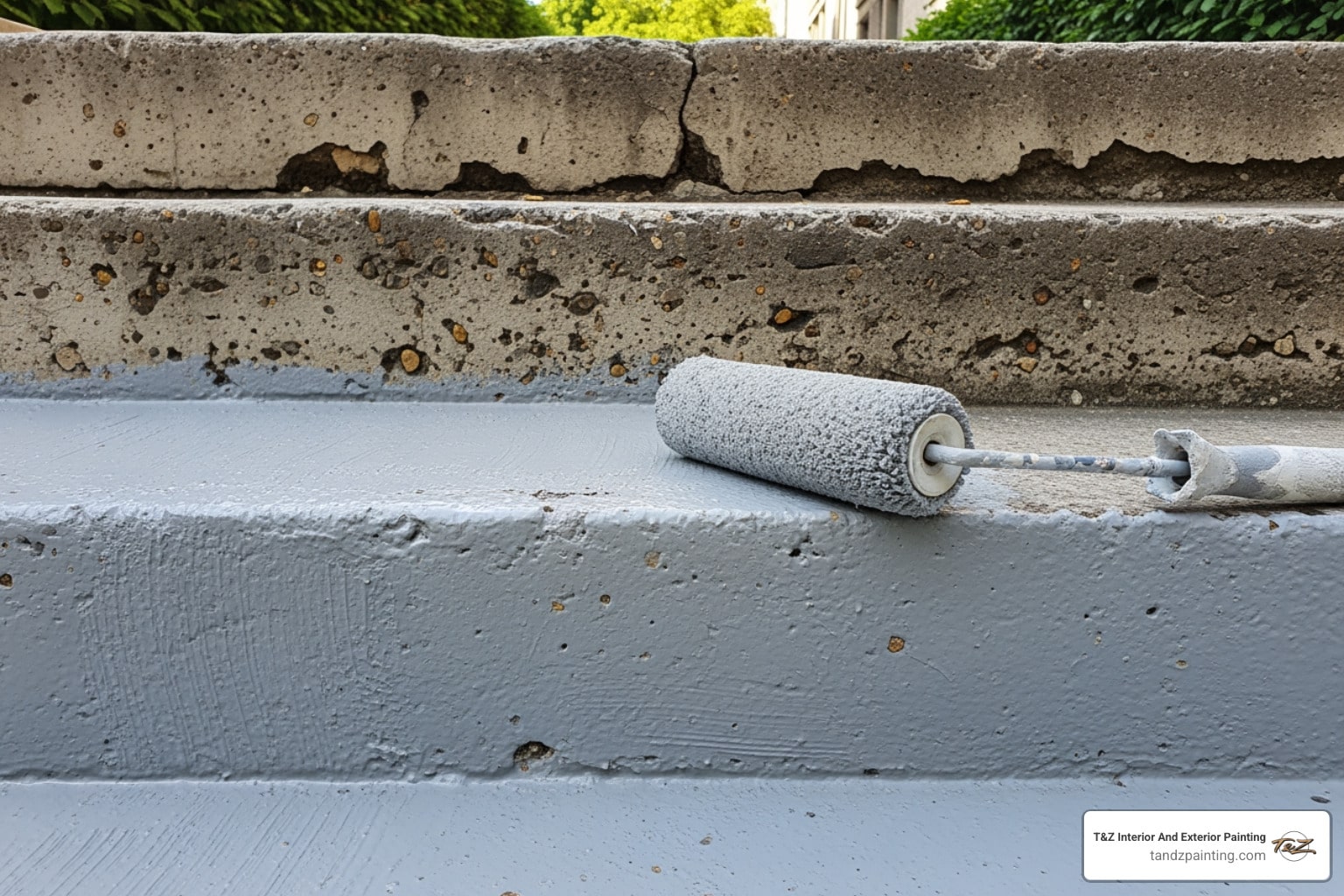
Epoxy and high-performance coatings require mechanical prep. Garage floors and commercial concrete surfaces need acid etching or mechanical grinding before epoxy is applied. Epoxy bonds to the concrete substrate, not to the surface layer — any barrier between the epoxy and the concrete causes delamination. Adhesion failure on epoxy is expensive to fix because the failed coating has to be mechanically removed before starting over.
How Long Specialty Coatings Last in Lombard — and How to Keep Them Looking Sharp
Expected lifespan by finish type:
Knock-down and skip-trowel textures: 10 to 15 years before a texture refresh is needed. These finishes are durable because they’re essentially a textured compound layer over the wall surface — they don’t peel or fade the way paint does. Touch-up and section repair is possible as long as the existing texture can be matched, which T&Z handles as part of ongoing maintenance visits.
Faux and layered decorative finishes: 7 to 10 years under normal conditions. Direct sunlight on south or west-facing walls fades glaze layers faster — window treatments or UV-blocking glass slow this meaningfully. High-humidity rooms shorten the cycle; moisture-resistant topcoats extend it.
Epoxy floor and wall coatings: 5 to 10 years in residential use. Garage floors with regular vehicle traffic and chemical exposure sit at the lower end of that range. Interior floors and wall coatings in lower-traffic areas last toward the upper end. Commercial environments with proper maintenance protocols can extend epoxy life beyond 10 years.
Venetian plaster and limewash finishes: 15 to 20 years or more. These finishes are mineral-based and extremely durable. They don’t crack or peel like paint — they develop a patina over time that many homeowners find more appealing than the original application. Touch-up requires skill to match but is entirely possible.
Maintenance by finish type:
Faux finishes and decorative glazes are more sensitive to harsh cleaning than standard paint. Use a soft cloth and mild soap — no abrasive cleaners, no Magic Erasers, no bleach-based products. These cleaners cut through the glaze layers and leave dull patches that can’t be touched up without reapplying to the entire section.
Textured surfaces like knock-down and skip-trowel collect dust in their recesses. Gentle vacuuming with a soft brush attachment or a light wipe with a barely damp cloth keeps them clean without damaging the texture.
Epoxy floors need regular sweeping and occasional mopping with a pH-neutral cleaner. Avoid oil-based cleaners that leave a residue the next coat can’t bond to when the time comes to recoat.
High-humidity rooms in older Lombard homes — bathrooms and kitchens in Westmore and Maple Knoll properties that lack modern ventilation — accelerate the wear cycle on any coating. Specialty finishes formulated for moisture resistance handle these conditions significantly better than standard decorative products, but ventilation improvements are the only way to extend coating life in rooms with chronic humidity issues.
Send Us a Message
FAQ
What are specialty coatings and how are they different from regular paint?
Specialty coatings add texture, depth, durability, or protective properties that standard flat or eggshell paint cannot deliver. They include textured wall finishes, faux decorative effects, epoxy floor and wall coatings, elastomeric exterior coatings, and high-performance products for moisture-heavy or high-traffic environments. Standard paint covers a surface. Specialty coatings transform it.
Which finish level is right for high-traffic rooms in a Lombard home?
Satin for kitchens, hallways, and bathrooms — it cleans well and resists moisture without looking overly shiny. Semi-gloss for trim and doors. Specialty coatings for surfaces that need texture, heavy protection, or decorative effects that sheen level alone can’t provide — such as a heavily used garage floor, a feature wall, or a high-humidity bathroom that keeps failing standard paint.
Can specialty coatings hide wall imperfections in an older Lombard home?
Yes — heavy-bodied textured coatings like knock-down and skip-trowel are among the most effective ways to unify a wall surface full of patches, repairs, and settling cracks. The surface still needs basic prep — holes filled, loose material removed — but the texture conceals the kind of minor imperfections that standard paint highlights. Full skim-coating is not required in most cases.
How long does a specialty textured finish last in a Lombard home?
Knock-down and skip-trowel textures last 10 to 15 years. Faux and layered decorative finishes last 7 to 10 years. Epoxy coatings last 5 to 10 years depending on traffic and maintenance. Venetian plaster and mineral-based finishes are the longest-lasting — 15 to 20 years or more with basic care.
Do specialty coatings require different prep than standard interior painting?
More prep, not less. Specialty finishes amplify what’s underneath rather than hiding it — surface imperfections that would be acceptable under standard paint become visible problems under a textured or faux finish. Skim-coating, sanding flush, and applying a product-specific primer are standard steps before any specialty coating goes on. Plaster walls in older Lombard homes require a penetrating sealer before any specialty finish can be applied evenly.