
Cabinet Finishing Advice in Lombard, IL
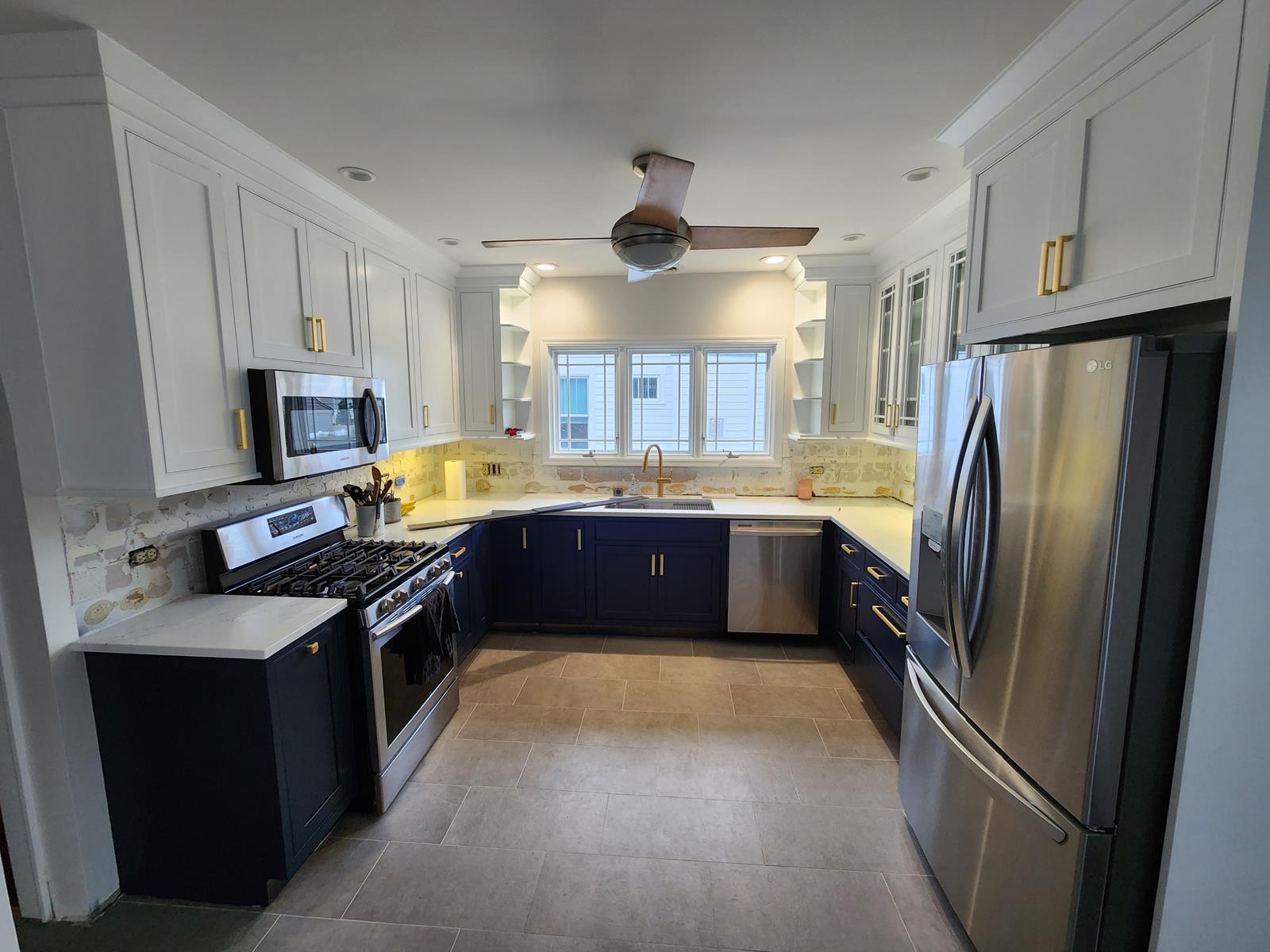
Cabinet finishing decisions are among the most permanent choices in a home update. Unlike wall paint, which can be changed in a weekend, cabinet finishing requires full surface preparation, multiple product applications, and significant dry time — making a wrong decision expensive and time-consuming to correct. In Lombard, homeowners updating kitchen and bathroom cabinets turn to T&Z for Cabinet Finishing Advice before any work begins. We provide on-site guidance on color selection, finish type, paint versus stain decisions, material coordination with countertops and hardware, and prep requirements — for residential kitchens, bathrooms, and commercial spaces. Schedule an on-site advice session and receive specific recommendations before any cabinet work is committed. We’re a licensed Painter with 15+ years of cabinet finishing expertise, and we help you make decisions that produce durable, cohesive results from day one.
What Cabinet Finishing Advice Includes — and Why It Matters Before Any Work Begins in Lombard
Paint versus stain:
This is the first and most fundamental cabinet finishing decision, and it’s one that wall painting never requires. Painted cabinets provide a smooth, uniform surface in any color — the wood grain is concealed beneath primer and topcoat. Stained cabinets preserve and enhance the natural wood grain — color is added but the grain character of the wood remains visible and becomes part of the aesthetic.
The right choice depends on the cabinet material, the door style, and the aesthetic goal. Paint works on any material — solid wood, MDF, plywood boxes, and thermofoil-wrapped doors that are being painted for the first time. Stain requires bare or previously stained wood — MDF and thermofoil cannot be stained. Raised-panel doors with profile detail often look better stained because the profile is part of the door’s visual character. Flat-panel contemporary doors often look better painted because their aesthetic is the clean, uniform surface that paint provides.
Getting this decision right before the project starts determines which prep sequence, which products, and which application method are appropriate. Getting it wrong after the project has begun means stripping back to start over.
Finish level:
Cabinet finish level — satin, semi-gloss, or gloss — determines durability, cleanability, surface reflectivity, and how visible every surface imperfection will be after application. These are not interchangeable choices, and the wrong finish level produces failures that are visible from across the room.
Color selection:
Cabinet color is not selected from a chip at the paint store. It is selected on-site, in the actual kitchen or bathroom, in relationship to the countertop material, hardware metal tone, backsplash tile, flooring, and wall color that will surround the cabinets when the project is finished. Every one of these materials has an undertone that either supports or conflicts with the proposed cabinet color. Advice identifies those relationships before any commitment is made.
Prep requirements:
Different cabinet materials require completely different prep sequences. Original 1970s oil-based paint on solid wood cabinets requires specific deglossing and priming before any water-based topcoat. MDF cabinet doors require edge sealing before primer or moisture will raise the MDF edge fibers. Thermofoil-wrapped surfaces require a bonding primer before any other product. Previously painted cabinets in sound condition require different prep than cabinets with failing, peeling, or delaminating finish. Advice identifies what the specific cabinets in the specific Lombard home require — not a generic prep assumption.
Lombard kitchens span six decades of cabinet styles. Original 1970s oak raised-panel cabinets with deep profile detail. Honey-maple frameless boxes from the 1990s. Contemporary flat-panel MDF doors in newer builds. Each of these cabinet types requires a different advice approach, different products, and different finish recommendations. On-site assessment is the only way to give relevant guidance for the specific cabinets in the specific home.
Why Coordinating Cabinet Color With Countertops and Hardware Produces Better Results in Lombard Kitchens
The countertop relationship:
Countertop and cabinet are the two dominant visual elements in any kitchen. Their relationship determines whether the kitchen reads as cohesive or conflicted. The critical factor is undertone alignment.
Warm-toned countertops — beige granite, cream quartz, warm white marble — have yellow, red, or brown undertones in their base color. Cabinet colors paired with warm countertops need to either share that warmth or provide enough contrast to read as intentional. A cool gray cabinet with blue undertones against a warm beige granite countertop creates a warm-cool conflict where neither material looks as good as it does alone. A warm white, cream, or greige cabinet against the same countertop reads as cohesive.
Cool-toned countertops — white quartz with gray veining, cool gray stone, blue-gray concrete — pair best with cool or true neutral cabinet colors. A warm cream cabinet against cool white quartz creates the same conflict in reverse — the countertop looks yellow in comparison to what it actually is, and the cabinet looks warmer than intended.
The hardware relationship:
Hardware is attached directly to the cabinet face. The cabinet color and the hardware metal are always seen together. Their relationship is either harmonious or tense — and the tension, when it exists, is immediately visible to anyone who uses the kitchen.
Brushed brass and unlacquered brass hardware have warm yellow-orange undertones. They pair best with warm cabinet colors — cream whites, warm grays, greiges with yellow or orange undertones. Placed against a cool, blue-toned white cabinet, brass hardware reads as too warm and the cabinet reads as too cold.
Brushed nickel and chrome have cool silver undertones. They pair best with cool or true neutral cabinet colors. Against a warm cream cabinet, cool nickel hardware reads as out of place — it looks like the hardware and cabinets came from different design plans.
Oil-rubbed bronze has warm, dark brown undertones — one of the most specific hardware tones to coordinate. It pairs well with warm medium-toned or dark cabinet colors, and poorly with cool whites and pale grays.
Matte black hardware is one of the most versatile options because it has a relatively neutral undertone that works in a wide range of cabinet color contexts — the main consideration is contrast level rather than undertone alignment.
The backsplash relationship:
Backsplash tile is directly adjacent to both cabinets and countertop and is seen in full view every time someone uses the kitchen. Tile pattern, grout color, and tile finish all affect how the cabinet color reads. A patterned Moroccan tile backsplash with warm terracotta tones makes adjacent white cabinets look cooler than they are. A cool gray subway tile with dark charcoal grout makes adjacent warm cream cabinets look warmer. Advice accounts for the backsplash material in cabinet color selection — not as an afterthought but as a primary coordination element.
Kitchen renovations in Yorkshire Woods and Summit at Yorktown where new quartz countertops, updated hardware, and cabinet painting are being done simultaneously are the highest-value coordination scenario. When all new materials arrive together, the cabinet color is the last decision and the one that either unifies everything or reveals that individual elements weren’t chosen in relationship to each other. T&Z reviews all new materials together before recommending cabinet color so nothing arrives and conflicts with what’s already been decided.
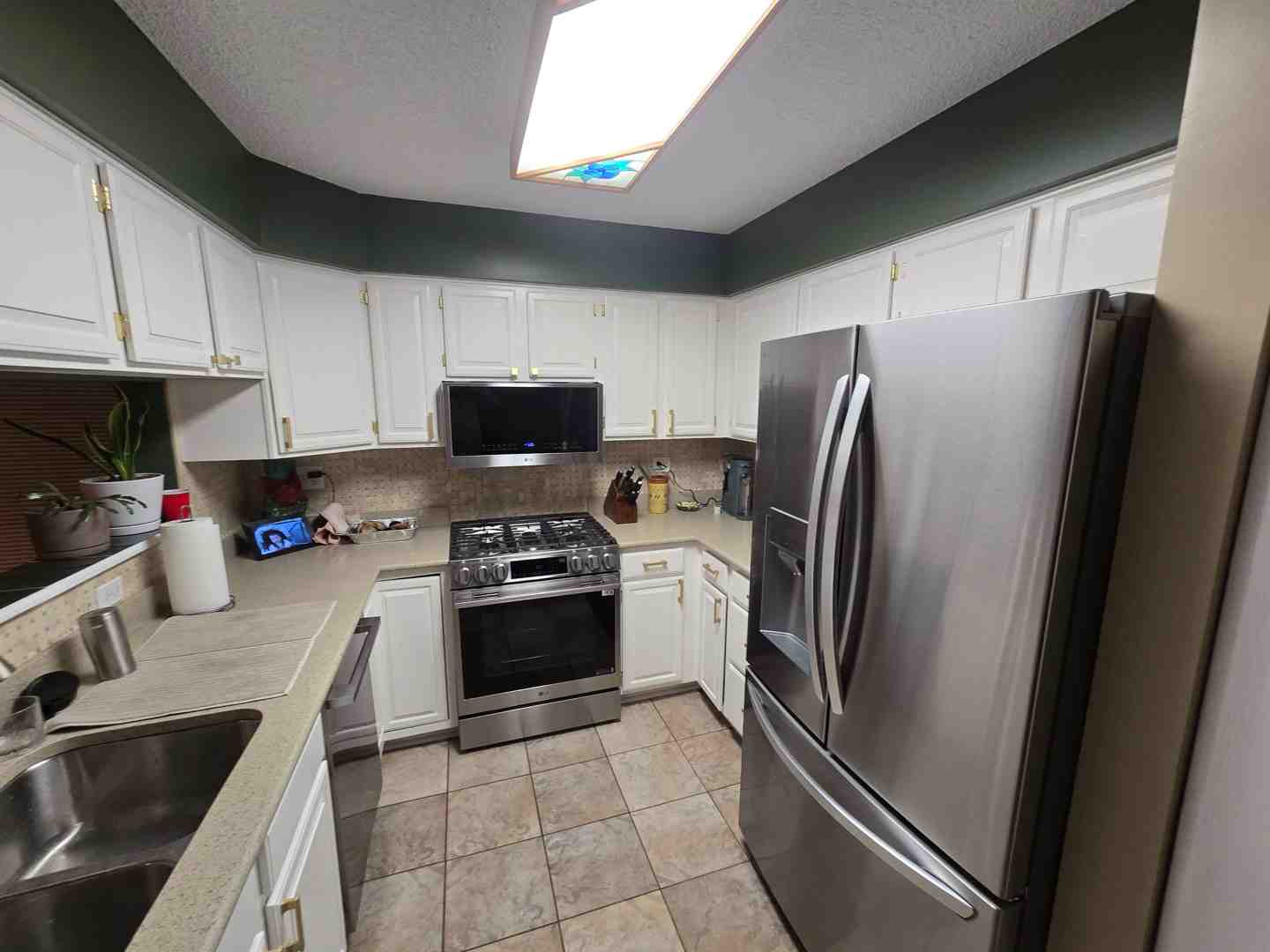
How to Choose the Right Paint Finish for Cabinets in Lombard Homes
Why standard wall paint is the wrong product for cabinets:
This is the starting point for finish advice — not which sheen to use, but which product category. Standard interior wall paint — even at a high sheen level — is not formulated for the demands of cabinet surfaces. Cabinet doors are opened, closed, gripped, and wiped hundreds of times per week. They’re exposed to kitchen steam, cooking grease, and cleaning products on a daily basis. Wall paint, regardless of sheen, breaks down under this contact and cleaning frequency far faster than cabinet-specific products.
Cabinet-grade enamel is formulated specifically for cabinet surfaces. It’s harder, more chemical-resistant, and more durable than wall paint at any sheen level. It levels better during application — producing fewer brush marks and roller texture in the dry film. And it cures to a harder surface that withstands contact without scuffing and marking the way wall paint does.
T&Z specifies cabinet-grade enamel on all Lombard cabinet projects. Not standard wall paint at semi-gloss. Cabinet enamel.
Satin:
Satin finish on cabinets has a soft, low-sheen appearance that is forgiving of surface imperfections — minor prep variations and small surface irregularities are less visible under satin than under higher sheens. The trade-off is cleanability and hardness. Satin cleans less easily than semi-gloss under grease and food contact, and it’s softer than higher sheens.
Satin is the right finish for lower-traffic cabinet applications — bathroom vanities, bedroom built-ins, laundry room cabinetry, and any cabinet that doesn’t face daily kitchen-level contact and cleaning. For kitchen cabinets, satin is the floor of the acceptable range, not the preference.
Semi-gloss:
Semi-gloss is the most widely used and broadly appropriate cabinet finish for Lombard kitchen projects. It provides meaningful durability improvement over satin — harder, more washable, better resistance to grease and steam. It cleans well under daily kitchen conditions without requiring aggressive cleaning products that would damage a softer finish.
Surface imperfections are more visible under semi-gloss than satin — joints, minor surface variation, and prep quality show more clearly. This makes thorough prep more important at semi-gloss, but thorough prep is standard practice on every T&Z cabinet project regardless of finish level.
Semi-gloss works on any cabinet door style — raised panel, shaker, flat panel — and any cabinet material, making it the default recommendation for Lombard kitchen cabinets unless there’s a specific reason to go higher.
Gloss:
Gloss is the hardest, most washable, and most reflective cabinet finish. It’s ideal for contemporary flat-panel cabinet doors where the clean, uniform reflective surface is part of the design intention. It cleans the most easily of all finish levels — in commercial kitchen applications and high-use residential kitchens, gloss provides the greatest durability under frequent cleaning with commercial cleaners.
The trade-off: gloss amplifies every surface imperfection. Minor surface variation, prep inconsistency, dust contamination during application, and any brush or roller texture in the dry film are all more visible under gloss than under any other finish level. This means prep quality at gloss is non-negotiable — every surface must be sanded perfectly smooth, primed uniformly, and applied in controlled conditions to produce a result that justifies the sheen level.
Gloss on raised-panel cabinet doors with deep profiles is a decision that requires advice — the reflectivity of gloss in the recesses of a complex profile reads differently than on a flat surface, and not always in the intended direction.
Lombard kitchens with original cabinets from the 1980s and 1990s often have softer wood, MDF components, and surfaces with decades of accumulated surface variation. Gloss on these cabinets requires significant additional prep to produce a result that doesn’t amplify the surface history of the cabinet. Advice accounts for the cabinet material and construction when specifying finish level — not just the homeowner’s aesthetic preference.
How T&Z Helps Lombard Homeowners Coordinate Cabinet Colors With Both Interior Rooms and Exterior Spaces
Cabinet color and the interior palette:
In open-plan Lombard homes — particularly the ranch and split-level layouts common in Westmore and Maple Knoll where kitchen, dining, and living areas flow together — the kitchen cabinet color is visible from multiple other rooms simultaneously. A decision made purely for the kitchen reads against living room furniture, dining area flooring, and entry lighting that weren’t part of the kitchen decision.
T&Z’s whole-home coordination approach addresses cabinet color as part of the full interior palette. The cabinet color is specified to work with the kitchen wall color, the adjacent living and dining wall colors, the trim color that runs through the full interior, and the flooring that connects all spaces. The result is a kitchen that belongs to the home rather than existing as a separate color environment.
The wall-to-cabinet relationship:
Wall color and cabinet color in a kitchen need a clear relationship. They can be high-contrast — dark cabinets against a light wall, or light cabinets against a deep wall accent — or low-contrast with a clear undertone connection. What they cannot be is two neutrals with different undertones that read as neither matching nor contrasting. A warm cream cabinet against a cool gray kitchen wall creates this problem — too similar in value to read as intentional contrast, too different in undertone to read as harmonious.
The advice session specifies wall color and cabinet color together when both are changing, or identifies the wall color that works correctly with existing cabinets when only the walls are being updated.
Whole-home color documentation:
For comprehensive whole-home painting projects that include cabinet finishing, T&Z provides a complete color specification — cabinet color code, kitchen wall color, trim color, ceiling color, and colors for all adjacent rooms. This document gives the homeowner a confirmed reference for purchasing and ensures the painter has a complete, confirmed specification before any phase of the project begins.
For homes where the interior is visible from exterior entry points — through glass entry doors or sidelights that look directly into the kitchen — the cabinet color is considered alongside exterior palette decisions. A kitchen visible from the street through a glass front door is part of the home’s exterior impression, and a cabinet color that conflicts with the exterior palette creates a visual disconnect that is noticed even when it can’t be named.
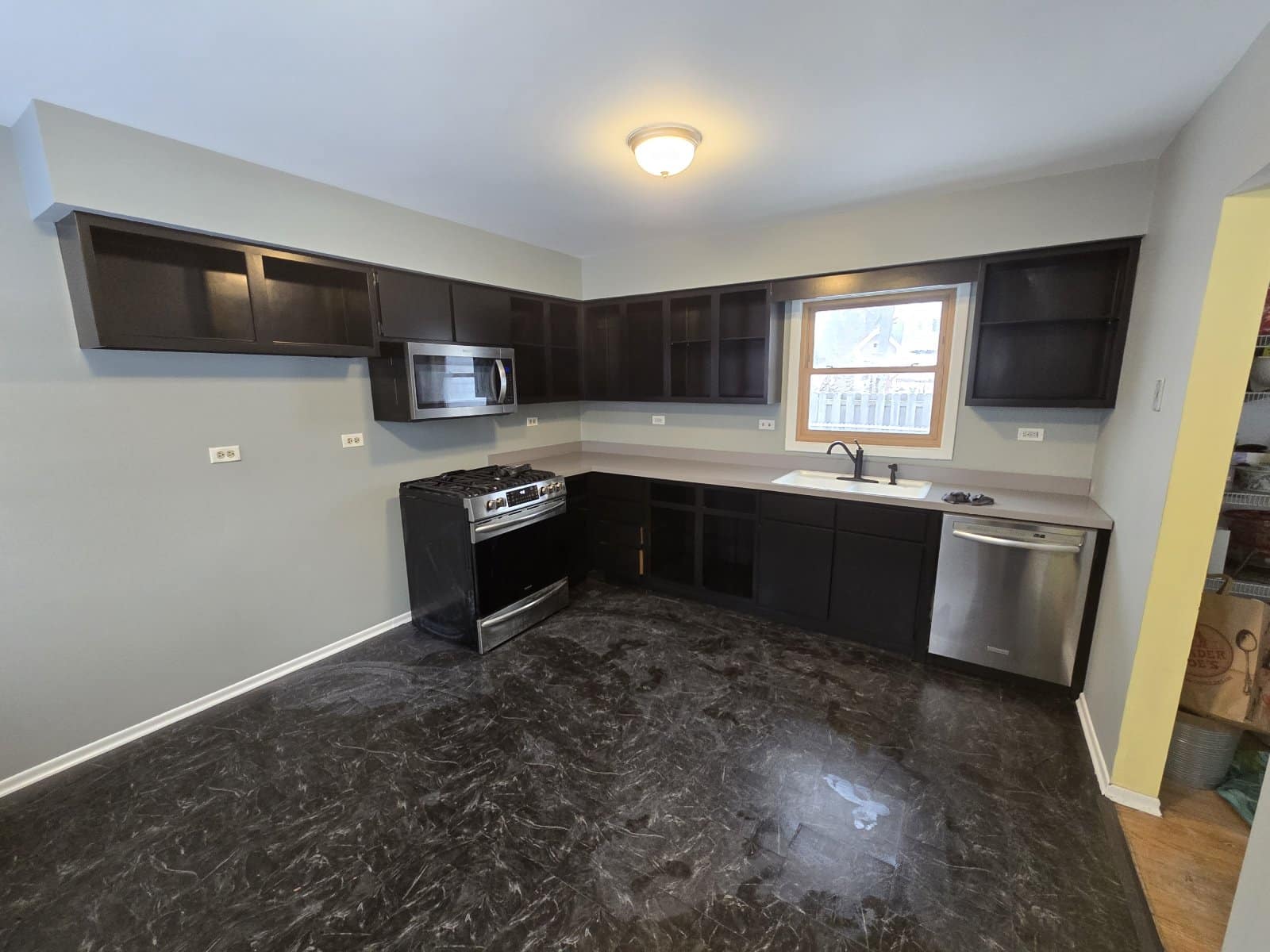
How T&Z Guides Lombard Homeowners Who Aren't Sure Which Cabinet Colors Work With Their Existing Décor
How the on-site session resolves uncertainty:
The session starts not with color options but with the existing materials in the space. Every material on-site — the countertop, the backsplash tile, the hardware, the flooring, the wall color — is assessed for its undertone profile. This assessment identifies which color families are supported by the existing material context and which ones will create conflicts.
Most Lombard kitchens, once the existing materials are assessed, point clearly toward two or three color directions. A kitchen with warm oak flooring, beige granite countertops, and oil-rubbed bronze hardware has a warm material context that supports warm cabinet colors — warm whites, creams, greiges, soft sage with yellow undertones, navy with red undertones. Cool cabinet colors — pure whites with blue undertones, cool grays, blue-grays — will conflict with the warm material context regardless of how much the homeowner likes them in other settings.
Narrowing from all options to a supported direction transforms the decision from overwhelming to manageable. Within the supported color families, personal preference guides the final choice — and that final choice, made within a clearly defined range of materials-supported options, has a very high probability of producing a result the homeowner loves in the finished kitchen.
From direction to specific recommendation:
The advice session doesn’t end with color families — it ends with a specific paint code recommendation and a specific rationale. The homeowner leaves with a written summary that includes the recommended cabinet color with product code, the finish level specification, coordination notes about why that color works with the existing materials, and any prep notes specific to the cabinet type.
This document removes the uncertainty between the advice session and the paint store. There’s no relying on memory, no second-guessing the chip under different lighting, no restarting the decision process from the beginning when the samples arrive home.
When the homeowner has a color in mind:
Many homeowners arrive at the advice session with a specific color they’re drawn to and want validated. The session tests that color against the actual materials in the kitchen — not in theory, but on-site, in the room, under the actual lighting, against the actual countertop and hardware.
If the color works, the session confirms it with a clear rationale — the homeowner proceeds with confidence rather than hope. If the color has an undertone conflict with a dominant kitchen material, the session identifies the specific conflict and recommends an adjustment — a version of the color with a slightly different undertone direction that produces the same aesthetic while resolving the material conflict.
Lombard homeowners updating kitchens with existing ceramic tile backsplash, original countertop, and original hardware — changing only cabinets — present the most constrained coordination scenario. The existing materials define a clear set of cabinet colors that will work and a clear set that won’t. T&Z’s on-site approach finds the cabinet color that makes the unchanged materials read as intentional and well-chosen rather than as things that should have been replaced alongside the cabinets.
Cabinet Finishing Advice for Lombard Commercial Properties — Offices, Retail, and Hospitality Spaces
Where commercial cabinet finishing advice applies:
Break room and kitchenette cabinetry in Lombard office buildings is the most common commercial cabinet application. These cabinets receive daily use from multiple users, are cleaned with commercial cleaning products, and need finishes that hold up under this contact level without the maintenance attention residential kitchen cabinets receive. Standard residential cabinet finish recommendations are not appropriate for this use environment.
Reception and lobby cabinetry in professional services offices — built-in reception desks, credenzas, storage walls — are client-facing surfaces that need to present professionally and coordinate with the commercial interior palette. Finish selection for these surfaces balances appearance with durability in a client-exposure context.
Restaurant and food service millwork requires the most demanding finish specification. Commercial kitchen cabinetry and prep area surfaces need chemical-resistant, waterproof finishes that can withstand daily sanitizer cleaning, steam exposure, and the rigorous cleaning requirements of a food service environment. Standard cabinet enamel is not sufficient here — advice identifies the correct commercial-grade product for the specific application.
Retail display fixtures and built-in retail cabinetry need finishes that coordinate with the brand palette, withstand customer contact, and maintain their appearance under commercial cleaning between store hours.
Durability-first specification:
Commercial cabinet advice starts with durability requirements and works back to appearance — the opposite sequence from residential advice, where appearance is often the primary driver. In a commercial break room, a finish that looks perfect but needs touch-up every six months under commercial cleaning is the wrong finish regardless of its appearance. The right finish holds up to the cleaning frequency and contact level of the specific commercial environment and looks professional doing it.
Brand color integration:
For commercial properties with established brand color standards, cabinet finishing advice coordinates the cabinet color with brand specifications, existing commercial flooring, furniture finishes, and wall color. Brand colors on built-in cabinetry extend the brand environment through the space in a way that generic commercial colors don’t — the cabinet reads as part of the designed environment rather than as a standard installation.
Commercial properties along Main Street and in Lombard’s professional office corridors frequently have reception cabinetry and break room kitchenettes that haven’t been updated since original installation. These surfaces have often been painted repeatedly without correct prep, producing multi-layer paint buildup that affects door clearance and finish quality. T&Z’s commercial cabinet advice identifies the correct approach for each specific surface — whether that’s stripping back and starting correctly, or assessing whether a sound existing finish can be properly prepared and topcoated.
Send Us a Message
FAQ
What does T&Z's cabinet finishing advice include for a Lombard kitchen or bathroom?
An on-site review of cabinet material, door style, existing finish condition, and all surrounding materials — countertops, hardware, backsplash, flooring, and wall color. A paint versus stain recommendation, specific finish level guidance, and a cabinet color recommendation coordinated with all existing materials. Written summary with specific product codes and finish specifications delivered before any cabinet work begins.
What paint finish is best for kitchen cabinets in a Lombard home?
Cabinet-grade enamel at semi-gloss is the standard recommendation for Lombard kitchen cabinets — durable, washable, grease and steam resistant, and appropriate for any cabinet door style. Gloss for contemporary flat-panel doors where a reflective surface is the design intention, with thorough prep as a mandatory prerequisite. Satin for lower-traffic bathroom vanities and bedroom cabinetry where cleaning demand is lower.
Can T&Z coordinate cabinet color with my existing countertops and hardware in Lombard?
Yes. T&Z conducts an on-site review of countertop undertone, hardware metal tone, backsplash material, flooring, and wall color, then recommends a cabinet color that works with all existing materials simultaneously — not chosen in isolation from any one element.
What if I don't know which cabinet color works best with my Lombard kitchen?
The on-site advice session identifies which color families are supported by your existing material context — flooring, countertops, hardware, and backsplash together define a clear range of cabinet colors that will work. T&Z delivers a specific color recommendation with a specific rationale so you leave the session with a confident decision rather than a list of possibilities.
Does T&Z provide cabinet finishing advice for commercial spaces in Lombard?
Yes. Commercial cabinet advice covers break room and kitchenette cabinetry, reception and lobby built-ins, restaurant and food service millwork, and retail display fixtures. Finish specifications prioritize durability for commercial cleaning frequency and contact level, with brand color coordination where applicable.