
Why Choosing the Right Paint Finish Changes Everything
Choosing a paint finish is one of the most important decisions in any painting project — yet most homeowners spend 90% of their time picking a color and almost no time thinking about sheen.
That’s a mistake. The finish determines how your walls look and how long they last.
Quick answer: How to choose a paint finish
| Room / Surface | Best Finish | Why |
|---|---|---|
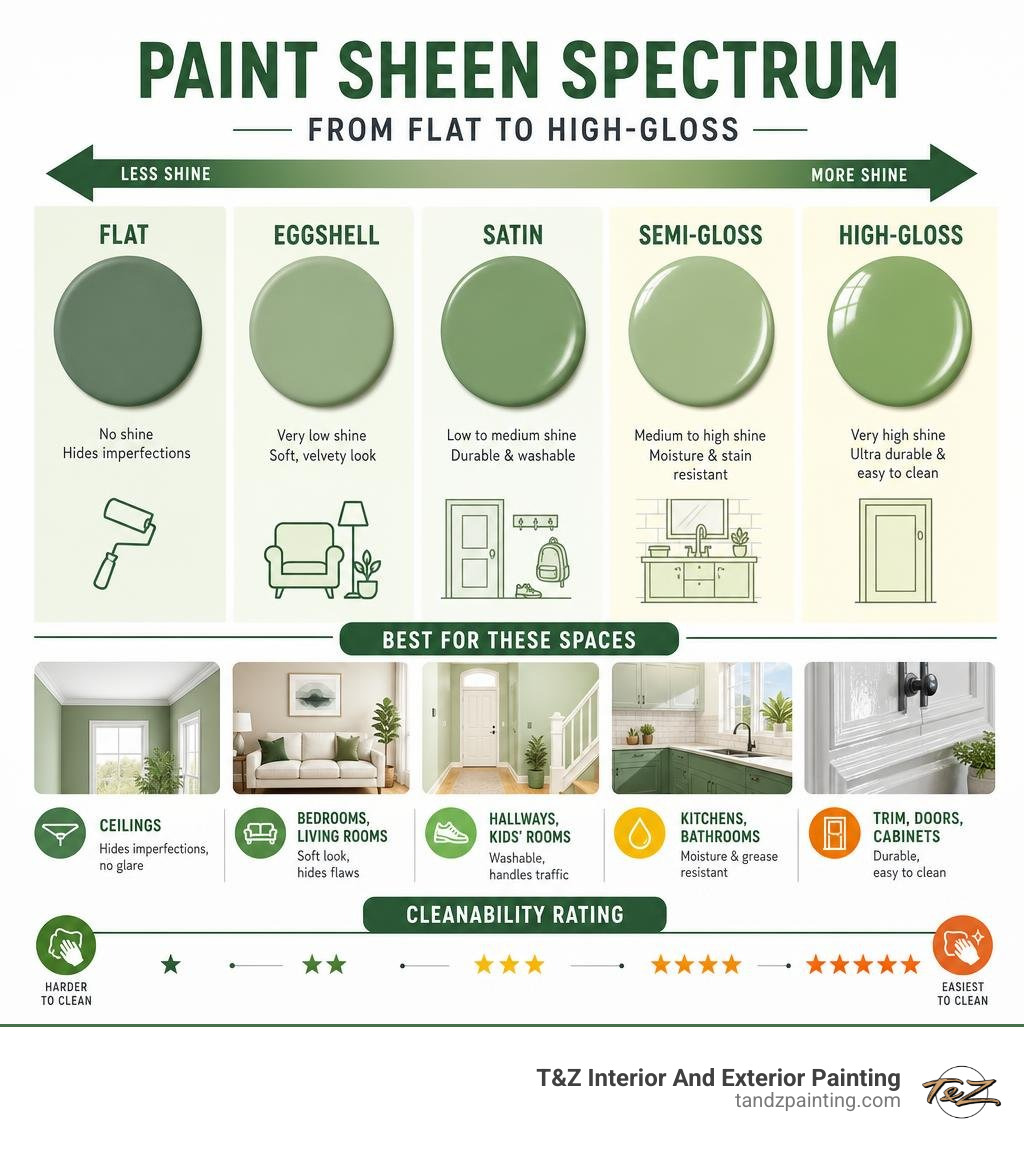
| Ceilings | Flat | Hides imperfections, no glare |
| Bedrooms, living rooms | Flat or Eggshell | Soft look, hides flaws |
| Hallways, kids’ rooms | Eggshell or Satin | Washable, handles traffic |
| Kitchens, bathrooms | Satin or Semi-Gloss | Moisture and grease resistant |
| Trim, doors, cabinets | Semi-Gloss or High-Gloss | Durable, easy to clean |
The basic rule: move up the sheen scale when you need durability or moisture resistance, move down when you need to hide imperfections.
Here’s why it matters in the real world. A flat paint on a busy hallway wall can look worn and streaky within months — scuffed by bags, hands, and everyday life. The wrong finish in a bathroom can trap moisture and invite mold. The right finish, matched to the right room, makes your paint job last years longer and look better doing it.
I’m Tomasz Niemotko, owner of T&Z Interior And Exterior Painting in Lombard, IL — with over 15 years of hands-on experience helping homeowners across the Chicago suburbs get choosing paint finish decisions right the first time. In this guide, I’ll walk you through everything you need to know, room by room, finish by finish.
Choosing paint finish terms to remember:
Understanding Paint Sheen: Appearance vs. Performance
To make an educated decision when choosing paint finish options, it helps to understand what paint sheen actually is. At its core, sheen refers to the level of light reflection a paint surface provides once it has fully dried and cured.
But paint sheen is not just an aesthetic choice; it directly dictates how the paint performs under physical stress.
From a formulation standpoint, paint is made of pigments (which provide color), binders/resins (which hold the paint together and glue it to the wall), and solvents (which keep the paint liquid until application).
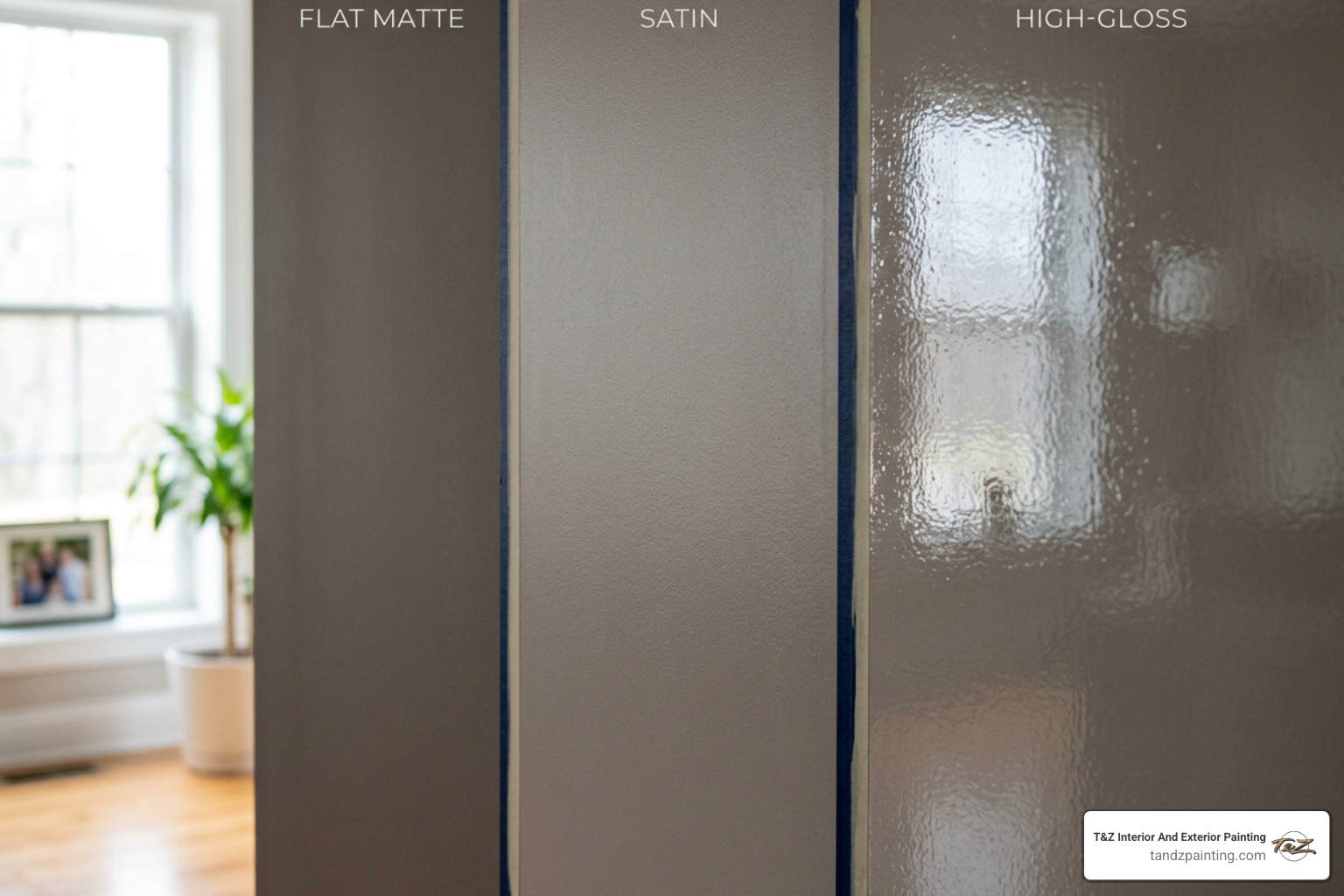
- Low-Sheen Paints (Flat/Matte): These contain a higher concentration of pigment particles and fewer binders. When light hits a flat surface, the microscopic roughness created by the pigment particles scatters the light in all directions. This minimizes reflection, making the paint look smooth and non-reflective.
- High-Sheen Paints (Semi-Gloss/Gloss): These contain a higher concentration of resins and binders. As the paint dries, these binders cure into a tight, dense, and incredibly smooth film. When light hits this surface, it reflects directly back, creating a shiny, mirror-like appearance.
This chemical makeup is why higher sheens are inherently more durable and easier to clean. The dense resin layer acts as a protective shield, making the surface resistant to moisture, stains, and physical scuffing. However, that same reflective barrier acts like a magnifying glass for surface flaws. Every minor drywall wave, nail pop, or patched area will bounce light unevenly, making those imperfections jump out at you.
When you are looking into different interior paint finishes, you are balancing this exact trade-off: flaw concealment vs. protective durability.
The Sheen Spectrum: From Flat to High-Gloss
When consulting with our clients in Lombard, Downers Grove, and Elmhurst, we like to break the sheen spectrum down into clear, manageable categories. While paint manufacturers sometimes use proprietary names, the industry generally follows a standardized scale of reflectivity.
To help you visualize the entire spectrum, here is a breakdown of the standard paint finishes used today:
| Paint Finish | Reflectivity Level | Durability & Cleanability | Best For |
|---|---|---|---|
| Flat | 0% – 3% | Low (Hard to clean, prone to burnishing) | Ceilings, low-traffic adult bedrooms |
| Matte | 3% – 10% | Low-Medium (Slightly wipeable) | Living rooms, dining rooms, master bedrooms |
| Eggshell | 12% – 25% | Medium (Wipeable, soft luster) | Family rooms, hallways, entryways |
| Satin | 25% – 35% | Medium-High (Scrubbable, rich luster) | Kids’ rooms, active hallways, kitchens |
| Semi-Gloss | 35% – 70% | High (Highly moisture-resistant and scrubbable) | Bathrooms, baseboards, trim, cabinets |
| High-Gloss | 70%+ | Extremely High (Glass-like, maximum durability) | Front doors, shutters, accent furniture |
Understanding how these finishes perform in real-world environments is the key to a successful project. Let’s look closer at the three primary categories on this spectrum, drawing on expert insights from resources like 11 Types of Paint Finishes—and Where to Use Each, According to Experts.
Flat and Matte Finishes
Flat and matte finishes sit at the very bottom of the sheen scale, offering a velvety, non-reflective appearance that absorbs light rather than reflecting it. Because they do not bounce light, they are the absolute best choice for hiding surface imperfections such as hairline cracks, patch marks, and drywall waves.
According to industry statistics, flat and matte finishes are the most popular choices for living rooms and bedrooms, with 65% of homeowners preferring them for their exceptional ability to hide imperfections.
Historically, flat paint was notorious for being impossible to clean—wiping it with a damp cloth would often leave a permanent shiny spot (known as burnishing) or wear the paint away entirely. However, modern paint technology has significantly narrowed this gap. High-quality matte paints now offer improved washability while maintaining a low-gloss, sophisticated look.
If you want to dive deeper into the pros and cons of these velvety options, check out our guide on Beyond Flat: Unpacking the Pros and Cons of Matte Paint.
Eggshell and Satin Finishes
If flat paint is a cozy sweater and high-gloss is a polished mirror, eggshell and satin are your dependable, everyday wardrobe.
- Eggshell gets its name because its low-sheen luster resembles the delicate surface of a chicken’s egg. It provides a soft, warm depth to walls while offering significantly better durability than flat paint. Eggshell finishes are selected for high-traffic areas like hallways and kids’ rooms by 60% of homeowners who want to balance durability with a subtle, non-glare sheen.
- Satin steps up the reflectivity just a bit, offering a smooth, pearl-like radiance. It is highly durable, resists stains, and can handle regular scrubbing. In fact, testing shows that satin finishes are roughly 30% easier to clean than eggshell, making them a fantastic option for active households with pets and young children.
To learn more about how to navigate these mid-spectrum options, read our detailed article on wall paint finishes.
Semi-Gloss and High-Gloss Finishes
These are the heavy-hitters of the sheen spectrum. Formulated with a tight, highly reflective resin binder, semi-gloss and high-gloss paints create an incredibly hard, moisture-resistant barrier.
Because they can withstand frequent washing, grease splatters, and heavy physical contact, high-gloss finishes are used on trim, doors, and cabinets by 55% of professional painters for their superior durability and cleanability.
While semi-gloss is the standard choice for architectural details, high-gloss is the “diva” of paint finishes. It offers a striking, glass-like reflection that looks incredibly luxurious on cabinets and front doors. However, high-gloss requires flawless surface preparation. Because it reflects so much light, any bump, scratch, or speck of dust left underneath will be highly visible.
For a closer look at why a glossier finish is so effective on high-touch surfaces, explore Why Semi-Gloss Paint is the Secret Sauce for Your Kitchen Cabinets.
Key Factors to Consider When Choosing Paint Finish
Choosing the perfect paint finish is a balancing act. To get the best results, you need to look beyond the color swatch and evaluate the physical environment of the room itself.

When we plan painting projects for homeowners in Plainfield, La Grange, and Downers Grove, we walk through these critical decision factors, which are also highlighted in the How to Choose Paint Finishes | Sherwin-Williams guide:
- Traffic Levels: How busy is the room? Hallways, entryways, and mudrooms take a beating from backpacks, muddy paws, and stray elbows. These spaces demand a washable finish like eggshell or satin. Low-traffic areas, like a guest bedroom or a formal dining room, can easily use flat or matte finishes.
- Moisture and Humidity: Bathrooms, kitchens, and laundry rooms are constantly exposed to steam, water droplets, and high humidity. If you use a flat paint here, moisture can penetrate the paint film, leading to water staining, peeling, and mold growth. These spaces require a semi-gloss or a high-quality satin that sheds water.
- Cleanability and Washability: There is a difference between “wipeable” and “scrubbable.” If you anticipate needing to scrub off crayon marks, grease splatters, or muddy prints, you must choose a finish with enough resin density (satin or semi-gloss) to withstand repeated cleaning without wearing away.
How Lighting and Wall Imperfections Impact Choosing Paint Finish
The lighting in your home plays a massive role in how a paint finish looks.
- Sun-Drenched Rooms: If a room has large, south-facing windows that let in abundant natural light, a high-sheen paint (like semi-gloss or even satin) can create a harsh, blinding glare. In these spaces, flat, matte, or eggshell finishes are ideal because they scatter the light, softening the room’s ambiance.
- Dark or North-Facing Rooms: Rooms with limited natural light can feel cozy but sometimes a bit gloomy. Using a finish with a touch of sheen, like satin or eggshell, can help bounce what little light is available around the room, making the space feel brighter and more open.
Your wall’s physical condition is just as important. In older homes—such as those in historic parts of Hinsdale or La Grange—walls often have decades of plaster repairs, settling cracks, and texture variations.
Applying a glossy paint over these walls will highlight every single flaw. If your walls are imperfect, sticking to a flat or matte finish will help mask those issues, giving your walls a smooth, uniform appearance.
Oil-Based vs. Water-Based Paints: Finish and Application
Another layer to the paint finish puzzle is the chemistry of the paint itself: oil-based (alkyd) vs. water-based (acrylic latex).
- Oil-Based (Alkyd) Paints: Historically, professional painters favored oil-based paints for trim, doors, and cabinets. Oil paint dries slowly, allowing the paint brush marks to level out and disappear, leaving a perfectly smooth, hard, enamel-like finish. It offers exceptional “block resistance” (meaning painted surfaces won’t stick together when closed, like a door in its frame). However, oil-based paints have high VOCs, a strong odor, take a long time to dry, and can yellow over time.
- Water-Based (Acrylic Latex) Paints: Modern water-based paints have come a long way. They dry quickly, have very low odor, and do not yellow over time. High-quality waterborne alkyds now offer the best of both worlds—they use water as the carrier but cure to a hard, durable finish that mimics the leveling properties of traditional oil paint. For interior walls, high-quality acrylic latex paints in eggshell or satin provide excellent flexibility and washability.
Common Mistakes to Avoid When Choosing Paint Finish
Over our 15+ years of painting homes in the Chicago suburbs, we have seen a few common mistakes pop up time and again. Here is what to avoid:
- Using Flat Paint in Bathrooms: It can be tempting to use flat paint to hide drywall flaws in a bathroom, but without specialized mildew-resistant additives, standard flat paint will quickly deteriorate, absorb moisture, and show unsightly water streaks.
- Overusing High-Gloss on Large Walls: High-gloss is fantastic for accentuating architectural details, but using it across an entire living room wall is rarely a good idea. The result is often an overwhelming glare and a surface that highlights every single roll mark and drywall seam.
- Skipping Proper Surface Prep: A higher sheen paint requires a perfectly smooth surface. If you do not sand down old paint drips, patch nail holes, and clean off dust before applying a semi-gloss or satin topcoat, those hidden flaws will become highly visible once the paint dries.
Room-by-Room Guide: Selecting the Perfect Sheen
To make your next home improvement project as straightforward as possible, let’s look at a practical, room-by-room breakdown for selecting the ideal paint finish, drawing on recommendations from the How to Choose the Right Paint Finish for Rooms: Complete 2026 Guide – weXournal guide.
Kitchens and Bathrooms
Kitchens and bathrooms are the most demanding environments in any home. Between boiling water, sizzling pans, and steaming showers, these walls face constant moisture, grease, and humidity.
- Our Recommendation: Semi-gloss is the traditional gold standard for bathrooms and kitchen walls because it creates a hard, non-porous barrier that moisture cannot easily penetrate. However, if you prefer a slightly softer look that still offers excellent protection, a high-quality satin is a fantastic alternative.
- The Proof: Semi-gloss and satin finishes are chosen for kitchens and bathrooms by 70% of homeowners due to their outstanding durability, moisture resistance, and ease of cleaning.
For more expert tips on finding the right balance for your cooking space, read our guide on how to choose the best kitchen paint finish.
Cabinets, Trim, and Doors
Trim, baseboards, doors, and cabinets are the highest-touch surfaces in your home. They take constant abuse from vacuum cleaners, kicking feet, slamming doors, and sticky fingers.
- Our Recommendation: We highly recommend using semi-gloss or high-gloss for these surfaces. These finishes cure to a hard-as-nails enamel shell that resists chipping, scuffing, and scratching. Furthermore, the higher sheen creates a beautiful, crisp contrast against lower-sheen walls, highlighting your home’s architectural details.
- Pro Tip: If you are planning a kitchen refresh, getting the cabinet finish right is critical for both durability and style. Check out our advice on how to pick the perfect cabinet finish to ensure a long-lasting, beautiful result.
Frequently Asked Questions
Which paint finish is easiest to clean?
Semi-gloss and high-gloss finishes are the easiest to clean. Because they contain a high concentration of binders and resins, they cure into a dense, smooth, and non-porous film. This prevents dirt, grease, and stains from penetrating the paint. You can easily wipe away smudges, food splatters, and dirt with a damp cloth and mild soap without worrying about wearing away the paint or creating shiny spots (burnishing).
Can you change the sheen of an existing paint job?
Yes, but you cannot simply paint a new sheen directly over an old, glossy surface without preparation. If you paint a flat or satin paint over an existing high-gloss wall, the new paint will struggle to adhere and may peel off.
To change the sheen, you must first scuff-sand the existing glossy paint to dull the shine and create a “profile” (tiny scratches) for the new paint to grip. After sanding, wipe away all dust, apply a high-quality bonding primer, and then apply your new topcoats in the desired sheen.
Why is flat paint recommended for ceilings?
Ceilings are rarely touched, but they are highly visible and subject to harsh, direct light from fixtures and windows. Flat paint is recommended for ceilings by 80% of painting professionals because it has zero reflectivity. This completely eliminates glare and hides minor texture variations, plaster repairs, and drywall joints that would otherwise stand out under directional light.
Conclusion
At the end of the day, choosing paint finish options is just as critical as picking the perfect color. The right sheen ensures your walls look beautiful, stand up to daily wear and tear, and remain easy to maintain for years to come.
If you are feeling overwhelmed by the choices, or if you want to ensure a flawless, professional application, our team at T&Z Interior And Exterior Painting is here to help. Based in Lombard, IL, we have spent over 15 years delivering stunning, high-quality results to homeowners in Addison, Elmhurst, Downers Grove, Plainfield, La Grange, and surrounding communities. As a fully licensed and insured contractor with a consistent 5.0 Google Reviews rating, we pride ourselves on expert craftsmanship, meticulous preparation, and outstanding customer service.
Ready to transform your home with the perfect color and finish? Contact us today to discuss your next project and experience the peace of mind that comes with hiring local, trusted professionals. Explore our interior painting services to get started!