
Why Choosing the Best Month to Paint Exterior of House Can Make or Break Your Results
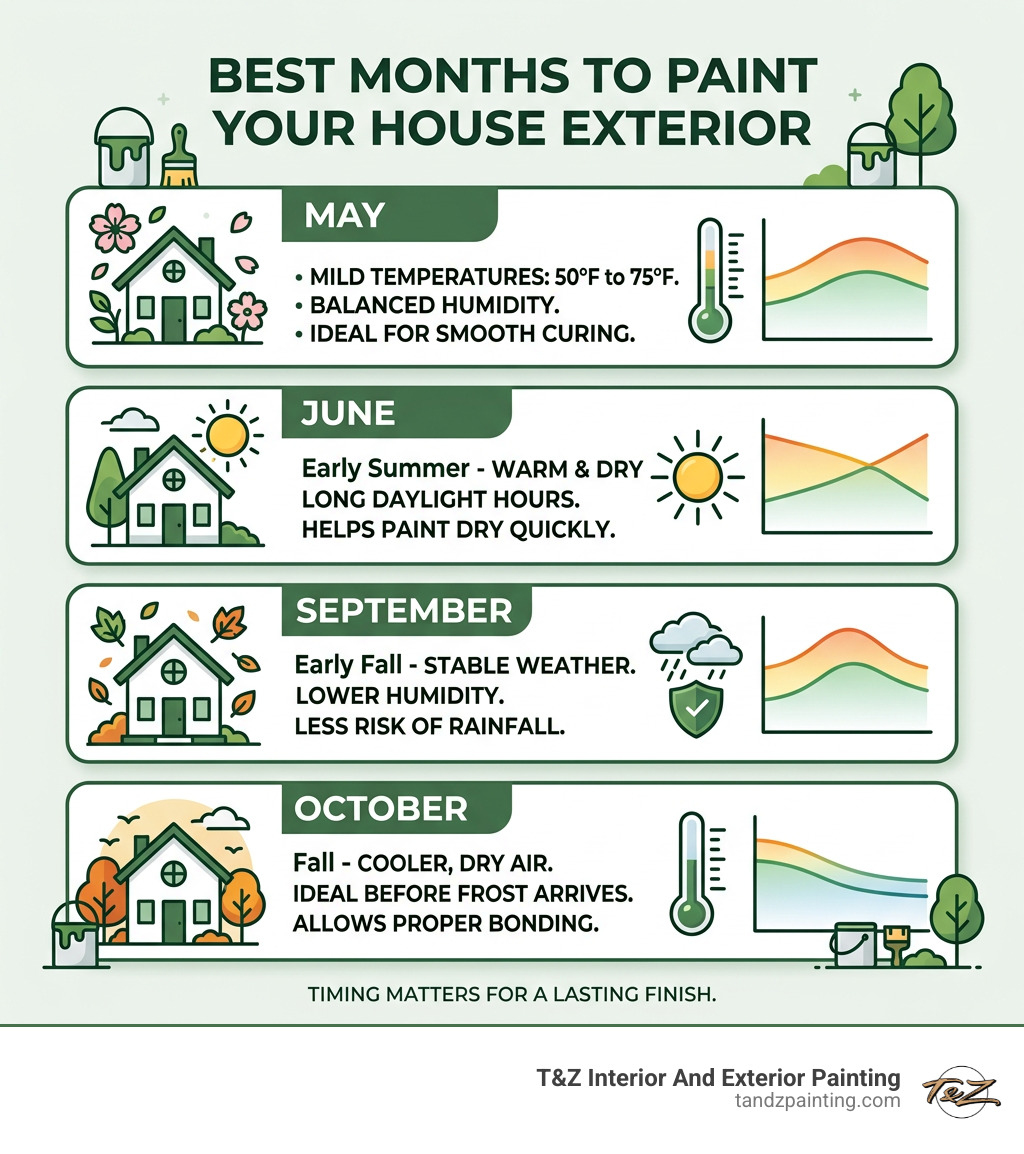
The best month to paint exterior of house projects in the Midwest is May, followed closely by September and October — when temperatures, humidity, and rainfall all align for the most durable, professional results.
Quick answer at a glance:
| Month | Season | Why It Works |
|---|---|---|
| May | Late Spring | Mild temps (50-75°F), low pollen, balanced humidity |
| June | Early Summer | Warm and dry, long daylight hours |
| September | Early Fall | Stable temps, less rain, lower humidity |
| October | Fall | Cooler and dry, ideal before frost arrives |
Painting your home’s exterior isn’t just about picking a color you love. Timing matters just as much as technique. Paint applied in the wrong conditions — too cold, too humid, or right before a rainstorm — can blister, peel, or fail to bond properly within months.
As one painting expert put it, a bad exterior paint job doesn’t just look poor — it costs you again sooner than it should.
Whether you’re planning a full exterior refresh or touching up worn surfaces, understanding when to paint is the first step toward a finish that lasts 5 to 10 years or more.
I’m Tomasz Niemotko, owner of T&Z Interior And Exterior Painting, with over 15 years of experience helping homeowners in Lombard, IL and surrounding suburbs choose the right time and conditions for exterior painting projects. That experience has given me a clear picture of which months consistently deliver the best results for the best month to paint exterior of house decisions in our Midwest climate. Let’s walk through everything you need to know to plan your project with confidence.
Determining the Best Month to Paint Exterior of House Projects
When we look at the calendar in places like Wheaton, Carol Stream, or Downers Grove, we aren’t just looking for a sunny day. We are looking for a “weather window.” In the painting world, this means a stretch of time where the temperature and moisture levels allow the paint to transition from a liquid in the can to a solid, protective shield on your siding.
The best month to paint exterior of house surfaces is one that offers stability. In the Midwest, our weather is famous for changing every five minutes. However, certain months offer more predictable patterns that favor the curing process. Curing is different than drying; while paint might feel dry to the touch in an hour, it can take weeks to fully harden and bond to the substrate. If the weather turns foul during that critical curing phase, the longevity of your investment is at risk.
We often tell our clients that When is the Best Time to Paint the Exterior of Your Home? depends largely on the “Goldilocks” principle: not too hot, not too cold, and definitely not too wet.

Why May is Often the Best Month to Paint Exterior of House
For many of our projects in Addison and Elmhurst, May takes the crown. Why? Because it sits right in that sweet spot after the final frost of spring but before the sweltering humidity of a Chicago summer.
In May, daily temperatures typically fluctuate between 50°F and 75°F. This is the ideal range for latex and acrylic paints. It allows the water in the paint to evaporate at a steady rate, ensuring the pigment and binders knit together perfectly. Furthermore, while spring is known for rain, May often provides clear stretches that are perfect for professional application.
Another hidden benefit of May is the pollen count. While early spring can see thick blankets of yellow dust that stick to wet paint, by late May, much of that initial “pollen dump” has subsided. This results in a smoother finish without microscopic debris embedded in the coat. If you are still deciding on a look, using a Color Visualizer during this time can help you see how the bright spring sun will interact with your chosen shades.
September: Another Best Month to Paint Exterior of House
If you missed the spring window, don’t worry. September is frequently cited by our teams as the runner-up for the best month to paint exterior of house projects. In fact, for some homeowners in Schaumburg or Glenview, it might even be superior to May.
By September, the heavy “pop-up” thunderstorms of July and August have usually tapered off. The air becomes crisper and significantly less humid. Lower humidity is a painter’s best friend because it prevents moisture from getting trapped behind the paint film. September also offers very stable day-to-night temperature transitions. We don’t see the massive 40-degree swings that can occur in early spring, which means the house’s siding (whether wood, vinyl, or fiber cement) isn’t expanding and contracting violently while the paint is trying to dry.
We’ve completed numerous projects during this window, such as our work in this Portfolio: Exterior Painting Elmhurst IL, where the calm fall weather allowed for a flawless, streak-free finish.
Ideal Temperature and Humidity for a Flawless Finish
To understand why May and September are so effective, we have to look at the science of adhesion. Paint is a chemical compound that requires specific environmental triggers to work. If the surface is too hot, the paint “flashes” (dries too fast), leading to brush marks and poor bonding. If it’s too cold, the paint stays liquid too long and may run or sag.
Humidity is the other half of the equation. We aim for a “dry” surface, but “dry” is relative. We often use moisture meters on wood siding to ensure the internal moisture content is below 15% before we even open a paint can.
The 50-85°F Sweet Spot
Most modern high-quality paints, especially the premium acrylic formulas we use, are designed to be applied when the air and surface temperatures are between 50°F and 85°F.
- At 50°F: The paint flows well and has enough time to level out, hiding brush and roller marks.
- At 85°F: We are reaching the upper limit. Above this, the sun can bake the paint before it has a chance to soak into the surface.
| Paint Type | Ideal Temp Range | Minimum Temp (Modern) | Humidity Limit |
|---|---|---|---|
| Latex | 50-85°F | 35-40°F | < 70% |
| Acrylic | 50-85°F | 35°F | < 70% |
| Oil-Based | 40-90°F | 40°F | < 60% |
When we stay within this range, the evaporation rate is controlled. This is crucial for achieving that “factory-smooth” look that characterizes a professional job.
Managing Humidity and Dew Point
In the Chicago area, humidity can be our biggest hurdle. Ideally, we look for humidity levels between 40% and 70%. If the humidity is higher than 70%, the air is already saturated with moisture, leaving no room for the water in the paint to evaporate. This leads to a phenomenon called “surfactant leaching,” where brown or clear sticky spots appear on the surface because the paint’s ingredients couldn’t escape properly.
Dew point is equally important. If we paint too late in the afternoon in October, the temperature might drop quickly toward the dew point. If moisture settles on the paint before it has dried for at least 4 to 6 hours, it can cause the finish to become dull or splotchy. This is why we carefully monitor local forecasts in places like La Grange and Wilmette to ensure a clear “dry-to-touch” window before the sun goes down.
Regional Climate Considerations for Illinois Homeowners
Living in Lombard or neighboring towns like Itasca and Glen Ellyn means dealing with a four-season climate that can be harsh on a home’s exterior. Our homes face everything from sub-zero winters to 95-degree summers with high UV exposure.
When choosing the best month to paint exterior of house projects locally, we must account for these extremes. A home in the Midwest isn’t just a building; it’s a structure that breathes, expands, and contracts. Our Services: Exterior Painting are specifically tailored to handle these regional quirks.
Avoiding the Summer Heat and Winter Cold
While many people think summer is the best time to paint, mid-July and August can actually be quite risky. When temperatures exceed 90°F, several problems arise:
- Blistering: The surface of the paint dries so fast that solvent or water vapor gets trapped underneath, creating bubbles.
- Lap Marks: Because the paint dries almost instantly, it’s impossible to maintain a “wet edge,” resulting in visible lines where one stroke overlaps another.
Conversely, winter is generally a “no-go” for exterior work in Illinois. Once temperatures stay consistently below 35°F, most paints simply cannot cure. The chemical reaction stops, and the paint remains a soft, gummy mess that will eventually peel off in sheets when the spring thaw arrives.
Planning Around the Rainy Season
In the Midwest, spring showers are a reality. A general rule of thumb we follow is the 24-hour rule:
- Before Painting: The surface should have at least 24 hours (ideally 48) to dry out after a heavy rain. This is especially true for wood siding, which acts like a sponge.
- After Painting: Most latex paints need at least 6 to 12 hours of dry weather to be “rain-safe,” though 24 hours is much better for a full cure.
We always keep a close eye on the precipitation forecast. If there is a 50% chance of rain within the next 24 hours, we usually postpone the start of a project to ensure the quality isn’t compromised. You can see the results of our careful timing in our Portfolio: Exterior Painting.
Preparation and Timing: Setting the Stage for Success
Even if you pick the best month to paint exterior of house projects, the job will only be as good as the preparation. Timing the prep work is just as vital as timing the application.
The Best Time of Day to Apply Paint
Timing isn’t just about the month; it’s about the hour. On a typical day in Downers Grove or Lemont, we don’t start painting at the crack of dawn. Why? Morning dew. If there is moisture on the siding from the night before, the paint won’t stick.
We generally start our application around 10:00 AM. This gives the morning sun a chance to burn off any lingering dew. We also “follow the shade.” This means we start on the side of the house the sun has already passed or hasn’t reached yet. Painting in direct, intense sunlight is a recipe for rapid drying and poor adhesion. By staying in the shade, we keep the surface temperature of the siding lower, allowing for a better bond.
Curing vs. Drying Times
It’s important to distinguish between drying and curing.
- Drying: The solvent evaporates, and the paint is no longer sticky. (1-4 hours)
- Curing: The paint reaches its maximum hardness and chemical resistance. (Up to 30 days)
During the first few days of curing, the paint is most vulnerable. High winds can be a major problem during this time. Wind doesn’t just dry the paint too fast; it carries dust, leaves, and insects that can become permanently stuck in your new finish. When we plan a project, we look for a window of “calm” weather to ensure your home stays debris-free. Proper How to Prepare a House for Painting includes checking these environmental factors well in advance.
Frequently Asked Questions about the Best Month to Paint Exterior of House
How long should I wait to paint after it rains?
As mentioned, patience is key. For most modern siding materials like James Hardie or vinyl, 24 hours of dry, sunny weather is usually sufficient. However, if you have older wood siding that has begun to “check” or crack, it can hold water deep within the fibers. In those cases, we recommend waiting 48 hours. Painting over trapped moisture is the #1 cause of premature paint failure. We take this very seriously, as seen in our detailed Portfolio: Exterior Painting 2.
Can modern paints be applied in cold weather?
Yes, but with caveats. There are specialty “low-temp” paints designed to be applied in temperatures as low as 35°F. These are great for late October or early November projects in the Chicago suburbs. However, even with these paints, the temperature must stay above freezing for at least 48 hours to allow for proper curing. If the thermometer hits 30°F the night after you paint, the finish may still fail. We only use these specialty coatings when the forecast is stable enough to guarantee a professional result.
What are the signs my house needs repainting?
You shouldn’t wait until the paint is falling off in strips to call a professional. Look for these early warning signs:
- Chalking: Run your hand across the siding. If a chalky residue comes off on your fingers, the paint’s binders are breaking down from UV exposure.
- Fading: If the sunny side of your house looks three shades lighter than the shaded side, the protective qualities of the paint are diminishing.
- Hairline Cracks: Small “alligatoring” or cracks are the first sign that moisture is about to start getting under the paint film.
- Gaps in Caulk: If the caulk around windows and doors is shrinking or cracking, it’s time for a refresh to prevent wood rot.
Choosing the right Outside House Painting Color Combinations can also help with longevity; lighter colors tend to reflect more UV rays and stay cooler, which can actually help the paint last a bit longer in high-exposure areas.
Conclusion
Choosing the best month to paint exterior of house projects is a strategic decision that balances temperature, humidity, and local climate patterns. For homeowners in Lombard, IL, and the surrounding Chicago suburbs, targeting May, June, September, or October provides the highest probability of a flawless, long-lasting finish.
At T&Z Interior And Exterior Painting, we bring over 15 years of licensed and insured experience to every job. We don’t just show up with brushes; we arrive with a plan that respects the science of painting and the realities of Midwest weather. From our 5.0 Google Reviews rating to our commitment to using top-tier materials, our goal is to provide a stress-free experience that enhances your home’s curb appeal and protects its value for years to come.
Whether you are in Elmhurst, Schaumburg, or Downers Grove, we are ready to help you transform your home. When you’re ready for expert craftsmanship and attention to detail, explore our Services: Exterior Painting and let us help you find the perfect window for your next project.