
Spray Painting for Large Surfaces in Lombard, IL
Some surfaces are too large, too open, or too complex for a roller to handle well. In Lombard, two-story exterior walls, open commercial facades, large interior ceilings, and expansive fence runs all fall into this category — surfaces where rolling produces visible lap marks, inconsistent coverage, and hours of extra labor that spray application handles in a fraction of the time. T&Z Interior and Exterior Painting handles spray painting for large residential and commercial surfaces across Lombard and the surrounding area — exterior siding, stucco, fences, open interior ceilings, and commercial building facades. Call us for a free on-site estimate. Exterior spray jobs require weather windows, so scheduling ahead matters. We’re a licensed Painter with 15+ years of experience, and we mask properly, select the right tip and pressure for every surface, and back-roll where the substrate requires it.
When to Spray and When to Roll — Choosing the Right Method for Your Lombard Project
When spray is the right choice:
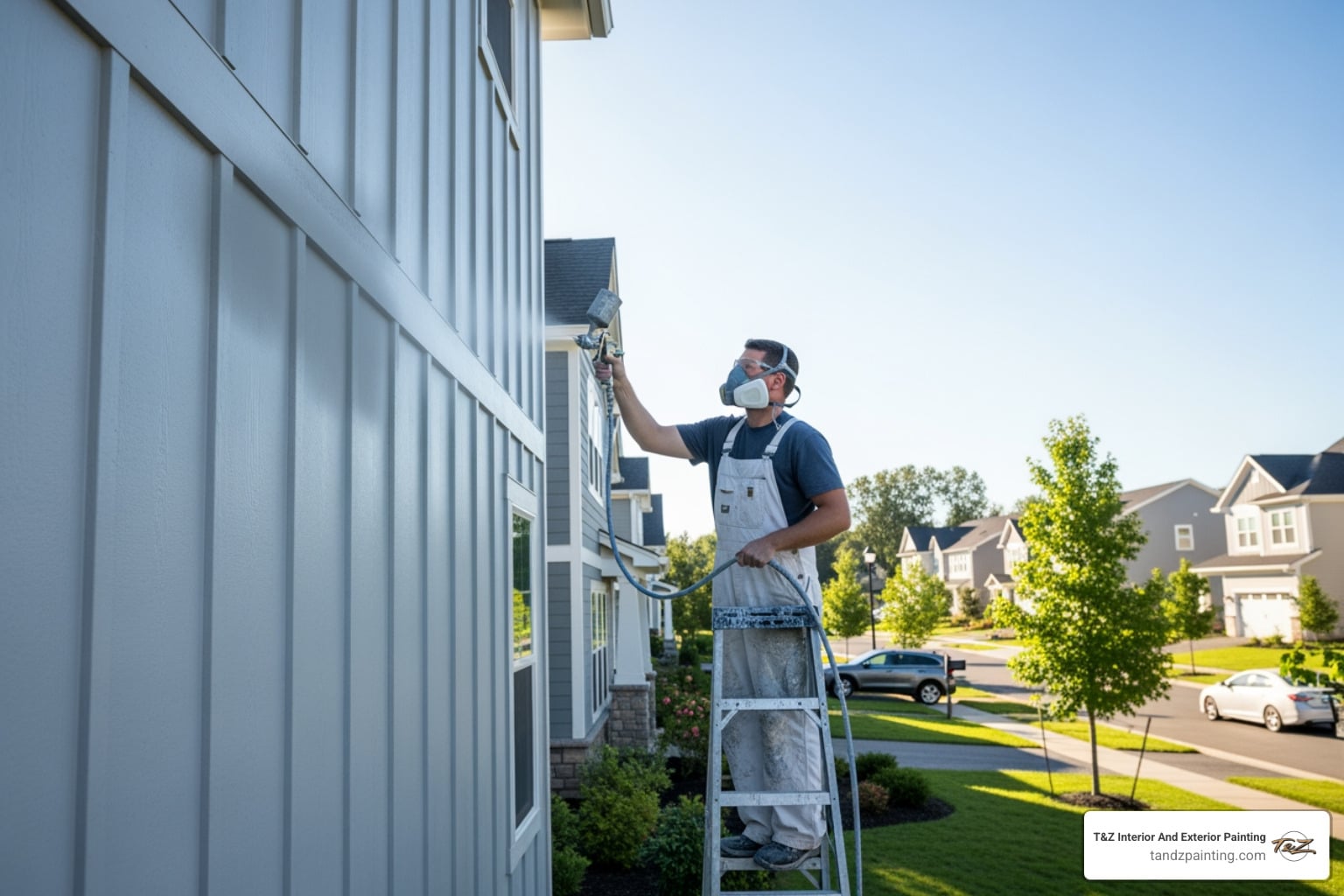
Large, open, relatively flat surfaces are where spray painting delivers its clearest advantages. Exterior siding on a two-story home, a long run of privacy fence, a commercial facade, an open warehouse ceiling, or the exterior stucco on a 3,000 square foot Lombard home — these are all surfaces where rolling is slow, produces visible lap marks as sections dry before the adjacent section is complete, and struggles to maintain even film thickness across the full area.
Spray atomizes paint into fine, uniform particles and deposits them evenly across the surface in overlapping passes. Done correctly, the result is a film thickness that is consistent from one end of the wall to the other — no lap marks, no roller texture, no thick edges where the roller reversed direction.
When rolling is the right choice:
Smaller areas, tight spaces where masking is impractical, and surfaces that need maximum penetration into deep texture are all situations where rolling outperforms spray. A single bedroom, a bathroom, or a section of wall surrounded by furniture and trim that would require extensive masking — rolling is faster and cleaner for these jobs.
Roller also penetrates deep texture more reliably than spray alone. On heavily textured surfaces, spray deposits paint on the peaks of the texture but doesn’t always reach the valleys. This is why back-rolling after spray is the professional standard on porous and textured exterior surfaces.
The professional standard — spray plus back-roll:
For most large exterior surfaces in Lombard, the correct method combines both. Spray applies the paint fast and evenly across the full surface area. A roller follows immediately while the paint is still wet, pressing it into the surface profile and ensuring full contact with every recess, pore, and texture valley. The result is faster than rolling alone and better bonded than spray alone.
Lombard’s two-story colonials and newer open great rooms present exactly the kind of large, uninterrupted wall and ceiling surfaces where spray is the only practical choice for even coverage. Rolling a two-story exterior wall produces visible horizontal lap lines where each roller section meets the next. Spray eliminates them entirely.
What Spray Painters Mask Before the Gun Ever Starts — and Why It Matters
What gets masked on a typical Lombard exterior spray job:
- All windows — full coverage with plastic sheeting and tape at every edge
- Entry doors and garage doors — fully masked, hardware removed or taped
- Exterior light fixtures, electrical meters, hose bibs, vents, and utility connections
- All trim surfaces not being painted — fascia, soffits, window casings, and door surrounds
- Foundation plantings, shrubs, and garden beds within overspray range
- Lawn areas directly below the work zone — fine spray mist settles on grass
- Neighboring structures, fences, and vehicles within range of wind-carried overspray
What gets masked on a large interior spray job:
- All flooring — drop cloths and plastic sheeting from wall to wall
- Furniture that cannot be removed — fully wrapped with plastic
- Cabinetry, countertops, and appliances in kitchen areas
- All trim, doors, and windows not being painted
- Switch plates, outlet covers, and light fixtures — removed or fully taped
Masking a large exterior project takes hours. On a full-house exterior spray job, masking is often the longest single phase of the project. It cannot be rushed. A small gap in window masking creates a spray pattern across the glass that requires razor blade and solvent work to remove. Overspray on a neighbor’s car or freshly painted trim creates a repair obligation that falls on the painter — T&Z masks completely, every time, before the sprayer starts.
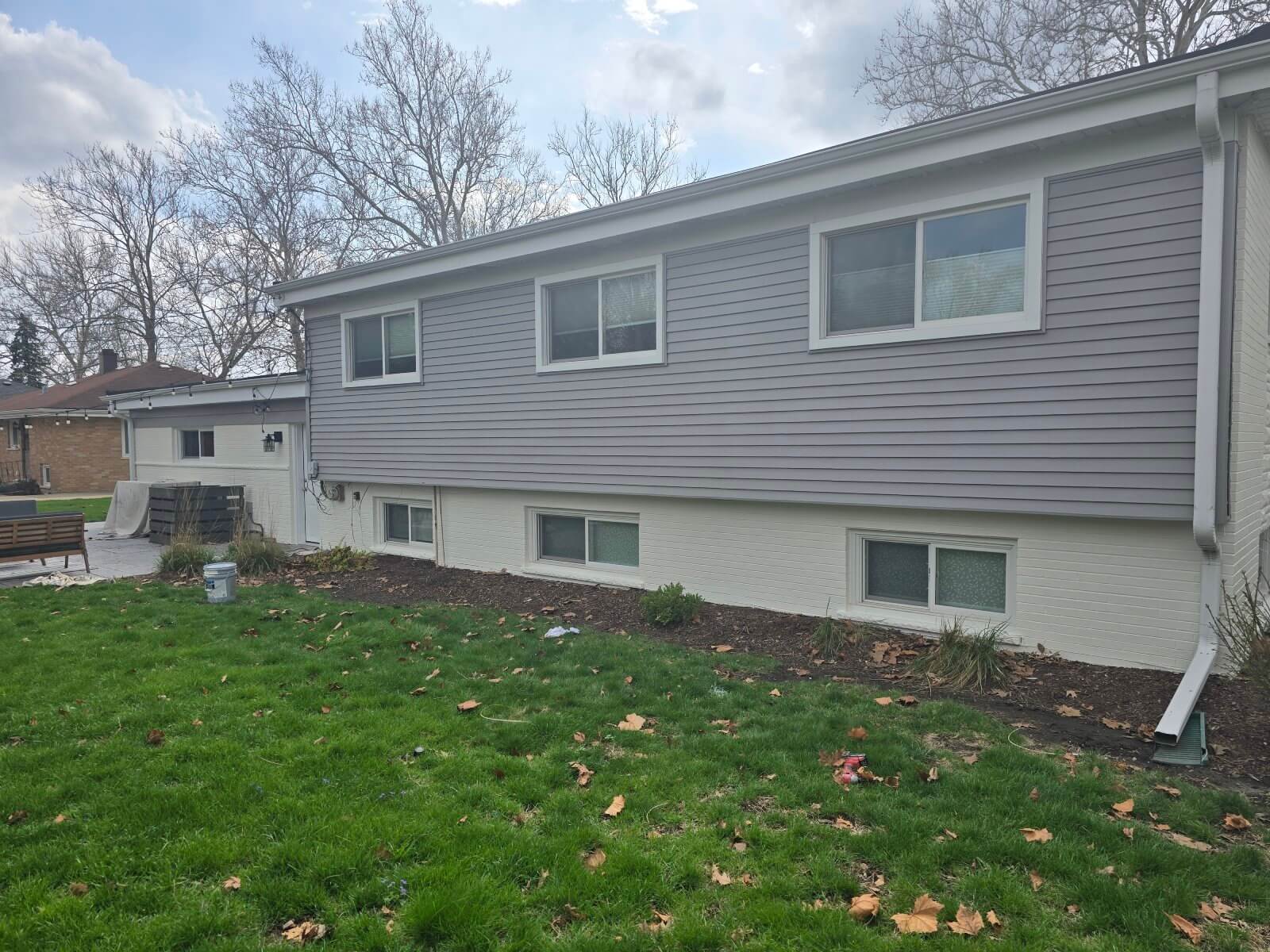
Many Lombard backyards in Westmore and Maple Knoll have fences, mature landscaping, and neighboring structures within close range of exterior walls. Full perimeter masking on these properties requires careful setup before any spray work begins — and wind assessment before the first trigger pull.
The Techniques That Separate a Professional Spray Job From a DIY Mistake
Tip selection. The spray tip determines fan width and flow rate. A tip that’s too large for the paint viscosity produces heavy, uneven drops. A tip too small for a thick exterior paint produces dry spray — particles that partially dry before hitting the surface and create a rough, sandy texture. Professional painters select tip size based on paint type, viscosity, and surface profile. T&Z uses different tips for smooth siding, textured stucco, and fence applications — one tip does not serve all surfaces.
Pressure settings. Pressure that’s too high atomizes paint into an ultra-fine mist that drifts on any air movement and deposits unevenly. Pressure too low produces heavy, wet deposits that sag and run on vertical surfaces. Correct pressure produces a consistent, teardrop-shaped fan pattern with defined edges and no tailing — thin, streaked areas at the outer edges of each pass.
Spray distance. The standard working distance for most airless applications is 10 to 12 inches from the surface. Closer than that causes runs and heavy buildup at the center of each pass. Farther creates dry spray and thin film thickness. On a large wall, maintaining consistent distance while moving at a consistent speed is a physical skill that takes real practice to execute correctly across a full surface.
Overlapping passes. Each pass overlaps the previous by 50 percent. This sounds simple until you’re moving across a 40-foot exterior wall and trying to maintain consistent overlap, consistent distance, consistent speed, and consistent trigger timing simultaneously. Gaps in overlap create visible stripes — lighter areas where two passes didn’t overlap enough. Double-coverage areas create darker, thicker bands. A professional spray job has none of these.
Trigger control. The gun should be moving before the trigger is pulled and the trigger should be released before the gun stops moving. Starting and stopping with the trigger engaged deposits heavy blobs at each end of every pass. On a large surface with hundreds of passes, poor trigger control creates a pattern of dark spots and runs across the entire surface.
Lombard’s flat Chicagoland terrain means west-facing walls face open wind exposure with no windbreaks. T&Z monitors wind speed throughout exterior spray jobs and pauses when gusts exceed conditions that allow controlled application. Spray painting in high wind is one of the fastest ways to produce an unusable result and create overspray damage across a wide area.
Spraying Dark Colors, Problem Surfaces, and Difficult Coverage in Lombard
The hardest colors to spray over:
Dark red, deep navy, forest green, and black are the most difficult exterior colors to cover. These pigments are chemically aggressive — they bleed through standard primer and light topcoats, sometimes immediately, sometimes over the first few weeks after painting. The old color ghosts back through the new surface in a mottled, uneven pattern.
The correct approach: two coats of stain-blocking primer — oil-based or shellac-based — before any topcoat is applied. Water-based primer alone is not sufficient over these colors on large exterior surfaces. The stain-blocker seals the old pigment permanently and gives the topcoat a neutral, uniform base to build on. For a large two-story exterior, this adds a full primer phase to the project timeline — it cannot be compressed without sacrificing the result.
Tannin-bleeding wood surfaces:
Cedar and certain pine species bleed brown tannins through standard primer and light exterior paints. The bleeding appears as yellow-brown stains that work through the topcoat over days and weeks after application. On a large cedar-sided Lombard home, tannin bleed across an entire facade is a significant problem. Oil-based primer or shellac primer seals tannins before topcoat.
Heavily weathered and chalked surfaces:
Exterior surfaces that have gone several cycles without repainting develop a chalky oxidized layer on the surface. Fresh paint applied directly over heavy chalk doesn’t bond to the surface — it bonds to the chalk layer, which then releases from the wall and takes the new paint with it. A penetrating binding primer applied as the first coat seals the chalk, consolidates the surface, and creates a stable base for topcoat adhesion.
Large color-change projects:
Spray is the most efficient application method for full exterior color changes on large Lombard homes. Even atomization produces more uniform coverage per coat than rolling, which means the color change is achieved in fewer total coats. For homes in Yorkshire Woods and Summit at Yorktown with large two-story facades and dark factory-applied exterior colors, correct primer selection and spray technique are what make the difference between a clean, lasting color change and a job that needs repainting within three years.
Why Back-Rolling After Spraying Produces a Better Finish Than Spray Alone
What spray alone does on a porous surface:
Airless spray deposits paint as atomized particles traveling at high velocity. On a smooth surface — primed drywall, previously painted smooth siding — the particles arrive and level into a continuous film. On a porous or textured surface — stucco, brick, rough wood siding, textured stucco, old exterior paint with surface profile — the particles land on the peaks of the texture and bridge across the valleys rather than penetrating into them.
The result looks like full coverage in a visual inspection immediately after application. The paint appears to cover the entire surface. But in the texture valleys and pores, there are micro-voids where paint didn’t make full contact with the substrate. These voids are entry points for moisture. Over the first freeze-thaw cycle, water gets into those voids, freezes, expands, and begins lifting the paint from the surface — starting from the inside of the film rather than the outside.
What back-rolling accomplishes:
Immediately after spray application, while the paint is still wet, a roller is run over the sprayed surface. The roller pushes the wet paint into every texture valley and surface pore — full contact, full adhesion. The spray put the paint on the surface. The roller works it into the surface. The combination produces a film that is mechanically bonded to the substrate across its entire area, not just on the peaks.
Where back-rolling is required:
Stucco, brick, textured fiber cement siding, rough wood, rough masonry, and any previously painted surface with significant texture or surface profile all require back-rolling after spray. On Lombard’s brick and stucco exteriors — common throughout 1950s through 1980s construction — spray without back-rolling leaves uncoated voids in the texture that allow moisture intrusion. This is one of the primary reasons exterior paint jobs on these surfaces fail in three to five years instead of lasting seven to ten.
Where spray alone is acceptable:
Smooth surfaces — metal, previously painted smooth siding in good condition, and primed interior drywall — can be finished with spray alone when the correct tip and pressure are used. The surface has no texture for the paint to bridge across, so atomized particles arrive and level into continuous film contact with the substrate.
T&Z back-rolls all exterior porous surfaces on Lombard projects as a standard part of the process — not an add-on, not an upgrade. It’s included because the alternative produces a finish that fails prematurely and reflects on the quality of the work.
The Most Common Spray Painting Mistakes on Large Surfaces — and How Pros Avoid Them
Inadequate masking. The most costly mistake. Overspray on windows creates a fine, hazy film that is difficult and time-consuming to remove completely. Overspray on a neighbor’s freshly painted trim or vehicle creates a repair obligation. T&Z masks every surface not being painted before the sprayer starts — no exceptions and no shortcuts in masking setup regardless of how small the adjacent surface appears.
Painting in wind. Exterior spray painting in wind conditions above 10 to 15 mph produces inconsistent results and overspray damage. The atomized paint cloud drifts with the wind rather than depositing straight onto the surface. Film thickness becomes uneven — thicker where the wind pushed the cloud into the wall, thinner in areas where it was carried away. T&Z monitors wind speed throughout exterior spray jobs and pauses application when conditions exceed the safe working threshold. On Lombard’s open west-facing walls, wind assessment is a real part of every exterior spray job.
Wrong tip or pressure for the material. Every paint type and every surface profile has a correct tip size and pressure range. Outside that range, the spray pattern breaks down — runs from too much flow, dry spray from too little atomization, orange peel texture from incorrect pressure at the tip. T&Z sets up and test-sprays on a sample surface before committing to a full pass on any large project.
Skipping back-roll on porous surfaces. Covered in detail above — spray without back-roll on textured or porous surfaces produces a finish that looks complete on day one and starts failing within seasons. On stucco, brick, and rough wood siding across Lombard, back-rolling is not optional.
Applying too heavy in a single pass. Heavy, wet passes on vertical surfaces sag and run before they can level. Thin, multiple overlapping passes build film thickness correctly — each pass levels and begins to flash before the next pass adds to it. The instinct to cover more surface faster by spraying heavier produces the opposite of efficiency — runs that have to be sanded and recoated once dry.
Painting in direct hot afternoon sun. Paint applied to a surface heated by direct summer sun skins over on the surface before the deeper film can level. The result is a wrinkled, uneven surface with visible lap marks where each pass met the previous skinned edge. T&Z schedules large exterior spray jobs in Lombard during early morning hours in July and August — surfaces are cool, humidity is lower than midday, and the paint has maximum leveling time before direct sun hits the fresh film.
Send Us a Message
FAQ
Is it better to spray or roll a large exterior surface in Lombard?
Spray with back-rolling is the professional standard for large porous exterior surfaces. Spray provides speed and even atomization across the full surface area. Back-rolling immediately after spray pushes paint into the substrate for full adhesion and a finish that lasts. Spray alone without back-rolling on textured or porous surfaces fails significantly sooner than the spray-plus-back-roll combination.
What surfaces in Lombard homes benefit most from spray painting?
Large exterior walls, stucco, privacy fences, open interior ceilings, commercial facades, and two-story great rooms. Any large open surface where rolling produces visible lap marks as sections dry before adjacent areas are completed, or where roller texture is unwanted on the finished surface.
What precautions does T&Z take to prevent overspray in Lombard yards and properties?
Complete masking of all surfaces not being painted — windows, trim, plants, neighboring structures, and all ground surfaces below the work area. Wind assessment before and throughout exterior spray work. Application paused when gusts exceed safe working conditions. No spray work begins until masking is complete and inspected.
Can dark exterior colors be spray painted over in Lombard without bleeding through?
Yes — with two coats of stain-blocking oil-based or shellac primer before topcoat. Standard water-based primer alone is not sufficient over dark reds, navies, forest greens, or black on large exterior surfaces. The stain-blocker seals the old pigment permanently before any topcoat is applied.
How long does a professional spray paint job last on a large Lombard exterior?
Seven to ten years on properly prepped, primed, and back-rolled surfaces. Spray-only without back-rolling on porous or textured surfaces fails noticeably sooner — typically three to five years before visible peeling begins at texture peaks and surface pores where paint contact was incomplete.