
Why Choosing the Right Sheen for Kitchen Walls Matters More Than You Think
Quick answer: The best sheen for kitchen walls is satin for most kitchens, or semi-gloss for walls near the stove or sink. Both resist grease, moisture, and frequent cleaning far better than flat or matte finishes.
| Sheen Level | Best For | Cleanability | Recommended? |
|---|---|---|---|
| Flat / Matte | Low-traffic accent walls only | Poor | Rarely |
| Eggshell | Low-moisture kitchen zones | Fair | Sometimes |
| Satin | Most kitchen walls | Good | Yes — top pick |
| Semi-Gloss | Near stove, sink, splatter zones | Excellent | Yes — high-use areas |
| High-Gloss | Cabinets, trim only | Best | Not for large wall areas |
Your kitchen is the hardest-working room in your home. It deals with grease, steam, splashes, and daily scrubbing — all of which punish paint in ways no other room comes close to matching.
And yet, most homeowners pick a wall color they love and then barely think about sheen. That’s a mistake.
The wrong sheen means walls that look dingy after six months, paint that won’t wipe clean, or a finish that peels near the stove. The right sheen means walls that stay looking fresh for years, even through heavy daily cooking.
This guide breaks down exactly which sheen levels work in a kitchen — and which ones don’t — so you can make a confident, informed choice before you pick up a brush or call a painter.
I’m Tomasz Niemotko, owner of T&Z Interior And Exterior Painting, with over 15 years of experience helping homeowners in Lombard and surrounding suburbs choose the right sheen for kitchen walls and achieve results that hold up long-term. In the sections ahead, I’ll walk you through everything you need to know — from paint science to product picks — so your kitchen walls look great and stay that way.
Learn more about sheen for kitchen walls:
Understanding Paint Sheen and Kitchen Wall Performance
To understand why certain finishes fail in a culinary environment, we have to look at the science of paint sheen. At its core, paint is a mixture of pigments (which provide color), binders or resins (which hold the paint together and stick it to the wall), and solvents (which keep the paint liquid until it dries).
The ratio of resins to pigments determines the paint’s sheen level. Flat and matte paints have a high concentration of pigments and very little resin. This creates a rough, microscopic surface that scatters light in every direction, hiding imperfections but leaving the dried paint film highly porous.
On the other hand, semi-gloss and satin paints contain a much higher ratio of binders. As these binders dry, they cure into a tight, closely packed polymer shield. This smooth, non-porous structure reflects light directly, creating that characteristic glow.
In a kitchen, this microscopic structure makes all the difference. When you cook, aerosolized grease particles travel several feet from your stove, settling on your walls. If you have a porous flat or matte finish, the grease penetrates deep into the paint film, bonding with it at a molecular level. Trying to scrub it off often results in removing the paint itself.
Steam from boiling water and dishwashers also attacks the paint film. Moisture can penetrate porous finishes, weakening the adhesion between the paint and the drywall primer underneath. This cyclic exposure to moisture, combined with the physical pressure of cleaning, leads to bubbling, peeling, and premature failure.
By choosing a tighter, more resin-rich paint finish, you create an impenetrable barrier that keeps grease and moisture on the surface, where they can be safely wiped away. To dive deeper into the chemistry of paint finishes, check out Paint Sheens 101: The Official Guide to Choosing the Right Finish.
The Best Paint Sheen for Kitchen Walls: A Complete Breakdown

When selecting the perfect sheen for kitchen walls, you are balancing two competing factors: cleanability and light reflection. While highly reflective sheens are the easiest to clean, they also highlight every minor plaster wave, dent, and nail pop on your walls.
Let’s look at how the primary paint sheens perform under kitchen conditions:
- Flat (0-5% Sheen): Virtually no light reflection. It provides beautiful, deep color but possesses zero stain resistance. Flat paint is highly vulnerable to burnishing (developing shiny, worn patches when rubbed) and should be avoided on kitchen walls.
- Matte (5-10% Sheen): Offers a smooth, velvety appearance. While slightly more durable than flat, standard matte paints absorb oils easily and are difficult to scrub without altering the finish.
- Eggshell (10-25% Sheen): Has a soft luster reminiscent of a chicken egg. It is a versatile choice for low-traffic living spaces, but is only suitable for low-moisture, low-splatter areas of the kitchen.
- Satin (25-35% Sheen): The absolute sweet spot for most kitchen walls. It provides a soft, warm glow that bounces light around the room without looking overly reflective. More importantly, it offers excellent scrub resistance.
- Semi-Gloss (35-55% Sheen): Highly durable and moisture-resistant. It is easy to clean but will show wall texture and prep work under bright kitchen lighting.
- High-Gloss (70%+ Sheen): Maximum durability, reflecting up to 85% more light than matte finishes. However, it is far too reflective for large wall surfaces and is best reserved for kitchen cabinets and trim.
Statistics show that satin and semi-gloss finishes are recommended for 80% of high-traffic kitchen and bathroom walls due to their superior moisture and stain resistance. Conversely, flat and matte finishes are suitable for only about 10-15% of kitchen wall applications, primarily in low-moisture, low-traffic butler’s pantries or decorative accent zones.
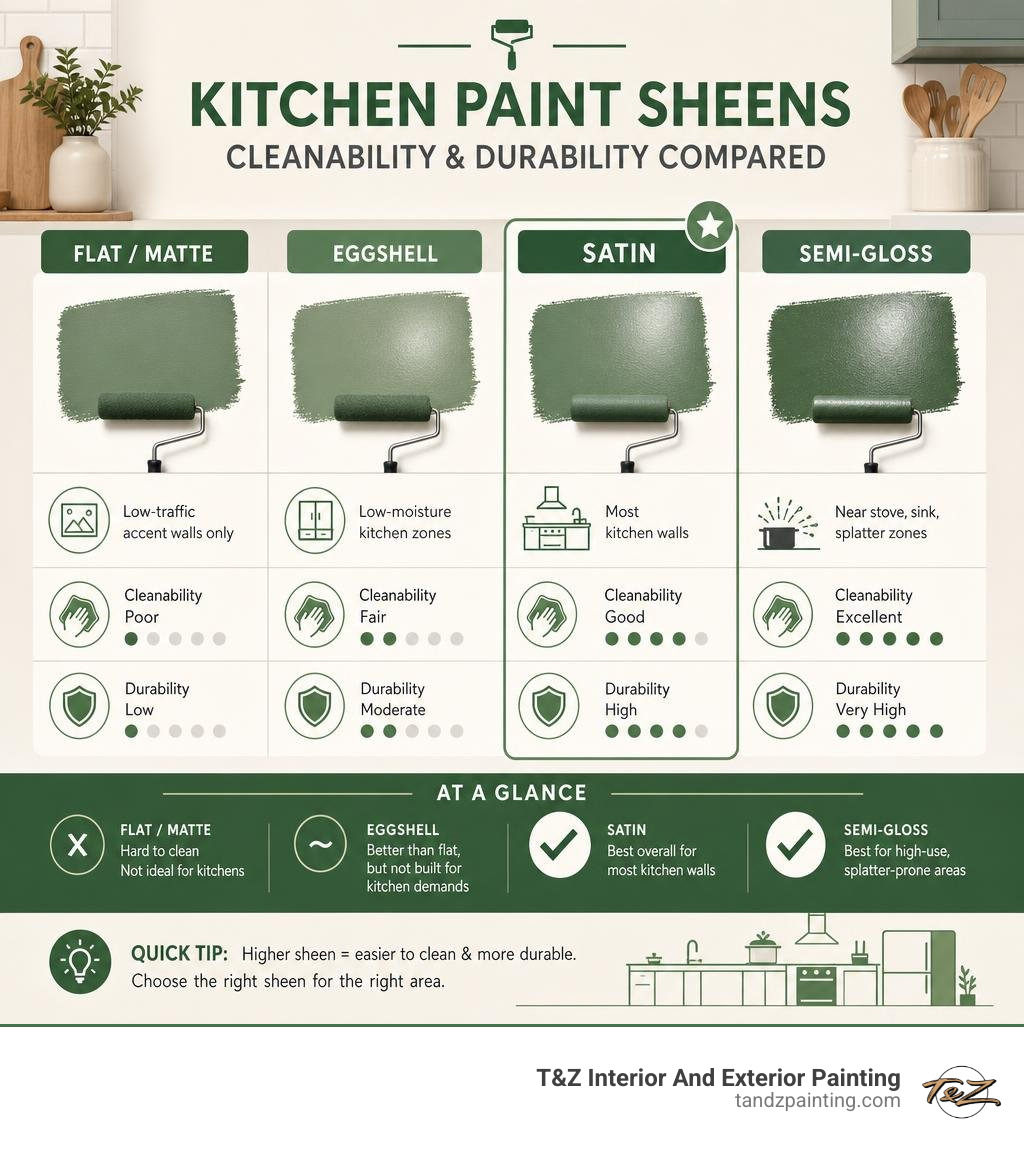
To help you visualize these differences, refer to this breakdown or read our guide on How to Choose the Best Kitchen Paint Finish Without Losing Your Sheen.
Satin vs. Semi-Gloss: Choosing the Right Sheen for Kitchen Walls
For the vast majority of homeowners, the decision comes down to a direct comparison between satin and semi-gloss. Both are incredibly durable, but they serve slightly different purposes.
Satin is the designer’s favorite. It offers a gentle luster that captures light beautifully without highlighting wall imperfections. It strikes a perfect visual balance, making the kitchen feel cozy and inviting. If your kitchen has large, open wall expanses that receive direct sunlight, satin is usually the best choice to avoid blinding glare.
Semi-gloss, however, is a performance-first finish. It can withstand up to 5x more frequent cleaning cycles than flat finishes without showing wear. If you have a busy household with young kids, pets, or if you love high-heat cooking that produces lots of steam and grease, semi-gloss is highly practical. It is the ideal choice for backsplashes, areas behind the trash can, and the wall space immediately surrounding your range.
If you are also planning to refresh your cabinetry, you can read about Why Semi-Gloss Paint Is the Secret Sauce for Your Kitchen Cabinets to see how these sheens complement one another.
Why Flat and Matte are Rarely the Right Sheen for Kitchen Walls
It can be tempting to choose a flat or matte finish, especially if you live in an older home in La Grange, IL or Elmhurst, IL with plaster walls that have settled over time. Matte paint is incredibly forgiving of surface flaws because it absorbs light rather than reflecting it.
However, using standard flat or matte paint in a kitchen usually leads to regret. Cooking oils, steam, and tomato sauce splatters will quickly find their way into the porous surface. When you attempt to clean these spots, the friction of your cloth will “burnish” the paint, leaving a permanent shiny spot that looks like grease even when clean.
If you absolutely insist on a matte look for your kitchen walls, you must use specialized, premium formulations designed specifically for high-moisture areas. Products like Dulux Easycare Kitchen Matt Emulsion Paint – Polished Pebble – 2.5L | Wickes.co.uk or Crown Paints easyclean® Kitchen Matt Emulsion aftershow® 40ML | Wall and Ceiling Paint (as well as Crown Easyclean Matt Emulsion Kitchen Paint – Aftershow – 2.5L | Wickes.co.uk ) utilize advanced stain-resistant resins to mimic the washability of higher sheens, though they still lack the raw defense of a true satin or semi-gloss.
Midwest Climate Factors: How Lombard Weather Affects Kitchen Paint
Here in the Chicago suburbs — whether you are in Lombard, Wheaton, Downers Grove, or Carol Stream — our homes experience extreme seasonal weather shifts. We go from freezing, dry winters to hot, incredibly humid summers.
These climate swings have a direct impact on the paint inside your home, particularly in the kitchen.
During our dry winters, indoor humidity levels can drop below 20%. The wood framing and drywall in your home contract. In the summer, humidity levels soar, causing the same materials to expand. This constant cycle of thermal expansion and contraction puts immense physical stress on your paint film.
Furthermore, during the winter, the temperature difference between the cold exterior walls of your kitchen and the warm, steam-filled interior air creates condensation pressure. If you are boiling pasta or washing dishes, moisture will condense on the coldest surfaces of your kitchen walls.
If you have used a low-quality or highly porous paint, this standing moisture can seep through the paint layer, weakening the bond with the drywall and causing the paint to crack, bubble, or peel.
To withstand these Midwest humidity swings, your kitchen paint needs to be highly flexible and moisture-resistant. High-quality satin and semi-gloss paints contain premium acrylic resins that allow the paint film to expand and contract without cracking, while blocking water from penetrating the surface.
Professional Product Recommendations and Surface Preparation

When we handle interior projects in towns like Plainfield, IL or Lockport, IL, we emphasize that 90% of a paint job’s success happens before the paint can is ever opened. This is especially true in the kitchen, where invisible grease films can ruin paint adhesion.
If you paint directly over a wall that has years of accumulated cooking oils, the new paint will fail to bond. It may look fine initially, but it will eventually bubble, peel, or scratch off with the slightest touch.
Here is the exact surface preparation process we use to ensure a lifetime of durability:
- Deep Degreasing: We wash the walls thoroughly using a solution of Trisodium Phosphate (TSP) or a dedicated heavy-duty degreaser. This breaks down stubborn cooking oils and grease shadows.
- Clean Rinse: We wipe down the walls with clean water to remove any soapy residue left behind by the degreaser.
- Sanding: Once dry, we lightly sand the walls to scuff up any existing semi-gloss or gloss paint, creating a “tooth” for the new paint to grab onto.
- Bonding Primer: If we are painting over old oil-based paints or dealing with tough water stains, we apply a high-quality bonding primer.
- Premium Topcoat: We apply two coats of a specialized kitchen paint.
We highly recommend using advanced formulations like PPG KITCHEN & BATH™ Interior Latex . This product is formulated with cross-linking resin technology that cures into an exceptionally hard, chemical-resistant film. It also contains active mildewcides to prevent mold and mildew growth in high-moisture zones.
Practical Maintenance Tips for Long-Lasting Kitchen Walls
Once your kitchen walls are beautifully painted, keeping them that way is a matter of simple, regular maintenance. Here are a few professional tips to extend the life of your kitchen paint:
- Use the Right Cloths: When cleaning splatters, always use soft microfiber cloths. Avoid abrasive scrubbing pads or stiff-bristled brushes, which can scratch the paint film and dull the sheen over time.
- Gentle Cleaners: Use mild dish soap diluted in warm water. Avoid harsh chemical cleaners, ammonia, or highly alkaline solutions that can break down the paint’s acrylic binders.
- Wipe, Don’t Scrub: For fresh splatters, gently wipe them away immediately. The longer grease or tomato sauce sits on the paint, the harder it will be to remove without leaving a shadow.
- Turn on Your Range Hood: Always run your exhaust hood while cooking, even if you are just boiling water. This captures steam and aerosolized grease before they can settle on your walls.
- Careful Touch-ups: If you ever need to touch up a scuff, use a small foam roller or dab the paint gently with a brush. That higher sheens are harder to patch invisibly than flat paints, so keeping the surface clean is always the best approach.
For more detailed guides on keeping your painted surfaces pristine, check out our resources on Kitchen Wall Painting.
Frequently Asked Questions About Kitchen Paint Finishes
Choosing the perfect paint finish often brings up a few common questions. Here are the answers to what we hear most frequently from homeowners.
Which paint sheen is easiest to clean in a kitchen?
Semi-gloss is the easiest paint sheen to clean on kitchen walls. Its high resin content creates a slick, non-porous surface that prevents grease, oils, and food splatters from penetrating. You can wipe it down repeatedly with a damp microfiber cloth and mild soap without worrying about wearing away the finish or creating dull spots.
Can I use eggshell paint on kitchen walls?
Yes, you can use eggshell paint on kitchen walls, but only in low-traffic, low-moisture zones. Eggshell is a great choice for dining areas, breakfast nooks, or walls that are far away from the stove and sink. However, for the main prep and cooking areas, we highly recommend upgrading to a satin or semi-gloss finish for better stain and moisture protection.
Why does kitchen paint peel near the stove?
Kitchen paint near the stove usually peels due to a combination of grease contamination, intense steam, and thermal fluctuations. As you cook, heat causes the wall to expand, while moisture penetrates the paint film. If the wall was not thoroughly degreased and primed before painting, or if a low-quality, porous paint was used, the paint will lose its adhesion and begin to peel away from the drywall.
Conclusion
Selecting the right sheen for kitchen walls is a critical decision that directly impacts how your kitchen looks, feels, and performs over time. While flat and matte finishes are best kept out of high-moisture cooking zones, a high-quality satin or semi-gloss finish will provide the perfect balance of beautiful light reflection and easy cleanability.
At T&Z Interior And Exterior Painting, we have over 15 years of experience helping homeowners across Lombard, IL, and surrounding communities like Wheaton, Downers Grove, and Glenview transform their homes. We pride ourselves on delivering stunning, long-lasting results through meticulous surface preparation, expert craftsmanship, and the highest-quality materials.
If you are ready to refresh your kitchen with a professional touch, we are here to help. Contact us today to discuss your project, and let our team bring your vision to life.
Explore our T&Z Interior Painting Services to learn more about how we can help you create the kitchen of your dreams.