
Why Commercial Metal Finishing Spraying in Lombard Matters for Your Business
If you’re looking for commercial metal finishing spraying Lombard businesses rely on, here’s what you need to know at a glance:
What it is: A professional process that applies liquid or specialty coatings to metal surfaces using spray equipment — protecting against rust, corrosion, and wear while improving appearance.
Who needs it:
- Warehouse and industrial facility owners
- Commercial property managers
- Businesses with structural steel, equipment, or metal facades
Why it matters in Lombard:
- Local climate — including humid summers and harsh winters — accelerates metal corrosion
- Properly sprayed and primed metal surfaces can last 7 to 10 years before needing maintenance
- Untreated or poorly finished metal surfaces degrade faster, raising long-term costs
What makes it different from other methods:
- Spraying works on large, complex, or already-installed metal surfaces
- It can be done on-site, unlike powder coating which requires a controlled facility
- Multiple coating types (epoxy, polyurethane, corrosion-resistant primers) can be applied in sequence
Metal is everywhere in commercial buildings — structural steel, railings, equipment, facades, and piping. When that metal isn’t properly protected, it rusts, weakens, and eventually fails. A high-performance spray finish is one of the most effective ways to stop that from happening.
I’m Tomasz Niemotko, owner of T&Z Interior and Exterior Painting, and over more than 15 years serving Lombard and the wider Chicagoland area, I’ve worked with commercial clients who need reliable, long-lasting results from commercial metal finishing spraying in Lombard — and I’ve seen what separates a finish that holds from one that fails within a few seasons. In this guide, I’ll walk you through everything your business needs to know to make the right call.
Learn more about commercial metal finishing spraying Lombard:
Understanding Commercial Metal Finishing Spraying
To understand how high-performance spraying can shield and elevate your business assets, we first need to look at what commercial metal finishing actually is. At its core, metal finishing is a branch of surface engineering. It involves altering the surface of a metal workpiece to achieve specific properties, such as enhanced corrosion resistance, improved wearability, electrical conductivity changes, or simply a pristine, professional appearance.
While there are several ways to finish metal, commercial spraying utilizes advanced liquid coatings applied via specialized spray guns. This process stands apart from other industrial methods like powder coating or electroplating. Liquid spraying offers unparalleled flexibility because we can apply it directly to existing structures in the field, whereas other methods often require dismantling the metal and shipping it to a specialized factory.
Learn more about industrial spray painting solutions to see how liquid spray systems provide a robust shield for commercial properties.
To help you visualize where liquid spraying fits in the metal finishing landscape, here is a quick comparison of the three primary finishing methods:
| Method | Key Characteristics | Best For |
|---|---|---|
| Liquid Spraying | Highly versatile; applied on-site or in-shop; fast curing options; massive range of colors and chemical formulations. | Large structures, structural steel, on-site machinery, and architectural elements. |
| Powder Coating | Dry powder applied electrostatically and baked in an oven; highly durable; solvent-free. | Small to medium parts, factory-manufactured goods, and items that can fit inside a curing oven. |
| Electroplating | Electrochemical bath that deposits a thin layer of metal (like chrome or nickel) onto the substrate. | High-precision parts, automotive trim, and applications requiring extreme hardness or electrical conductivity. |
How Spraying Differs from Alternative Finishing Methods
Each metal finishing method has its own place in the manufacturing and maintenance lifecycle. However, for existing commercial structures, liquid spraying is often the only viable choice.
One of the biggest differentiators is coating thickness control. With liquid spraying, a skilled technician can precisely control the wet film thickness (WFT) and dry film thickness (DFT) to match the exact specifications required for the environment. Whether a structure needs a thin, highly aesthetic coating or a heavy-duty, multi-layered protective barrier, spraying can accommodate it.
Furthermore, substrate versatility is where liquid spraying truly shines. Unlike electroplating, which only works on conductive metals, or powder coating, which requires materials that can withstand high oven temperatures (typically around 400°F), liquid spraying can be applied to virtually any metal substrate. This includes aluminum, carbon steel, stainless steel, cast iron, and galvanized metal.
For highly specialized industrial components, some facilities utilize engineered coatings to meet extreme performance metrics. You can learn more about these specialized surface treatments through Metal Finishing Services & Surface Treatments.
Commercial Metal Finishing Spraying Lombard: High-Performance Solutions for Local Businesses
Here in Lombard, Illinois, and the surrounding Chicagoland suburbs—such as Elmhurst, Downers Grove, Addison, and Wheaton—our local infrastructure takes a beating. Commercial properties are subjected to a brutal cycle of weather: freezing, snow-laden winters filled with road salt, followed by hot, humid summers. This combination is a breeding ground for rust and structural degradation.
For local businesses, maintaining metal surfaces isn’t just about looking good for customers; it’s about asset protection. From warehouse support beams to retail storefront facades, exposed metal that begins to oxidize can quickly become a structural hazard. Professional spray finishing provides a barrier that blocks moisture, salt, and chemicals from reaching the steel.

When we perform spray finishing in the local area, we focus on minimizing disruption to your daily operations. Because liquid spraying can be done on-site with proper containment, we can refresh and protect your metal assets without requiring you to shut down your facility.
Discover our guide to metal spray painting to find out how local businesses keep their properties in top condition.
Why Choose Commercial Metal Finishing Spraying Lombard for Large-Scale Projects?
Large-scale commercial and industrial projects present unique challenges. If you are managing a massive warehouse facility, an industrial manufacturing plant, or a complex of commercial buildings with extensive structural steel, you cannot simply pack up your metal supports and send them to a shop.
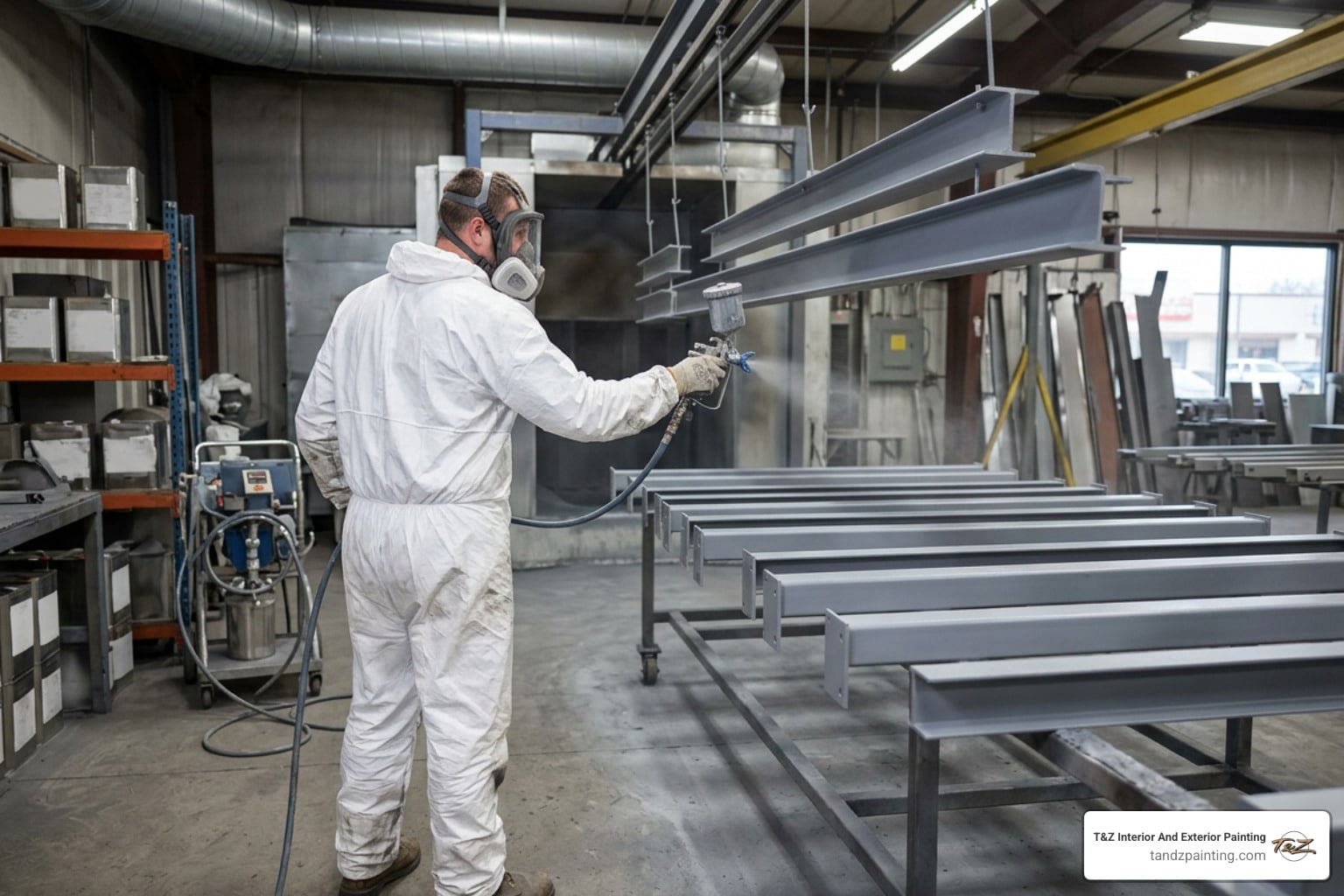
This is where on-site commercial spraying becomes indispensable. It is highly efficient and scalable. A professional crew utilizing industrial airless spray systems can cover thousands of square feet of structural steel in a fraction of the time it would take to brush and roll. This speed translates directly into less downtime for your business.
Additionally, spraying ensures that the protective coating penetrates deep into complex joints, rivets, welds, and hard-to-reach angles that brushes simply cannot coat evenly. By ensuring a uniform, continuous film across the entire metal surface, we eliminate the weak spots where rust usually gains a foothold.
More info about our metal spray painter services is available for businesses looking to protect their structural investments.
Key Spraying Techniques: Airless, HVLP, and Electrostatic
Depending on the specific requirements of your project, different spraying techniques are utilized to achieve the best bond, finish quality, and transfer efficiency.
- Airless Spraying: This technique uses high pressure (often between 1,500 and 3,000 PSI) to fluidize and atomize the paint without using compressed air. It is the absolute king of speed and thickness. Airless spraying is perfect for large-scale structural steel, metal roofs, and warehouse interiors because it can apply heavy-bodied protective coatings quickly.
- HVLP (High Volume, Low Pressure): HVLP systems use a high volume of air at a very low pressure to atomize the paint. This results in a highly controlled spray pattern with minimal overspray. It is ideal for detailed architectural metalwork, window frames, and decorative railings where a smooth, automotive-like finish is desired.
- Electrostatic Spraying: In this process, the liquid paint is given a negative electrical charge as it passes through the spray gun, while the metal object being painted is grounded (positive charge). Because opposites attract, the paint is magnetically drawn to the metal surface. This creates a “wrap-around” effect, allowing the paint to coat the back of pipes and railings even when sprayed from the front. Electrostatic spraying has an incredibly high transfer efficiency, meaning almost no paint is wasted as overspray.
For businesses looking for advanced engineered options, you can read more about proprietary surface solutions and Advanced Metal Coating Services.
Essential Surface Preparation and Coating Systems
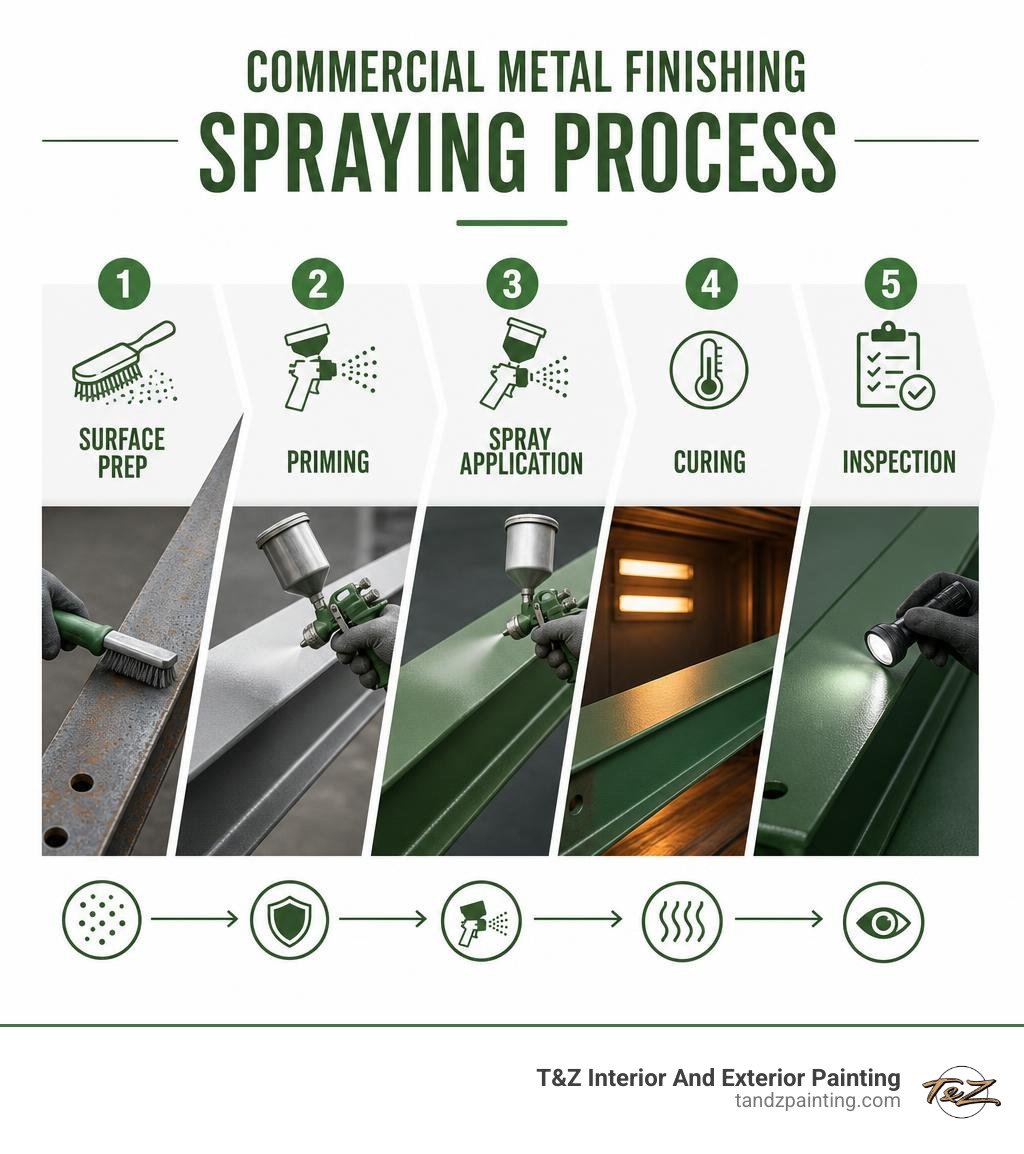
You could buy the most expensive, high-tech industrial topcoat on the market, but if it is applied over a poorly prepared surface, it will fail. In fact, in the professional painting industry, we often say that 80% of the success of a metal spray job happens before the spray gun is ever triggered.
Proper surface preparation is what allows the liquid coating to achieve a mechanical and chemical bond with the metal substrate. Without it, moisture trapped beneath the paint will cause rapid blistering, peeling, and rust creep.

Read our guide on how to spray paint metal to understand the steps required to transition a raw or rusted surface into a paint-ready canvas.
The Critical Role of Surface Preparation
Depending on the condition of the metal, several preparation methods are utilized to clean the surface and create an ideal “profile” (a microscopic roughness that gives the paint something to grip onto).
- Solvent Cleaning: This involves using specialized chemical solvents to wipe down the metal, removing oils, grease, cutting fluids, and drawing compounds.
- Power Tool Cleaning: Utilizing grinders, wire brushes, or needle guns to remove loose rust, scale, and old paint.
- Abrasive Blasting (Shot Blasting / Sandblasting): This is the gold standard for industrial prep. By blasting the metal with abrasive media (such as steel shot, sand, or coal slag), we strip away mill scale, rust, and old coatings, leaving behind a perfectly clean, profiled surface. For large steel pieces—sometimes up to 50 feet long—automated shot blasting or dedicated hand-blasting rooms are used to ensure every square inch is prepped.
To explore how these preparation steps integrate with comprehensive manufacturing and finishing pipelines, check out Metal Finishing Services: Powder Coating, Painting & Plating.
High-Performance Primers and Topcoats
Once the metal is clean and profiled, we apply a high-performance coating system. This usually consists of a primer coat and one or more topcoats, selected based on the metal type and the environmental exposure.
- Epoxy Primers: These are the ultimate rust-inhibiting primers. Epoxies offer incredible adhesion to bare metal and create a dense, chemical-resistant barrier. They are highly effective at preventing moisture from reaching the steel.
- Polyurethane Topcoats: Polyurethanes are highly resistant to ultraviolet (UV) radiation from the sun, meaning they won’t fade, chalk, or crack under intense sunlight. They also offer excellent gloss retention and impact resistance, making them perfect for exterior metal facades, structural steel, and outdoor equipment.
- Fluoropolymer (PVDF) Coatings: For extreme architectural applications, PVDF resin coatings offer unmatched resistance to solvents, acids, and heat, maintaining their color and integrity for decades.
Explore durable spray paints for Lombard metalwork to see how we protect local structures from the elements.
Environmental Regulations and Quality Standards in Illinois
Operating a commercial metal spraying service in Illinois requires strict adherence to environmental and safety regulations. The Illinois Environmental Protection Agency (IEPA) and federal EPA enforce rigorous standards to protect air quality and ensure worker safety.
When liquid coatings dry, they release Volatile Organic Compounds (VOCs) into the air. Because of this, commercial spraying must be carefully managed to comply with local laws while keeping workers and nearby properties safe from fumes and overspray.
Learn about on-site component repair spraying to see how professionals safely execute mobile and on-site spray applications.
Compliance with Local and State VOC Limits
In the Chicagoland area, environmental regulations limit the VOC content allowed in industrial and architectural coatings. To comply with these clean air regulations, we utilize modern, low-VOC paint formulations that deliver the same high-performance protection as older, high-solvent paints but with a fraction of the environmental impact.
In addition, any shop-based spraying must occur within a certified paint booth equipped with high-efficiency particulate air (HEPA) filters to capture overspray. Proper waste management protocols must also be followed to safely dispose of solvents, empty cans, and cleaning materials.
Quality Control and Testing Standards
To ensure that a commercial spray job will stand the test of time, we don’t just rely on visual inspections. Professional spray finishing involves rigorous quality control testing:
- Mil Thickness Testing: Using magnetic or ultrasonic dry film thickness (DFT) gauges to verify that the paint has been applied to the exact thickness specified by the manufacturer (usually measured in mils, or thousandths of an inch).
- Cross-Hatch Adhesion Testing: A quality control test where a small lattice pattern is cut into the cured paint film, and tape is applied and pulled off. This verifies how strongly the paint has bonded to the metal substrate.
- Holiday Detection: A test used on critical industrial coatings (like tank linings) that uses an electrical current to find microscopic pinholes or “holidays” in the paint film that could allow moisture to penetrate.
Frequently Asked Questions
What is the difference between commercial metal spraying and powder coating?
The primary difference lies in the application and curing process. Powder coating is applied as a dry, electrostatically charged powder that must be baked in an industrial oven at high temperatures to melt and cure into a solid film. This limits powder coating to items that can be disassembled and transported to a shop with an oven.
Commercial metal spraying uses liquid coatings that cure at room temperature or through chemical catalysts. This allows us to apply high-performance finishes directly in the field on large, fixed structures like structural steel, building facades, and heavy machinery.
How long does a professional commercial metal sprayed finish last?
When properly prepped, primed, and coated, a professional metal spray finish on commercial or industrial surfaces typically lasts between 7 to 10 years, even in harsh climates like Lombard’s. Without proper surface preparation or when using low-quality materials, finishes can fail in as little as 3 to 5 years. Regular inspection and minor maintenance touch-ups can extend the lifespan of the coating even further.
Find out more about spray painting for large surfaces to understand how professional techniques prevent premature wear.
How do I select a provider for commercial metal finishing spraying Lombard?
When evaluating a commercial painting and spraying provider, look for the following:
- Local Experience: Choose a contractor with a proven track record in the Chicagoland area who understands our climate challenges.
- Licensing and Insurance: Ensure the contractor is fully licensed, insured, and maintains strict OSHA safety standards.
- Technical Knowledge: They should be able to explain exactly which prep methods and coating systems (such as epoxies and urethanes) are best suited for your specific metal substrate.
- Clear Contracts: A professional provider will outline the preparation steps, coating specifications, and project timelines in writing.
Reviewing commercial painting contracts is an excellent way to ensure your business is protected from start to finish.
Conclusion
Investing in high-performance commercial metal spraying is one of the smartest decisions you can make to protect your business assets. From preventing structural rust on warehouse steel to maintaining a polished, professional look on your commercial storefront, a quality spray finish saves your business from costly structural repairs down the road.
At T&Z Interior and Exterior Painting, we have spent over 15 years delivering top-tier craftsmanship and exceptional customer service to the Lombard community and surrounding suburbs. Our experienced teams use only premium-grade materials and industry-leading techniques to ensure your commercial metal assets remain protected and beautiful for years to come.
Ready to protect and transform your business’s metal surfaces? Schedule a consultation for our professional spray painting services today, and let us show you the difference that true professional craftsmanship can make.