
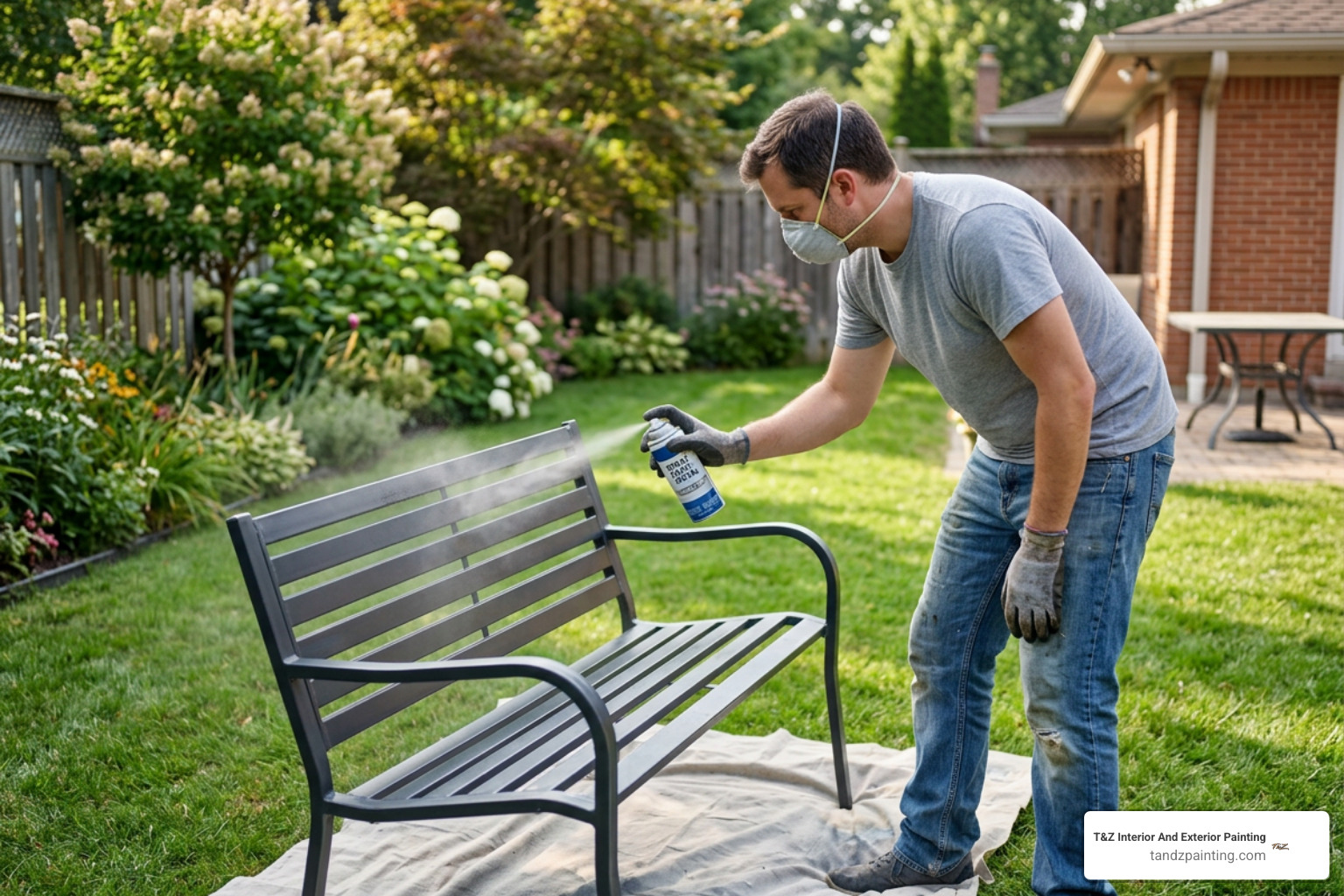
Choose Outdoor Spray Paint for Metal That Holds Up
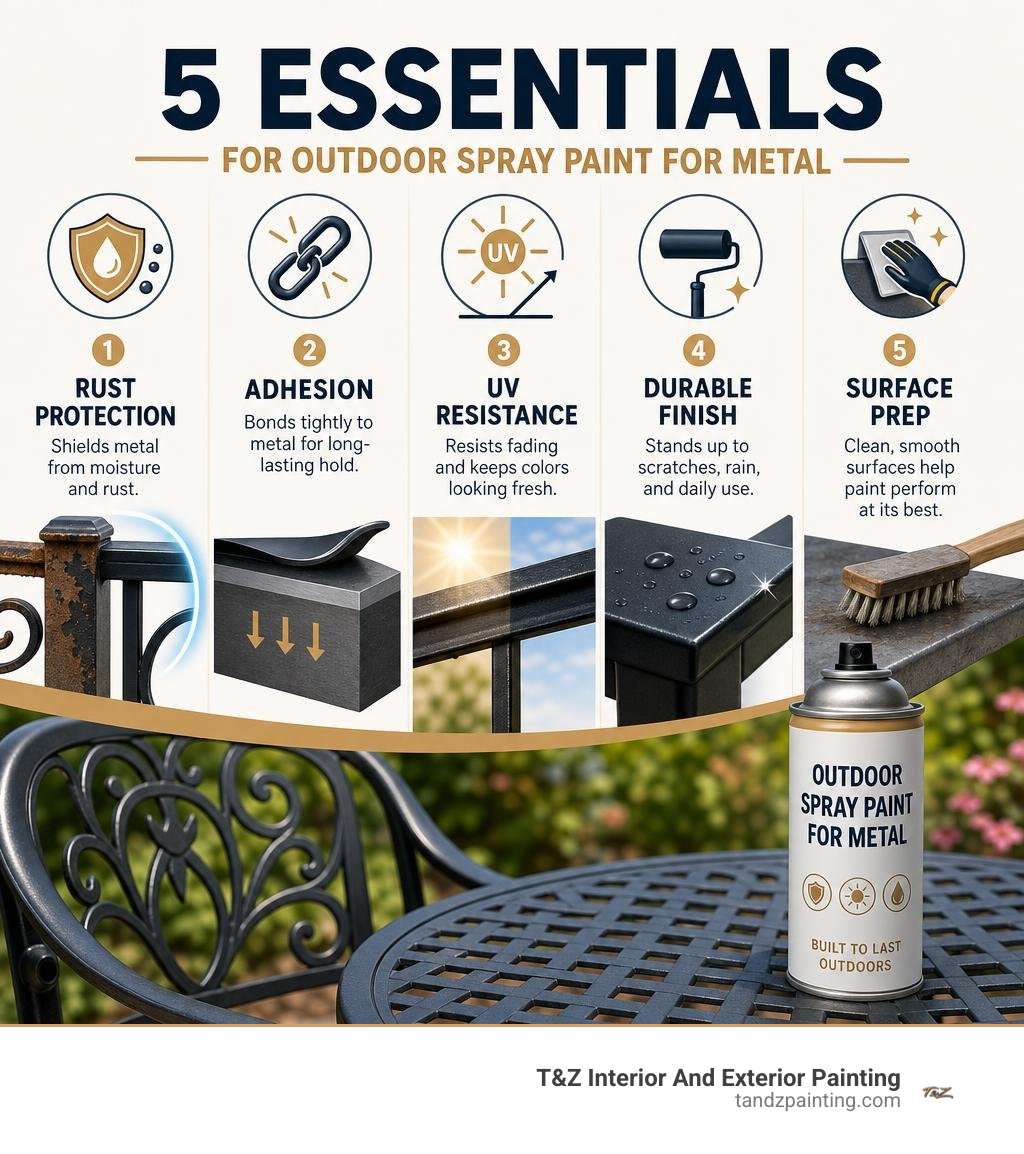
Outdoor spray paint for metal should be made for exterior use, resist rust and UV fading, and match the metal beneath it. For most patio furniture, a rust-inhibiting oil-based enamel is the strongest all-around choice; aluminum needs a coating with strong adhesion, while textured hammered finishes can help hide pits and old surface damage.
| What to look for | Why it matters outdoors |
|---|---|
| Rust protection | Helps shield steel and wrought iron from moisture |
| UV resistance | Limits fading in direct sunlight |
| Metal-specific adhesion | Reduces peeling, especially on aluminum and smooth metal |
| Durable finish | Better resists scratches, rain, and regular use |
| Correct preparation | Often makes the difference between months and years of performance |
A fresh coat can make a tired patio set look new, but paint is only as durable as the product choice and the surface beneath it. With proper cleaning, rust removal, primer, and a quality enamel topcoat, outdoor metal furniture can commonly stay in good condition for 3 to 5 years before noticeable wear appears.
I am Tomasz Niemotko of T&Z Interior And Exterior Painting, and our licensed and insured team brings more than 15 years of painting experience to homeowners in Lombard, Itasca, Addison, Glen Ellyn, Oak Brook, and nearby towns. We apply the same attention to surface prep, coating selection, and clean workmanship to every outdoor spray paint for metal project, starting with how to choose the right formula.
Basic outdoor spray paint for metal vocab:
Choosing the Right Types of Outdoor Spray Paint for Metal
When selecting an outdoor spray paint for metal, understanding the chemical differences between available formulations is key. Exterior metal fixtures, patio dining sets, railings, and garden decor face continuous exposure to rain, snow, humidity, and direct sunlight. Selecting a coating engineered specifically for exterior environmental strain prevents premature flaking, chalking, and corrosion.
The primary divide in standard consumer aerosols comes down to oil-based enamels versus acrylic water-based or acrylic-alkyd hybrid formulas. Oil-based enamel coatings create an impenetrable, flexible shield that resists moisture penetration better than standard acrylics. Because iron and steel oxidise rapidly upon contact with oxygen and water, an oil-based barrier provides continuous rust inhibition across changing seasons. In long-term outdoor exposure tests, high-performance oil-based enamels completely blocked rust formation with zero bubbles appearing after a full year outdoors, while also holding up exceptionally well against solar UV fading.
In contrast, standard water-based or acrylic spray paints dry much faster—often within 20 minutes—and produce less solvent odor during application. However, acrylic paint-and-primer products applied directly to bare metal that already has minor surface rust can trap microscopic moisture underneath the dried coating film. Testing reveals that trapping moisture this way can cause rust bubbles to rupture through the finish in as little as 12 months. Acrylic formulas perform best when applied over sound, previously painted surfaces or when paired with a dedicated rust-blocking primer.
| Performance Attribute | Oil-Based Enamel Spray Paint | Acrylic Paint-and-Primer Spray Paint |
|---|---|---|
| Drying Time (Touch) | 30 minutes to 2 hours | 15 to 30 minutes |
| Full Hard Cure Time | 24 hours to 3 days | 24 hours |
| Moisture Resistance | Superior continuous water blocking | Moderate water resistance |
| Rust Prevention | Exceptional on steel and iron | Requires dedicated primer over rust |
| UV Resistance | High retention against fading | Excellent color variety and sheen stability |
| Best Application | Heavy-duty iron, raw steel, high-use furniture | Refreshes on previously coated aluminum or decorative metal |
Matching Outdoor Spray Paint for Metal to Wrought Iron, Aluminum, and Steel
Not all metals respond to paint in the same way. Matching your chosen outdoor spray paint for metal to the specific underlying substrate ensures long-lasting adhesion and prevents coating failure.
- Wrought Iron: Wrought iron patio furniture and railings feature intricate curves, joints, and welds where water loves to collect. Because wrought iron is prone to severe oxidation, it demands a rust-inhibiting oil-based enamel. Heavy, oil-based coatings seep into microscopic metal pores to block humidity.
- Aluminum: Aluminum does not rust like steel, but it presents a different challenge: rapid oxidation. Bare aluminum forms a microscopic, slick oxide skin instantly upon air contact, which repels standard paints. Applying basic rust enamels directly to aluminum frequently results in paint flaking off in wide sheets. Aluminum requires specialized self-bonding aerosol formulas, such as high-adhesion metal coatings or dedicated etch primers, to lock onto the smooth substrate.
- Galvanized and Raw Steel: Raw steel requires maximum corrosion defense. Galvanized steel, coated in zinc, requires a primer compatible with zinc chemistry; standard oil primers can react chemically with zinc and cause saponification (a breakdown resulting in a sticky film). Using specialized industrial metal spray coatings or dedicated universal metal primers resolves this challenge, creating a reliable foundation for any topcoat.
Textured vs. Metallic Finishes in Outdoor Spray Paint for Metal
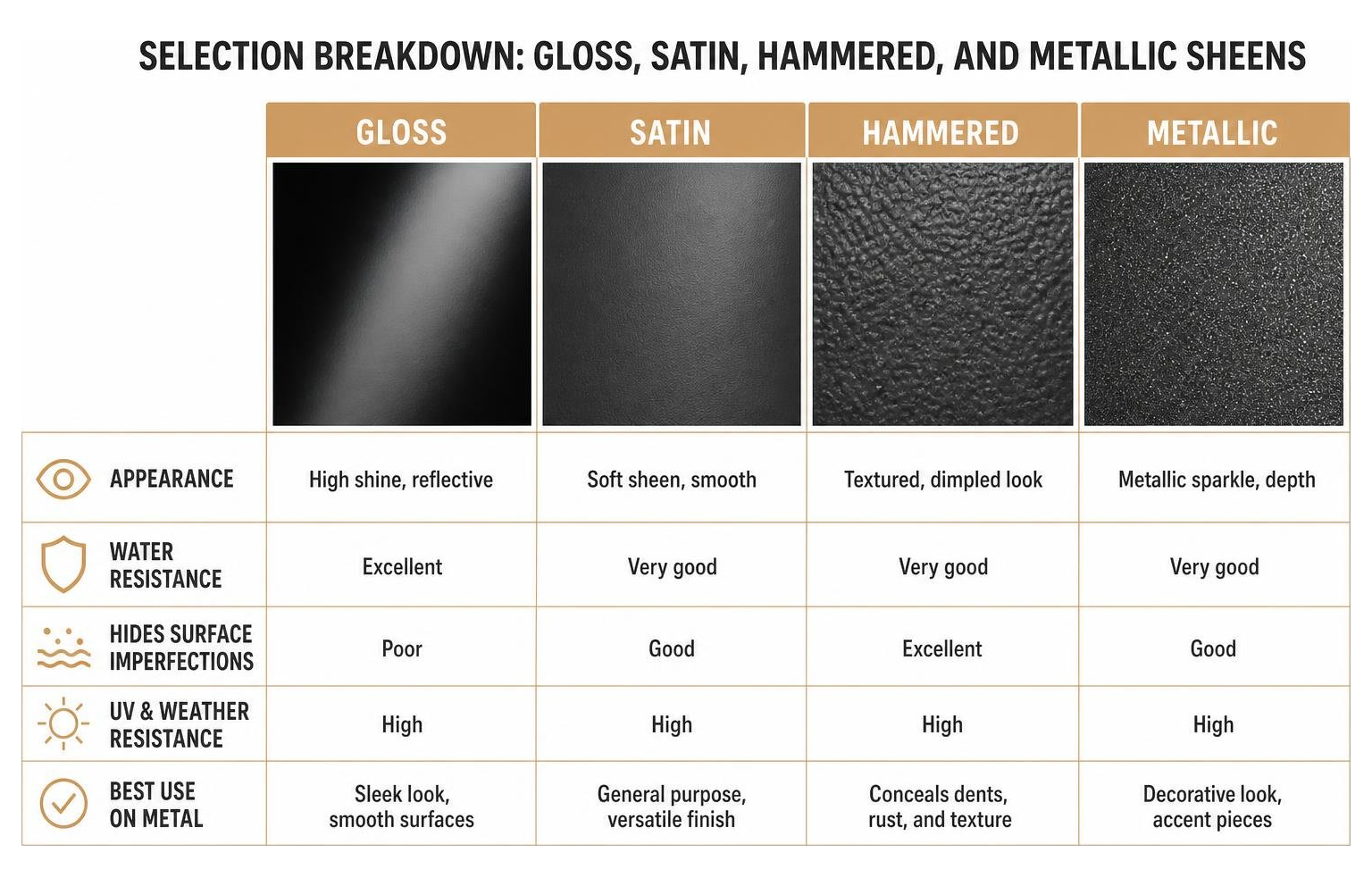
The finish sheen you select affects both visual appeal and how well the coating hides natural surface imperfections. Modern aerosol paints offer sheens ranging from flat matte to high-gloss, as well as specialty textured and metallic formulations.
High-gloss finishes reflect light, creating a clean sheen that repels water easily. However, gloss also highlights every ding, dent, scratch, and pit on older metal furniture. Flat and satin finishes present a softer, modern look that disguises mild surface unevenness, though satin can attract slightly more airborne dirt than slick gloss coatings.
Specialty finishes offer distinct practical advantages:
- Hammered Textures: Hammered finishes cure into a pattern resembling hand-hammered metal. This dimensional finish breaks up light, concealing pitted surfaces, rough rust scars, and uneven metal welds without requiring hours of filling or intense mechanical sanding.
- Metallic Sheens: Metallic coatings incorporate fine aluminum or bronze flakes to replicate stainless steel, oil-rubbed bronze, copper, or wrought iron. High-grade protective metal spray finishes feature UV-stable pigments that prevent metallic flecks from tarnishing or darkening under solar exposure.
Essential Surface Preparation and Priming Steps
No spray paint, regardless of marketing claims on the can, will adhere to loose rust, dirt, grease, or flaking paint. Proper prep work accounts for 80% of a spray job’s ultimate durability. Skipping prep reduces coating longevity from 3–5 years down to 6–12 months.
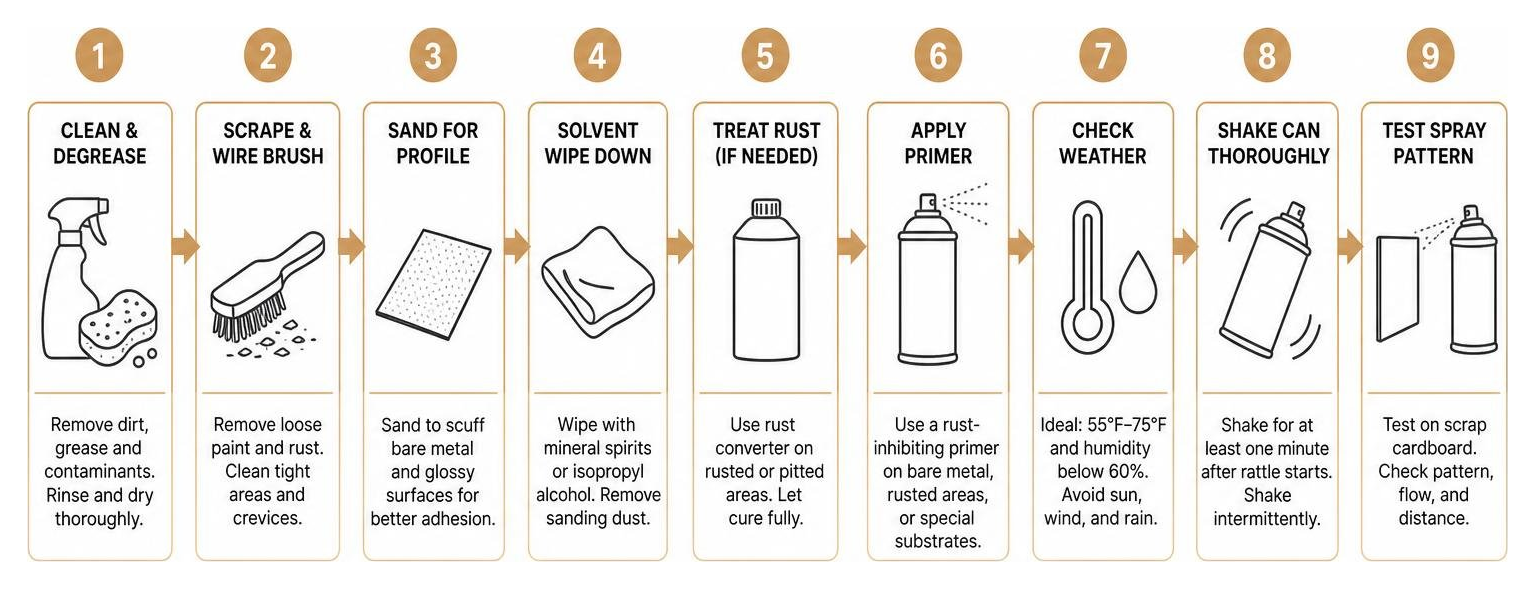
To establish a solid surface profile for paint bonding, follow a systematic cleaning and mechanical prep routine:
- Degrease and Clean: Wash the metal object thoroughly using a strong degreasing detergent or cleaner mixed with warm water. Remove all dirt, pollen, tree sap, and oily residues. Rinse thoroughly with clean water and allow to dry completely.
- Scrape and Wire Brush: Use a stiff wire brush or scraper to remove all loose, flaking paint and flaky, raised rust scale. Pay special attention to welded joints, underside curves, and tight lattice crevices where moisture lingers.
- Sand for Profile: Sand all bare metal, glossy old paint, and transition edges using 120- to 220-grit sandpaper. Sanding scuffs slick existing paint, giving new aerosol droplets a physical profile to grip.
- Final Solvent Wipe down: Wipe the entire assembly down with a lint-free tack cloth soaked in mineral spirits or isopropyl alcohol to remove fine sanding dust. Learn more detailed metal surface prep techniques before starting your application.
Treating Bare, Rusted, and Pitted Metal
When working on vintage or heavily weathered metal patio sets, you will often encounter deeply pitted iron where rust has eaten tiny pockets into the metal. Simply spraying over pitted rust leaves trapped moisture and oxygen deep inside the metal cavities, ensuring rust returns quickly.
For mild-to-moderate rust, scrub the pits clean with a wire wheel attached to an electric drill, then treat the area with a liquid rust converter or a dedicated rust-reforming aerosol. Rust converters react chemically with iron oxide, converting unstable rust into an inert, black protective film.
For smooth metal surfaces where old paint was removed down to bare steel, apply paint promptly after cleaning. Exposed steel can develop microscopic “flash rust” within hours in humid environments.
When to Use a Dedicated Rust-Inhibiting Primer
Many modern spray paints are marketed as “Paint & Primer in One.” While these all-in-one products work well on previously painted metal that is in sound condition, high-moisture exterior environments often demand a dedicated, stand-alone primer.
Always use a dedicated primer under these conditions:
- Bare Steel or Iron: Raw, unpainted steel requires active rust-inhibiting compounds (such as zinc chromate or red iron oxide) present in dedicated primers to prevent oxidation.
- Heavily Rusted or Sanded Areas: Bare spots surrounded by older paint require primer to seal transitions and build film thickness.
- Aluminum and Galvanized Substrates: Non-ferrous metals require specialized bonding primers designed to chemically grip slick surfaces.
- Drastic Color Changes: Transitioning from dark green or black to white or bright yellow requires a neutral gray or white primer coat to block bleed-through.
Consult our comprehensive rust-inhibiting primer guide to pair the right primer formula with your specific metal substrate.
Step-by-Step Spray Application for a Flawless Finish
Achieving a smooth finish with outdoor spray paint for metal relies on proper spraying technique and favorable ambient environmental conditions.
Follow these critical steps during application:
- Check the Weather: Ideal application conditions require temperatures between 55°F and 75°F (with an absolute workable range of 50°F to 90°F) and relative humidity below 60%. Never spray in direct sunlight, high heat, or windy conditions. Direct sun heats the metal, causing solvents to flash off instantly, resulting in bubbling, dry-spray texture, and poor bonding.
- Shake the Can Thoroughly: Shake the aerosol can vigorously for at least one full minute after the internal mixing ball begins to rattle. This redistributes heavy rust-inhibiting resins and pigments evenly throughout the liquid solvent. Shake intermittently during use.
- Test the Spray Pattern: Test your spray pattern on a piece of scrap cardboard to check nozzle flow, spray angle, and distance before pointing the can at your metal furniture.
Techniques to Prevent Drips, Sags, and Overspray
The number one mistake home DIYers make when using spray paint is attempting to cover the metal completely in a single heavy pass. Thick coats sag, run, take days to dry, and trap uncured solvents underneath a skin, leading to soft paint that tears easily.
- Maintain Distance: Hold the spray nozzle 8 to 10 inches away from the target metal surface. Holding the can closer causes liquid paint to pool and drip; holding it too far away lets airborne paint particles dry mid-air, creating a rough, sand-like surface texture.
- Use the Sweeping Motion: Start your arm sweeping motion before depressing the spray nozzle, and release the nozzle button after sweeping past the edge of the object. This prevents heavy paint buildup at the start and stop points of your stroke.
- Apply Multiple Thin Coats: Apply 2 to 3 light, misting coats rather than one heavy coat. Allow 15 to 30 minutes of flash time between coats (or follow label instructions for recoat windows).
- Overlap Your Passes: Overlap each spray stroke by approximately 50% to build an even, uniform film thickness across curved lattice work and tubular chair legs.
- Clear the Nozzle: After finishing, invert the can upside down and press the nozzle for 2 to 3 seconds until clear gas escapes. This prevents dried paint from clogging the nozzle tip between uses.
Estimating Can Quantities and Longevity Expectations
Planning your project requires accurate material estimates. A standard 12-ounce aerosol can covers approximately 15 to 25 square feet of flat surface area per coat. However, when spraying open metal lattice work, wrought iron mesh, or slender chair legs, up to 50% of the paint atomizes into airborne overspray.
Industrial-grade high-solids spray formulas deliver up to 18 square feet of dense coverage per 16-ounce fill, providing significantly higher solid film thickness and output than standard aerosol cans.
When planning project timelines, keep in mind the difference between dry time and cure time:
- Dry to Touch: Typically 15 to 30 minutes. The paint is safe to touch lightly without transferring to skin.
- Dry to Handle: 1 to 2 hours. The item can be moved carefully.
- Full Hard Cure: 24 hours for standard acrylics; 2 to 3 days for heavy-duty oil-based enamels and industrial coatings. Full cure allows paint resins to cross-link into an impact-resistant, scratch-resistant protective shell. Do not put furniture into active outdoor service or place heavy cushions on painted metal until the hard cure window has elapsed.
Frequently Asked Questions About Spray Painting Metal
How many cans of spray paint do I need for a patio set?
For a standard outdoor patio set consisting of four metal chairs and one small table, plan on using 3 to 4 cans of spray paint and 1 to 2 cans of primer.
Complex wrought iron latticework requires extra paint due to overspray around open wire patterns. Purchasing one additional backup can guarantees you will not run out midway through the job and avoids batch-to-batch color variation.
Can I use the same spray paint for outdoor metal and wood furniture?
Many modern multi-surface spray paints are labeled for both wood and metal. However, specialized metal coatings contain dedicated rust inhibitors that multi-surface wood coatings lack.
Conversely, wood expands and contracts significantly with moisture variations, requiring a more flexible coating. While multi-surface spray paints work well for light decorative items, high-wear outdoor metal items achieve maximum longevity when coated with a dedicated metal paint containing active rust inhibitors.
How long does spray paint last on outdoor metal furniture?
When outdoor metal is thoroughly prepared, treated for rust, primed with a dedicated primer, and coated with 2 to 3 thin layers of quality oil-based enamel, the finish typically lasts 3 to 5 years before requiring minor maintenance touch-ups.
Without proper surface prep, rust removal, or primer, outdoor metal spray coatings can fail within 6 to 18 months, resulting in peeling and rust bleed-through.
Conclusion
Restoring worn, rusted patio furniture with outdoor spray paint for metal is an effective way to revive your outdoor living area and protect your property investment from seasonal weather damage. Achieving durable results comes down to choosing the right paint formulation, prepping the metal substrate carefully, and applying light, even coats under favorable weather conditions.
While aerosol spray cans are great for small DIY touch-ups, coating extensive outdoor metalwork—such as expansive patio dining sets, wrought iron perimeter fencing, multi-story metal railings, or architectural exterior trim—demands commercial-grade spray equipment and expertise.
At T&Z Interior And Exterior Painting, our professional team brings more than 15 years of expert experience, licensed and insured protection, and a 5.0 Google Reviews rating to every project. We deliver durable, factory-smooth metal finishes for homeowners across Lombard, Itasca, Addison, Glen Ellyn, Oak Brook, and nearby communities. Whether you need exterior metal elements restored or a complete home refresh, we bring superior craftsmanship, meticulous preparation, and clean service to every job.
Contact us today to explore our professional spray painting services and protect your exterior metal investments for years to come!