
How to Choose the Best Cabinet Paint
The best cabinet paint for most kitchens is a water-based urethane or waterborne alkyd enamel. These paints level out smoothly, resist scuffs and moisture better than standard wall paint, and clean up with soap and water.
| Quick answer | Best choice |
|---|---|
| Best overall durability and finish | Sherwin-Williams Emerald Urethane Trim Enamel |
| Best classic self-leveling finish | Benjamin Moore Advance |
| Best value-focused alkyd option | Dutch Boy Cabinet, Door and Trim Alkyd Enamel |
| Best high-adhesion option | Insl-X Cabinet Coat |
| Best for a simple DIY project | Amy Howard Miracle Cabinet Paint or General Finishes Milk Paint |
| Best sheen for most kitchens | Satin, with semi-gloss for a brighter, easier-to-wipe finish |
Cabinets take more abuse than walls. They face grease, fingerprints, water, cleaning products, and doors that close against painted frames. That is why ordinary acrylic wall paint is usually the wrong choice. A cabinet-grade enamel, paired with solid surface prep and enough cure time, is what helps a new finish stay smooth and durable.
I am Tomasz Niemotko of T&Z Interior And Exterior Painting. With more than 15 years of painting experience serving homeowners in Lombard, Itasca, Addison, Glen Ellyn, Oak Brook, and surrounding towns, I have seen how choosing the best cabinet paint and using the right process affects the final result.
Must-know best cabinet paint terms:
Understanding Cabinet Paint Chemistry and Sheens

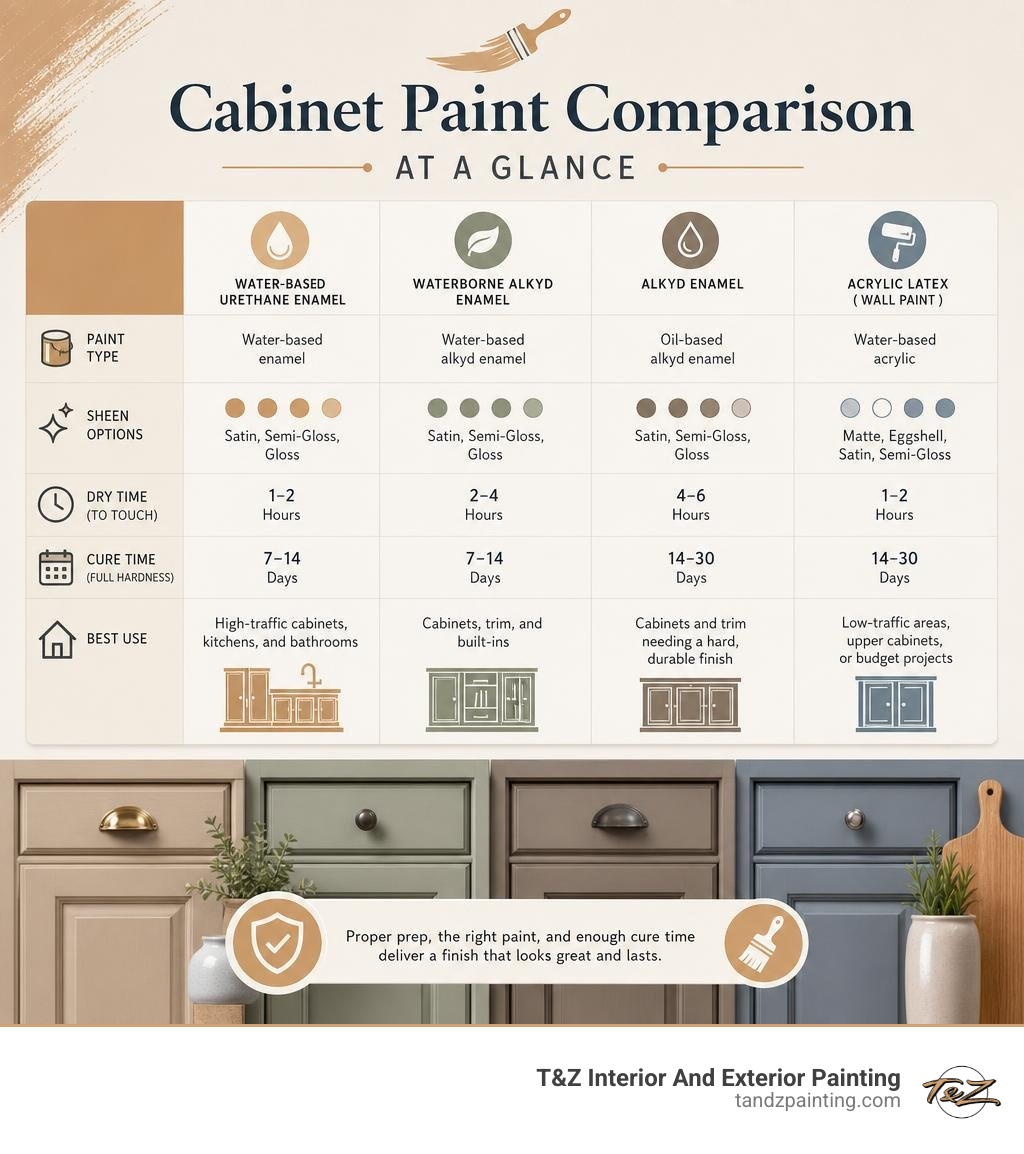
When selecting paint for kitchen or bathroom cabinetry, the chemical formulation of the paint dictates how well the finish stands up to daily life. Standard interior latex wall paint uses softer vinyl-acrylic resins that stay slightly rubbery. When applied to cabinet doors, latex paint prone to chipping, blocking (where closed doors stick to the face frames and peel away), and wearing down when scrubbed.
To get a hard, scrubbable finish, specialized cabinetry coatings rely on three main binder chemistries:
- Waterborne Hybrid Alkyd Enamels: These modern formulations blend water-based acrylic resins with alkyd (oil) polymers. When applied, water evaporates quickly while the alkyd cross-links to form a hard, durable shell. You get the rich flow, brush-leveling, and impact resistance of traditional oil paint, combined with low VOC emissions and simple soap-and-water cleanup.
- Urethane-Acrylic Blends: By infusing acrylic enamel with aliphatic urethane resins, these coatings deliver flexible impact resistance and superior block resistance. They resist thermal shock, yellowing, and constant hand-oil contact better than basic latex products.
- Traditional Oil-Based Paint: While historical oil enamels produce an ultra-hard surface, they emit strong chemical fumes, require hazardous mineral spirits for cleanup, and yellow significantly over time—especially in dark or low-light areas. Modern hybrid formulations have rendered traditional oil paints largely obsolete for indoor residential use.
Sheen selection is equally crucial for both aesthetics and maintenance performance. A higher sheen level creates a smoother, tighter surface film that sheds water and resists grease penetration. However, higher sheens also reflect light, making wood grain variations, minor prep flaws, or panel seams more noticeable.
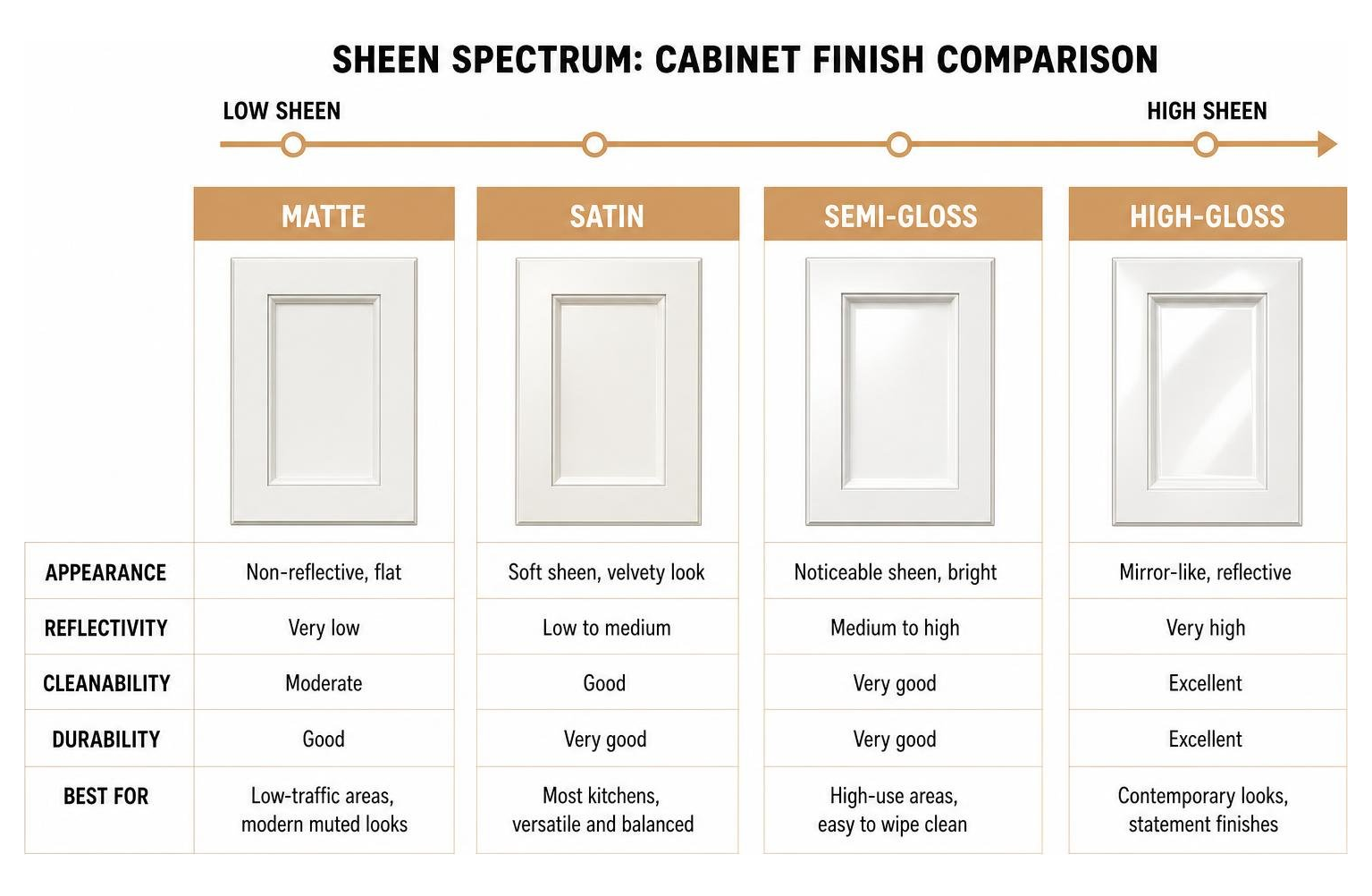
- Satin Finish: Offers a soft, velvet-like luster with roughly 15% to 25% gloss. It provides excellent cleanability while diffusing light to hide minor wood grain texture. Satin remains the most popular choice for modern, transitionally designed kitchens. Learn more about selecting sheens in our guide on how to stop the sheen stress and pick the perfect cabinet finish.
- Semi-Gloss Finish: Provides a brighter glow (roughly 35% to 50% gloss) that amplifies room lighting and creates a crisp, architectural look. Semi-gloss finishes form a slick surface film that allows cooking grease, tomato sauce splatters, and fingerprints to wipe away with minimal effort.
- Gloss Finish: Delivers a mirror-like sheen reminiscent of classic lacquered European cabinetry. High gloss demands flawless surface preparation, as every substrate imperfection will be magnified under direct light.
A dedicated topcoat or clear varnish is generally unnecessary when using high-grade urethane acrylic or hybrid alkyd enamels. These products cure into a solid structural film on their own. Adding an extra clear coat over top can cause cloudiness, yellowing, or inter-coat adhesion failures.
Comparing the Best Cabinet Paint Options: Product Roundup
To help you choose the right product, we have evaluated the leading cabinet enamels on performance metrics including leveling, recoat times, cure duration, and finish hardness.
| Paint Brand & Product | Coating Chemistry | Touch Dry Time | Recoat Window | Full Cure Duration | Key Performance Feature |
|---|---|---|---|---|---|
| Sherwin-Williams Emerald Urethane | Waterborne Urethane-Alkyd | 2 Hours | 2–4 Hours | 14–21 Days | Outstanding block resistance & fast recoat |
| Benjamin Moore Advance | Waterborne Alkyd Enamel | 4–6 Hours | 16–24 Hours | 21–30 Days | Unrivaled self-leveling brushability |
| Dutch Boy Cabinet & Trim | Water-Based Alkyd | 2 Hours | 4 Hours | 14 Days | Smooth levelling & low sheen warmth |
| Insl-X Cabinet Coat | Urethane Acrylic Enamel | 1 Hour | 6 Hours | 14 Days | Superior direct adhesion without primer |
| Behr Premium Cabinet & Trim | Acrylic Alkyd Enamel | 1 Hour | 2 Hours | 14 Days | Rapid 2-hour non-stick block resistance |
| Amy Howard Miracle Paint | All-in-One Acrylic | 30 Minutes | 2 Hours | 7–14 Days | Zero-prep multi-surface bonding |
| General Finishes Milk Paint | Acrylic Mineral Enamel | 30 Minutes | 2 Hours | 7–10 Days | Smooth, silky matte-satin finish |
Sherwin Williams Emerald Urethane: Best Cabinet Paint Overall
Sherwin-Williams Emerald Urethane Trim Enamel stands out as our top overall recommendation for residential kitchen cabinet transformations. Formulated with a urethane-modified alkyd resin, this coating handles daily kitchen traffic with exceptional resilience.
What makes Emerald Urethane superior is its fast recoat schedule and forgiving application properties. With a recoat window of just 2 to 4 hours under standard temperature conditions (50°F or warmer), you can apply primer and multiple finish coats in a single day without risking sag or coat lifting.
When brushed, rolled with a 1/4-inch nap mohair cover, or applied through an HVLP sprayer, Emerald Urethane flows flat across cabinet door stiles and recessed panels. Once cured, it yields a hard surface that withstands household cleaners, moisture, and frequent contact without softening or yellowing. For details on avoiding sticky cabinet doors, check out our insights on how to say goodbye to sticky doors the best paint for kitchen cabinets.
Benjamin Moore Advance: Classic Waterborne Alkyd Choice
Benjamin Moore Advance Waterborne Alkyd represents the gold standard for traditional self-leveling performance. Utilizing an extended-open-time waterborne alkyd resin, Advance behaves almost identically to classic oil paint under the brush.
It glides onto bare wood, MDF, or primed surfaces with long open-time windows, allowing brush marks and roller stipple to melt away completely before skinning over. This self-leveling capability makes Advance an exceptional choice for intricate millwork, fluted trim, and raised-panel doors.
The trade-off for Advance’s smooth finish is its timeline. It requires a mandatory 16 to 24-hour dry time between coats. Rushing this window by applying a second coat prematurely can trap moisture beneath the paint film, leading to wrinkling, soft spots, and extended curing times. Full film hardness requires 2 to 3 weeks of gentle handling before putting cabinets into heavy service.
Dutch Boy Alkyd Enamel: Best Cabinet Paint on a Budget
For homeowners looking for an accessible hybrid alkyd option that maintains smooth application standards, Dutch Boy Cabinet, Door and Trim Alkyd Enamel offers an impressive balance of quality and practical ease.
This water-based alkyd formula provides smooth leveling and leveling behavior that minimizes roller stipple on flat cabinet panels. It dries to touch in approximately 2 hours and allows recoating within 4 hours, making it easy to keep project timelines moving forward.
While it lacks the heavy urethane reinforcement found in premium industrial coatings, it cures into a washable finish that resists grease and water exposure across everyday kitchen environments.
Insl-X Cabinet Coat and Behr Premium: High-Adhesion Contenders
When dealing with tough substrates like factory polyurethane, varnished wood, or laminate without complete finish stripping, specialized high-adhesion coatings save significant prep labor.
Insl-X Cabinet Coat by Benjamin Moore is engineered specifically as a problem-solving cabinet finish. Its acrylic-urethane formula exhibits bond strength over slick substrates, polyurethane, and sealed woods. It dries to touch in 1 hour and can be recoated in 6 hours, developing an ultra-hard satin or semi-gloss shell that resists chipping, food stains, and scuffing.
BEHR PREMIUM Cabinet, Door & Trim Enamel (No. 7120 / No. 7520) focuses on speed and early block resistance. Featuring a non-stick dry time of just 2 hours, it allows cabinet doors and drawers to be reinstalled quickly without sticking to adjacent frames. It covers up to 400 square feet per gallon and offers excellent flow and resistance against household chemicals and grime.
Amy Howard Miracle Paint and General Finishes: Beginner-Friendly DIY Paints
Beginner DIY painters often seek formulas that minimize multi-step preparation while providing a forgiving finish.
Miracle Cabinet Paint in A Good Man Is Hard to Find and Miracle Cabinet Paint in Cashmere by Amy Howard at Home represent all-in-one water-based acrylic systems. Formulated to adhere directly to oak, melamine, factory coatings, and existing oil paints, these paints dry to touch in 30 minutes and can be recoated after 2 hours. Full cure occurs over 7 to 14 days, creating a sleek finish without separate topcoats.
General Finishes Milk Paint is another top recommendation for craftspeople seeking a smooth finish. Despite its name, this is a pre-mixed, heavy-duty acrylic mineral paint that flows cleanly and dries rapidly. Covering up to 571 square feet per gallon, it cures to a soft matte-satin luster. While exceptionally user-friendly, high-traffic kitchens benefit from applying an acrylic topcoat for enhanced grease resistance over lighter shades.
Key Application Prep, Priming, and Cure Rules

Achieving a durable cabinet finish requires thorough substrate prep and proper application technique. Even the highest-grade urethane paint will fail if applied over grease, dust, or glossy varnish.

Follow these rules for a lasting finish:
- Deep Degreasing: Kitchen cabinets accumulate microscopic layers of cooking oils, hand butter, and silicone spray residues. Scrub all doors, drawer fronts, and face frames using TSP (Trisodium Phosphate) or a dedicated heavy-duty degreaser before sanding. Sanding prior to cleaning drives grease deeper into the wood grain.
- Mechanical Scuff Sanding: Lightly sand all surfaces with 220-grit sandpaper or fine sanding sponges to dull existing gloss and create a mechanical profile for bonding. Vacuum away dust and wipe clean using a lint-free tack cloth.
- Stain-Blocking Primer Application: Never skip priming. Raw wood, oak, cherry, and previously stained woods contain soluble tannins that bleed through water-based topcoats as unsightly yellow or brown stains. Apply a dedicated stain-blocking primer—such as synthetic shellac or high-adhesion oil-alkyd primer—to lock down stains and ensure paint bonding. Read our detailed guide covering everything you need to know about kitchen cabinet primers.
- Intermediate Sanding: After the primer dries completely, lightly scuff sand the surface with 220 to 320-grit sandpaper to knock down raised grain fibers or dust nibs. Clean with a tack cloth before applying topcoats.
- Multiple Thin Coats: Apply two to three thin coats of enamel rather than one heavy layer. Thick paint applications trap solvents, sag along panel edges, and extend cure times dramatically.
- Application Tools: Use professional 100% nylon/polyester synthetic brushes for detail work around panel profiles, combined with a 1/4-inch nap mohair mini roller cover for smooth flat panel surfaces. High-density foam rollers should be rolled lightly to avoid trapped air bubbles.
- Spraying vs. Rolling: For a factory-smooth finish, spray applying cabinet paint using fine-finish airless tips (.011″ to .015″) or HVLP spray systems yields superior results. Discover why homeowners opt for spraying in our breakdown of kitchen spray painters the secret to a stunning kitchen makeover.
It is critical to distinguish between dry time and cure time. Paint is “dry” when solvents evaporate enough for the surface to feel non-tacky (typically 1 to 4 hours). However, paint is only “cured” when the binder resin cross-links into its maximum hardness. Most hybrid alkyd and urethane coatings require 14 to 21 days to reach full structural cure. Treat newly painted cabinets gently during the first two weeks of use.
Frequently Asked Questions
Do I Need to Prime Cabinets Before Painting?
Yes, priming is an essential step for durable cabinet refinishing. Even paints labeled as “self-priming” perform better over a dedicated primer.
Primers are specifically formulated with high resin concentrations and stain-blocking agents to stop wood tannins from bleeding through light paint colors. They establish a uniform absorption foundation across bare wood, filled seams, and old finish coats, preventing patchiness in the final sheen.
For raw wood, cherry, oak, or mahogany cabinets, a shellac-based or stain-blocking primer is essential. For slick factory laminates or thermofoil, use a dedicated bonding primer like KILZ Adhesion or Benjamin Moore Stix.
How Many Coats of Paint Do Kitchen Cabinets Need?
Kitchen cabinets typically require one coat of stain-blocking primer followed by two to three thin coats of cabinet enamel.
Applying multiple light coats ensures even film thickness, proper opacity over dark wood grain, and complete leveling. Always perform a light scuff-sanding pass with 220 or 320-grit sandpaper between coats (wiping clean with a tack cloth) to eliminate dust nibs and maintain a smooth profile. Light pastel tones or deep accent pigments over dark stained wood may require a third finish coat for uniform color depth.
How Long Should Cabinet Paint Cure Before Daily Use?
While modern urethane and hybrid alkyd paints feel dry to the touch in 1 to 2 hours and accept second coats in 2 to 4 hours, they require substantially longer to reach full hardness.
Allow cabinet doors to dry unclosed or off their hinges for at least 48 to 72 hours before reattaching doors and hardware. Once reinstalled, exercise care for the next 14 to 21 days while the paint film cures. Avoid aggressive scrubbing, harsh chemical cleaners, or snapping cabinet doors shut against bare face frames during this initial cure window to prevent sticking or chipping.
Conclusion
Transforming your kitchen cabinetry requires selecting a specialized enamel engineered to handle grease, frequent hand contact, and constant cleaning. Whether you choose the reliable urethane durability of Sherwin-Williams Emerald Urethane, the smooth leveling of Benjamin Moore Advance, or high-adhesion choices like Insl-X Cabinet Coat, taking time for thorough surface preparation makes all the difference.
While DIY cabinet refinishing is possible, achieving a smooth finish without brush marks, runs, or overspray requires specialized tools, controlled environments, and patience.
At T&Z Interior And Exterior Painting, we take the hassle out of cabinet transformations. With over 15 years of hands-on experience, our licensed and insured team delivers exceptional craftsmanship backed by our 5.0 Google Reviews rating. We use premium coatings, precise spray setups, and thorough prep processes to give your kitchen a durable, factory-grade finish.
We proudly serve homeowners in Lombard, Itasca, Addison, Glen Ellyn, Oak Brook, Wheaton, Lemont, Downers Grove, Carol Stream, La Grange, Lockport, Plainfield, Elmhurst, Glenview, Wilmette, Woodridge, Chicago, and Schaumburg.
Ready to update your kitchen with lasting results? Explore our professional cabinet painting services or contact T&Z Interior And Exterior Painting today to schedule your consultation!