
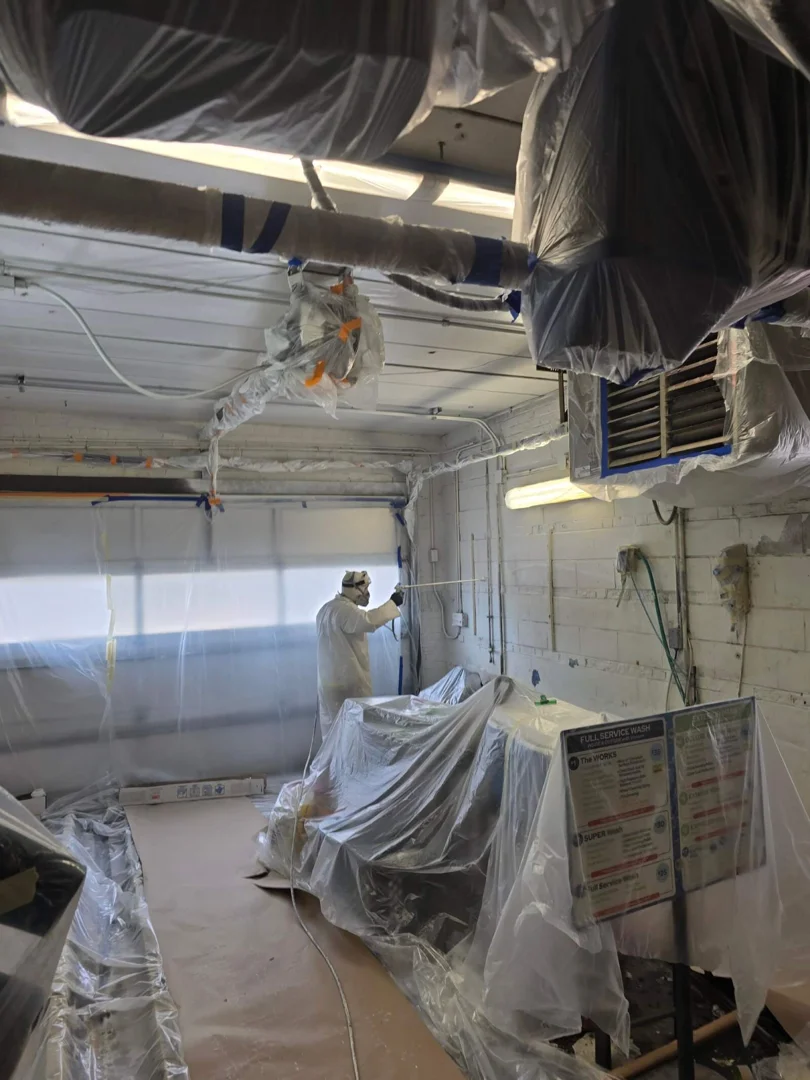
Why High Quality Industrial Metal Spray in Addison Is More Important Than Ever
Businesses in Addison, IL looking for reliable metal coating protection have more options than ever — but not all coatings are created equal.
Here are the top things to know quickly:
- What it is: Industrial metal spray applies protective metallic or ceramic layers to metal parts using thermal, cold spray, or powder coating processes
- Who needs it: Manufacturers in automotive, aerospace, heavy equipment, and construction industries across Chicagoland
- Key benefit: Dramatically stronger corrosion and wear protection compared to standard paint — some systems exceed 600 hours of salt spray resistance at coating thicknesses as thin as 8 µm
- What to look for: ISO 9001, Nadcap, RoHS, and REACH compliance from any provider you consider
Most industrial sites in Addison are built around structural steel and metal components that face constant exposure to moisture, chemicals, and mechanical wear. Without the right protective coating, premature failure is not a question of if — it’s when.
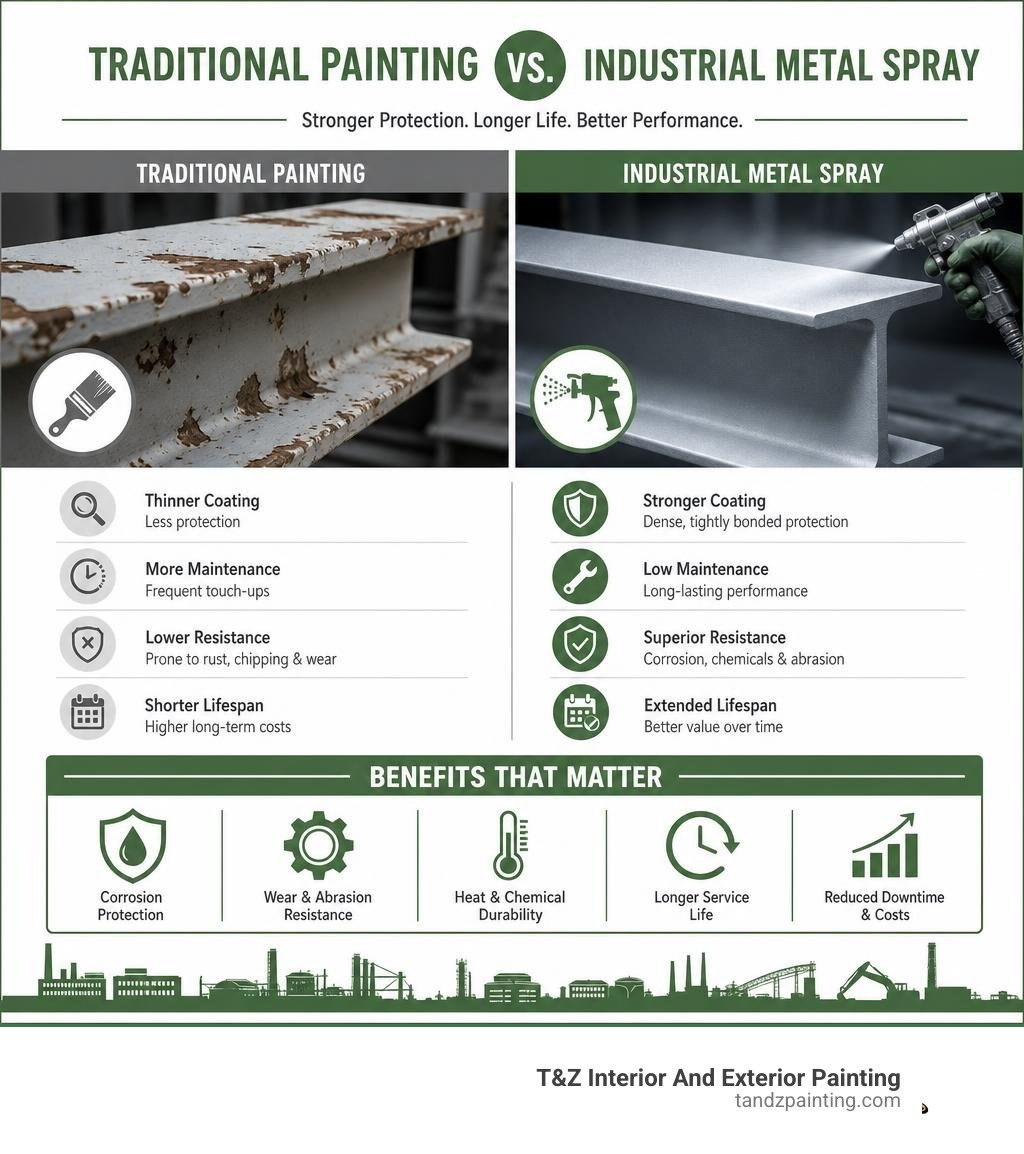
That’s where professional-grade industrial metal spray makes a real difference. It goes far beyond what a standard coat of paint can do, forming dense, tightly bonded layers that protect parts through demanding real-world conditions.
I’m Tomasz Niemotko, owner of T&Z Interior And Exterior Painting, and with over 15 years of experience delivering professional spray painting and specialty coating services across Addison and surrounding Chicagoland communities, I’ve seen what separates truly high quality industrial metal spray in Addison from a rushed, low-grade finish. In this guide, I’ll walk you through everything you need to know to find the right industrial metal spray solution for your project.
High quality industrial metal spray Addison terms to remember:
What is High Quality Industrial Metal Spray Addison Manufacturers Rely On?
When we talk about high quality industrial metal spray in Addison, we are looking at a suite of advanced surface engineering techniques designed to deposit metallic, alloy, or ceramic materials onto a substrate. Unlike standard commercial painting, these industrial spray methods are built to withstand extreme mechanical stress, harsh chemical environments, and high temperatures.
For local manufacturers in the Addison area, this technology is a game-changer. It serves three primary functions:
- Corrosion Protection: Providing an impenetrable barrier against moisture, wind-driven rain, and industrial chemicals.
- Wear Resistance: Shielding moving parts from friction, galling, and abrasive forces.
- Part Restoration: Rebuilding worn-out or mis-machined components back to their original dimensions, saving the cost of purchasing entirely new machinery.
Whether you are looking to protect heavy machinery, structural steel, or delicate automotive valves, understanding the underlying technology is the first step. To understand why these systems are so vital for long-term durability, you can explore our guide on Why Your Business Needs High Performance Metal Spraying.
How Metal Spraying Differs from Traditional Painting and Plating
At the shop, we often get asked: “Can’t I just use a high-durability liquid paint or send this out for standard electroplating?” While wet paint and plating have their places, they cannot match the performance profiles of specialized metal spraying for heavy-duty industrial applications.
The key differences lie in the bonding mechanism, coating thickness, and overall durability:
- The Bond: Traditional liquid paints rely on a chemical or mechanical bond with the surface profile of the substrate. Plating relies on an electrochemical reaction. Industrial metal spraying—particularly thermal spray processes—creates a highly tenacious mechanical and, in some high-pressure cold spray setups, a pseudo-metallurgical bond. The particles impact the surface at supersonic speeds, flattening out to create “splats” that interlock intimately with the substrate.
- Coating Thickness: While standard paint coatings are measured in mils (thousandths of an inch), industrial metal sprays can achieve much thicker profiles without sagging or running. Conversely, advanced dip-spin systems can apply incredibly thin, uniform coatings—as low as 8 µm—while still delivering superior corrosion resistance.
- Durability and Hardness: Metal spray coatings can incorporate incredibly hard materials like tungsten carbide or chrome oxide. Standard industrial paints simply cannot offer this level of wear resistance.
To dive deeper into how these liquid and thermal variations stack up, check out our breakdown of Industrial Spray Painting Coating and Finishing Solutions Explained.
Key Substrates and Materials for High Quality Industrial Metal Spray Addison Projects
One of the greatest strengths of industrial metal spraying is its versatility regarding substrates. Because the process can be carefully controlled to manage heat transfer, we can coat a vast array of materials without risking thermal distortion or changing the substrate’s metallurgical properties.
Commonly coated substrates in the Addison industrial corridor include:
- Structural Steel and Iron: The backbone of local manufacturing plants, warehouses, and material handling systems.
- Aluminum Alloys: Widely used in aerospace and automotive components where weight reduction is critical.
- Stainless Steel: Essential for food processing equipment, chemical storage, and marine hardware.
- Copper and Brass: High-conductivity components, such as custom bus bars and spot welding electrodes manufactured by local specialists like ZJ Industries, benefit from localized protective coatings to prevent oxidation without compromising conductivity.
Applying these coatings successfully requires a deep understanding of metal behavior and surface chemistry. If you are preparing metal surfaces for a professional finish, our practical guide on How to Spray Paint Metal with These 7 Quick Changes outlines the critical steps to ensure your coating adheres perfectly.
Core Metal Spray Technologies and Industrial Applications
Industrial metal spraying is not a single process; it is a family of distinct technologies, each suited to specific performance needs and production volumes. In the Addison area, local facilities utilize a mix of thermal spray, cold spray, powder coating, and specialized dip-spin systems to meet diverse engineering specifications.
To get an idea of how these technologies compare, let’s look at their primary characteristics:
| Process | Typical Thickness | Key Advantage | Best Application |
|---|---|---|---|
| High-Velocity Oxygen Fuel (HVOF) | 0.1 to 2.0 mm | Extremely dense, high bond strength, low oxide content | Wear plates, pump shafts, aerospace components |
| High-Pressure Cold Spray | 0.5 to 50+ mm | No thermal stress, oxidation-free, supersonic bonding | Rebuilding magnesium gears, aerospace structural repairs |
| Powder Coating | 2.0 to 6.0 mils | Uniform, aesthetic, excellent impact and chemical resistance | Enclosures, brackets, structural steel frames |
| Dip-Spin Coating | 8 to 15 µm | Chromium-free, no hydrogen embrittlement risk | High-volume fasteners, automotive clips, small parts |
For specialized applications where heat must be avoided entirely, high-pressure cold spray has emerged as a option. You can read more about how these non-thermal bonding layers function on the Protective Cold Spray Coatings | Cold Spray Protection resource page.
Thermal Spray and High-Pressure Cold Spray Processes
Thermal spray processes, such as HVOF and plasma spray, use a heat source (combustion or electric arc) to melt or soften the coating material before propelling it onto the part. While highly effective, the introduction of heat can sometimes cause slight oxidation or thermal stress in sensitive substrates.
This is where high-pressure cold spray shines. Instead of melting the metal powder, cold spray systems use pressurized nitrogen or helium gas jets to accelerate solid particles to supersonic velocities—up to Mach 3 (900 m/s). Upon impact, the kinetic energy causes severe plastic deformation of the particles, creating a dense, cold-welded, oxidation-free layer with exceptional bond strength. This is ideal for critical components in the aerospace and medical device sectors where material purity is non-negotiable.
Powder Coating and Dip Spin Systems for High-Volume Parts
For high-volume production runs of smaller parts, such as automotive fasteners, brackets, and brackets, thermal spray can be less efficient. Instead, local Addison manufacturers rely on electrostatic powder coating and dip-spin systems.
- Electrostatic Powder Coating: Powdered resins are electrostatically charged and sprayed onto grounded metal parts. The parts are then cured in an oven, creating a continuous, durable, and highly impact-resistant plastic-like shell.
- Dip-Spin Coating: Bulk quantities of small parts are placed into a mesh basket, submerged in liquid coating material, and then spun rapidly. The centrifugal force removes excess coating, ensuring a highly uniform thickness (often around 8 µm) without clogging threads or recesses. This process completely eliminates the risk of hydrogen embrittlement, which is a common failure mode in traditional electroplated high-strength fasteners.
If you are trying to source local industrial coating facilities with these high-volume capabilities, you can search verified providers via the Metal Spray Coating Suppliers & Manufacturers Serving Illinois directory.
Surface Preparation and Quality Control Standards

No matter how advanced the spray technology is, a metal coating is only as good as the surface preparation that precedes it. In fact, in the industrial coating world, we often say that 80% of coating failures are directly caused by poor surface prep.
To achieve a high-quality finish that stands the test of time, the substrate must undergo a rigorous, multi-step preparation process:
- Degreasing and Solvent Cleaning: Removing all traces of cutting oils, grease, and processing lubricants.
- Grit Blasting (White Metal Blast Cleaning): Utilizing aluminum oxide, steel grit, or glass bead media to strip away rust, mill scale, and old coatings. This step is crucial because it creates a controlled “anchor profile” (roughness) that allows the sprayed metal particles to lock mechanically onto the substrate.
- Masking: Applying specialized high-temperature silicone or metal tapes to protect high-tolerance areas, threads, and internal geometries from being coated.
- Pre-heating (for Thermal Spray): Removing any residual moisture from the metal pores to prevent adhesion failure.
Understanding these steps is vital when evaluating local service providers. For a comprehensive look at what to expect during this phase, check out Your Guide to Metal Spray Painting: Finding Quality Services in Your Area.
Achieving Tight Tolerances for High Quality Industrial Metal Spray Addison Components
In precision manufacturing, “close enough” is never good enough. When applying coatings to turbine components, pump shafts, or hydraulic cylinders, providers must control coating thickness within incredibly tight tolerances—often down to a fraction of a mil.
Achieving this level of precision requires:
- Automated Spray Systems: Utilizing multi-axis robotic arms to ensure uniform gun distance, angle, and travel speed across complex geometries.
- In-Process Metrology: Using electromagnetic or ultrasonic thickness gauges to monitor the build-up of the coating in real-time.
- Post-Coating Finishing: Because thermal sprays often leave a slightly textured surface, coated parts are frequently sent to precision grinding or machining bays to be polished down to their exact final dimensions.
When choosing a local partner, always verify that they adhere to recognized international testing standards, such as ASTM specifications for bond strength and coating density, and maintain a robust quality management system.
Environmental and Regulatory Compliance
Modern industrial manufacturing in Illinois requires strict adherence to environmental and safety standards. High-quality metal spray providers must design their operations to protect both their workers and the local Chicagoland environment.
Key regulatory frameworks include:
- RoHS (Restriction of Hazardous Substances): Ensuring that coatings are entirely free from harmful heavy metals like lead, mercury, and hexavalent chromium.
- REACH Compliance: Monitoring and controlling the chemical substances used in the formulation of coatings.
- VOC (Volatile Organic Compound) Elimination: Transitioning to high-solids paints, powder coatings, and closed-loop aqueous cleaning systems that eliminate harmful solvent emissions into the atmosphere.
At T&Z Painting, we highly value these green initiatives. We make sure our commercial and specialty coating projects utilize low-VOC, environmentally responsible materials to keep our local communities safe and healthy.
Frequently Asked Questions about Industrial Metal Spraying
What industries in the Chicagoland area benefit most from metal spray coatings?
The Chicagoland area—and Addison in particular—is a major Midwestern hub for manufacturing, logistics, and heavy industry. The sectors that rely most heavily on industrial metal sprays include:
- Aerospace: Coating landing gear, turbine blades, and structural components to handle extreme thermal and mechanical stress.
- Automotive: Applying wear-resistant coatings to engine parts, fasteners, and exhaust systems.
- Heavy Equipment and Agriculture: Protecting structural frames, boom arms, and wear plates from abrasive soil and harsh weather.
- Structural Steel and Infrastructure: Coating massive steel beams, outdoor tanks, and piping systems to prevent rust.
For a deeper look at how professional coating applications give commercial operations a competitive edge, read our article on Commercial Spray Painting Services: The Professional’s Edge.
How long do industrial metal spray coatings typically last?
The lifespan of an industrial metal spray coating depends heavily on the environmental exposure, the specific coating material used, and the quality of the initial surface preparation.
For example, high-performance zinc-rich coatings or dip-spin systems can easily exceed 600 hours of continuous salt spray exposure in laboratory testing, translating to decades of real-world protection in outdoor structural steel applications. When applied correctly to internal machinery components, wear-resistant coatings like tungsten carbide can extend the operational life of a part by 3 to 10 times compared to uncoated steel.
To learn more about selecting the most durable coatings for local environmental challenges, check out our guide on Don’t Let It Rust: Top Durable Spray Paints for Lombard Metalwork.
Can metal spray coatings be used to restore worn or damaged parts?
Yes, this is one of the most cost-effective maintenance applications of industrial metal spray technology. When a critical shaft, bearing journal, or housing becomes worn down due to friction, it can cause severe operational downtime.
Instead of waiting weeks for an expensive replacement part, a local metal spray provider can apply a dense thermal or cold spray coating to the worn area. By spraying an excess of material and then machining or grinding it back down to the original OEM specifications, the part is restored to “better-than-new” condition, often with superior wear resistance than the original substrate.
Conclusion
Finding the right solution for high quality industrial metal spray in Addison is about matching your specific performance requirements with certified, experienced professionals. Whether your project demands the extreme wear resistance of an HVOF thermal spray, the thermal-free bonding of high-pressure cold spray, or the high-volume efficiency of dip-spin systems, the local Addison industrial corridor is uniquely equipped to deliver.
At T&Z Interior And Exterior Painting, we specialize in high-end architectural, commercial, and specialty coatings. While we do not operate heavy robotic thermal spray bays, we understand the critical role that proper surface prep, high-performance coatings, and meticulous attention to detail play in protecting your investments. We are proud to serve the Addison community and the wider Chicagoland area with professional craftsmanship that stands up to the elements.
If you have a commercial facility, structural steel project, or specialty coating need that requires the touch of a seasoned, licensed, and insured painting crew, we are here to help. Explore our T&Z Spray Painting Services page today to see how we can bring professional durability and stunning results to your next project!