
Why Choosing the Best Paint Combination for Your House Is Harder Than It Looks
Finding the best paint combination for house interiors is one of the most impactful decisions you can make as a homeowner — and one of the easiest to get wrong.
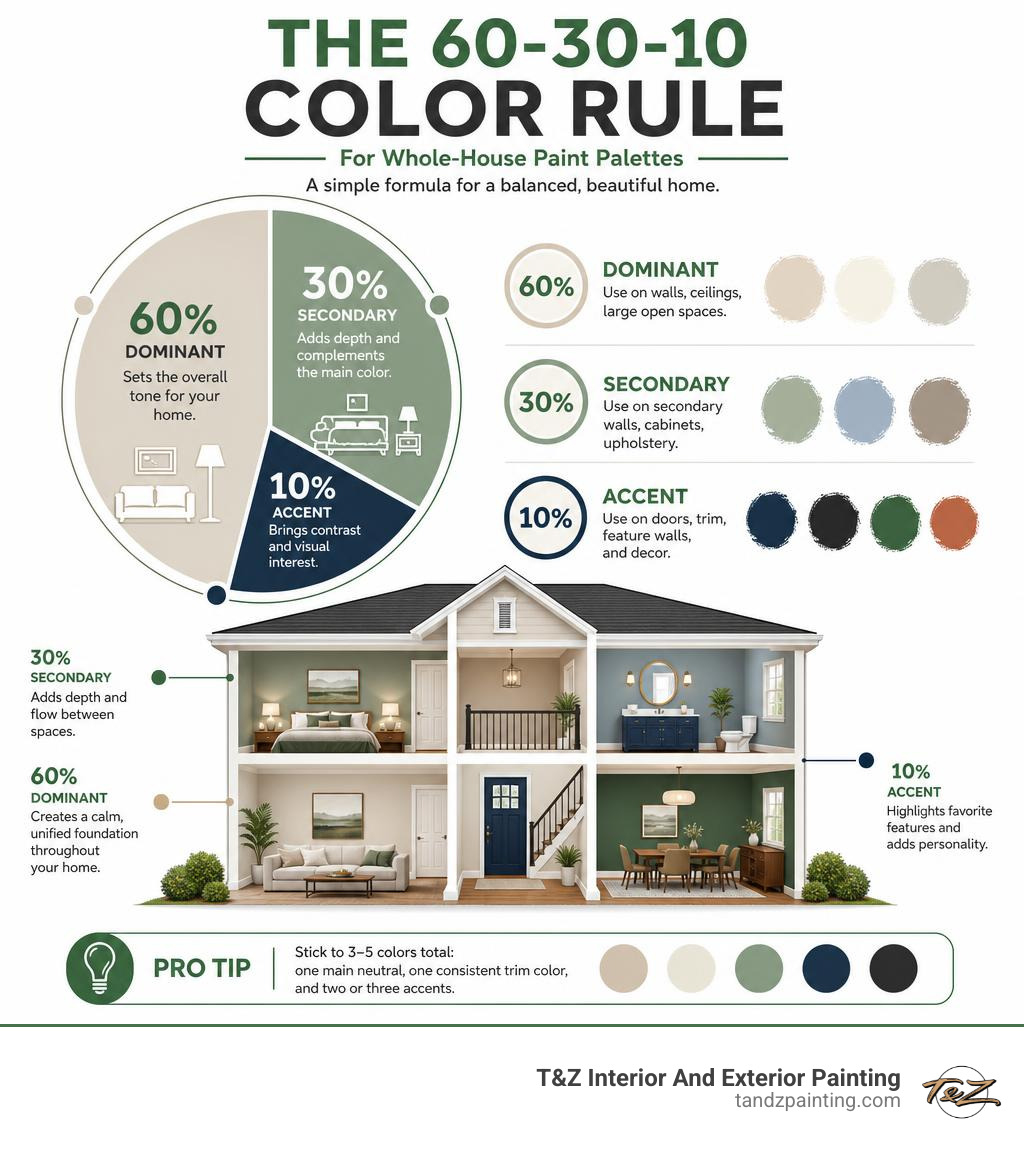
Here are the most trusted whole-house paint combinations to get you started:
| Color Role | Example Colors | Where to Use |
|---|---|---|
| Dominant (60%) | Warm greige, soft white, cool gray | Living areas, hallways, open spaces |
| Secondary (30%) | Sage green, dusty blue, taupe | Bedrooms, bathrooms, dining rooms |
| Accent (10%) | Navy, black, deep green, terracotta | Doors, trim, feature walls, decor |
Top timeless exterior and interior pairings:
- Snowbound + Iron Ore (crisp contrast, modern farmhouse)
- White Dove + Wrought Iron (classic, elegant)
- Warm greige + soft sage + crisp white trim (cohesive, versatile)
- Accessible Beige + Tricorn Black (balanced, bold)
Most homes look their best with 3 to 5 colors total — one main neutral, one consistent trim color, and two or three accents.
Walk into a beautifully designed home and everything just feels right. The rooms connect. The colors breathe. Nothing clashes.
That’s not luck. It’s the result of a deliberate, well-planned color palette — one that treats the entire home as a single connected story rather than a collection of separate rooms.
The challenge is that most homeowners choose paint colors room by room, often under store lighting, without testing how shades interact with natural light, flooring, or the colors in adjacent spaces. The result? Rooms that feel disjointed, undertones that clash, and colors that looked perfect on a swatch but strange on a wall.
The good news is that there’s a clear, repeatable process for getting it right — and it doesn’t require a design degree.
I’m Tomasz Niemotko, owner of T&Z Interior and Exterior Painting, with over 15 years of hands-on experience helping homeowners across Lombard, IL and surrounding communities find the best paint combination for house interiors that look polished, feel cohesive, and stand the test of time. In the guide below, I’ll walk you through exactly how our team approaches whole-house color planning — from choosing your foundation neutral to coordinating accents across every room.
The Science of Color Flow: Creating a Whole-House Palette
Creating a cohesive color flow throughout your home is about building a dialogue between spaces. It is highly tempting to treat each room as an independent canvas, but doing so can make your home feel like a disjointed bag of Skittles. Instead, we want to establish a unified color story where transitions feel natural and intentional.
To achieve this, you need to understand three core concepts: undertones, light reflectance value (LRV), and fixed elements.
The Mystery of Undertones
Undertones are the hidden colors beneath the surface of your paint. A gray is rarely just gray; it might have a blue, green, purple, or beige undertone. If you paint your living room in a cool gray with blue undertones and your adjacent hallway in a warm greige with yellow undertones, the transition will feel jarring.
For ultimate cohesion, ensure all the colors in your core palette share a similar temperature profile. You can read more about how to make these foundational colors work in our guide to neutral house paint ideas.
Understanding Light Reflectance Value (LRV)
LRV is a scale from 0 (absolute black, absorbing all light) to 100 (pure white, reflecting all light). This value tells you how bright a paint color will feel on your walls.
For instance, a soft designer white like Benjamin Moore’s Simply White has an LRV of 91.7, making it incredibly bright and reflective. Conversely, a dramatic charcoal like Sherwin-Williams Iron Ore has an LRV of 6, absorbing light to create cozy, intimate spaces. Balancing LRV throughout your home prevents open areas from feeling washed out and smaller rooms from feeling like dark caves.
Working with Fixed Elements
Your paint does not live in a vacuum. It must coordinate with the elements of your home that are expensive or impossible to change, such as:
- Flooring: Warm red oak floors clash with cool, blue-toned grays but look stunning next to creamy whites or earthy greens.
- Cabinetry & Countertops: Your kitchen finishes should dictate your wall color, not the other way around.
- Masonry: A brick fireplace or stone accent wall carries heavy warm or cool undertones that your paint must complement.
By auditing these permanent features first, you can build a palette that highlights your home’s natural beauty rather than fighting it. For a deeper dive into organizing these elements, check out this practical whole-house color harmony guide and read our advice on choosing a whole house palette.
How to Use the 60-30-10 Rule for the Best Paint Combination for House
In interior design, visual balance is achieved by distributing color in a structured ratio: 60% dominant color, 30% secondary color, and 10% accent color. This classic rule ensures your eyes have a place to rest while still enjoying pops of visual interest.
+-------------------------------------------------------+
| |
| DOMINANT COLOR (60%) |
| Walls, Open Concept Areas, Hallways |
| |
+------------------------------------+------------------+
| | |
| SECONDARY COLOR (30%) |   ACCENT (10%)   |
|   Bedrooms, Accent Walls, Cabinets | Doors, Decor, |
| | Focal Features   |
+------------------------------------+------------------+
When building this palette, many homeowners are also prioritizing their family’s health and environmental impact. If you are planning a refresh, we highly recommend looking into modern, eco-friendly formulations outlined in our guide to sustainable interior paints.
To see how these ratios translate into actual designer-approved paint options, you can browse through these designer-approved whole house paint colors for inspiration.
Selecting a Dominant Neutral for Your Best Paint Combination for House
The dominant color (60%) serves as the background of your home. It goes on your open-concept living areas, main hallways, entryways, and family rooms. Because it covers the most square footage, this color must be incredibly versatile.
- Warm Greiges: Colors like Benjamin Moore’s Revere Pewter or Sherwin-Williams’ Universal Khaki are the chameleons of the paint world. They bridge the gap between warm beige and cool gray, adapting beautifully to both modern and traditional architectures.
- Soft Off-Whites: Shades like Alabaster or Swiss Coffee reflect sunlight gently without the harsh, sterile glare of a true hospital white.
- Cool Grays: While cool grays have stepped back from their peak popularity, shades like Passive or Gray Owl still work beautifully in homes with abundant natural light and cool-toned stone finishes.
Choosing the right base color sets the tone for your entire living space. If you are looking to revitalize your main gathering areas, explore our curated list of living room painting ideas.
Coordinating Accent Colors in Your Best Paint Combination for House
The secondary (30%) and accent (10%) colors are where your home’s personality shines. While your dominant neutral keeps the house connected, these supporting shades add depth and character to individual rooms.
- Secondary Colors (30%): These are perfect for enclosed spaces like dining rooms, home offices, and bedrooms. Muted greens (like Sherwin-Williams’ Halcyon Green) or serene blues (like Benjamin Moore’s Boothbay Gray) provide a distinct mood while staying within the same undertone family as your main neutral.
- Accent Colors (10%): These high-contrast shades should be used intentionally on front doors, interior doors, powder room walls, or built-in bookshelves. Deep, dramatic hues like Tricorn Black, Hale Navy, or Urbane Bronze add instant architectural structure and grounding.
For bedrooms, these secondary and accent tones are crucial for setting a relaxing mood. You can learn how to balance these hues in our step-by-step guide on planning a master bedroom painting project.
Room-by-Room Color Coordination and Ceiling Transitions
One of the most overlooked areas of interior color planning is the ceiling. The old default was to paint every ceiling flat white and call it a day. While this works in many homes, modern design offers far more sophisticated ways to handle the transition between your walls and ceilings.
Depending on your room’s size, ceiling height, and natural light, you might choose to paint your ceiling the exact same color as your walls, or opt for a stark contrast.
 MONOCHROMATIC CEILING HIGH-CONTRAST CEILING
 +-----------------------+ +-----------------------+
 |   Same Wall Color | |   Crisp White/Accent  |
 | | | |
+----+ +----+   +----+ +----+
| |   | |
| |   | |
| WALL COLOR |   | WALL COLOR |
| |   | |
| |   | |
+---------------------------------+   +---------------------------------+
To help you decide which approach is right for your space, we have broken down the pros and cons of both styles:
| Design Approach | Best For | Visual Impact | Key Considerations |
|---|---|---|---|
| Monochromatic (Ceiling & Walls Same Color) | Small rooms, bedrooms, rooms with angled/vaulted ceilings | Creates a seamless, cozy, envelope-like feel; makes spaces look larger | Requires a soft neutral or muted tone; dark colors can feel very heavy |
| High-Contrast (White Ceiling, Colored Walls) | Rooms with heavy trim, traditional architecture, low ceilings | Highlights crown molding; provides a traditional, clean boundary | Can feel abrupt if the wall color is highly saturated or extremely dark |
If you are intrigued by the seamless look, we have compiled comprehensive resources to guide you. Check out our ultimate guide to painting your ceiling and walls the same color, weigh the benefits with the pros and cons of matching ceilings and walls, or read our detailed guide to painting ceiling same color as walls for professional application tips.
Common Mistakes to Avoid When Choosing Interior Paint Colors

Over our 15+ years of painting homes in Lombard, Elmhurst, Downers Grove, and surrounding areas, we have seen homeowners make the same few mistakes when picking colors. Fortunately, they are entirely avoidable if you know what to watch out for.
- Choosing Colors Under Store Lighting: The fluorescent lights at your local home improvement store are incredibly cool and blue. A paint color that looks like a beautiful, warm sand in the store can easily turn into a muddy peach or neon yellow once exposed to the natural light of your living room.
- Ignoring the Trim and Doors: Your trim is the frame of your color story. If you have warm, cream-colored trim and you paint your walls a crisp, cool white, your trim will instantly look dirty and yellowed. Always select your trim color and wall color together.
- Overcomplicating the Palette: You do not need a different color for every room. Stick to the 3-to-5-color rule. Let your main neutral do the heavy lifting, and use decor, textiles, and minor accents to give individual rooms their unique flair.
- Skipping the Paint Samples: Never buy multiple gallons of paint based on a tiny 2-inch paper swatch. Buy a small sample can or use high-quality peel-and-stick samples. Place them on different walls in the room and watch how the color shifts from morning light to evening lamplight.
Frequently Asked Questions about Whole-House Paint Combinations
Should every room in my house be painted the same color?
No, but they should belong to the same color family. Using a single dominant neutral in your open-concept areas, hallways, and foyers creates a sense of spaciousness and flow. You can then transition to cohesive, coordinating secondary colors in enclosed rooms (like bedrooms, bathrooms, or a study) to give those spaces their own distinct personality.
How many paint colors should be in a whole-house palette?
A professional whole-house palette typically consists of three to five colors. This includes one dominant neutral for main spaces, one consistent trim/ceiling color, and two to three secondary or accent colors to distribute throughout the home. Keeping your palette limited ensures your home feels intentional, calm, and beautifully designed.
How do I test paint colors in different lighting conditions?
Apply your paint samples to large white foam boards or use peel-and-stick swatches rather than painting directly onto your existing colored walls (which can distort the new color). Move the boards around the room throughout the day. Observe how they look in the bright, direct light of the morning, the softer afternoon sun, and under your warm light bulbs at night.
Elevate Your Home with T&Z Interior And Exterior Painting

Selecting the best paint combination for house interiors is only the first step. The true magic happens in the execution. Even the most carefully curated designer palette can fall flat without pristine prep work, sharp trim lines, and a flawless, uniform finish.
At T&Z Interior And Exterior Painting, we have spent over 15 years turning design visions into breathtaking realities for homeowners throughout Lombard, IL, and neighboring communities like Wheaton, Downers Grove, Carol Stream, La Grange, and Elmhurst. Our professional, licensed, and insured team is dedicated to providing clean, meticulous craftsmanship and unmatched customer service — a commitment reflected in our 5.0 Google Reviews rating.
Whether you are looking to paint your entire home, refresh your kitchen cabinets, or update your exterior trim, we bring the expertise and high-quality materials needed to protect and beautify your property.
Ready to transform your home’s interior with a stunning, harmonious color palette? Explore our professional interior painting services and let our experienced team bring your dream color combination to life.