
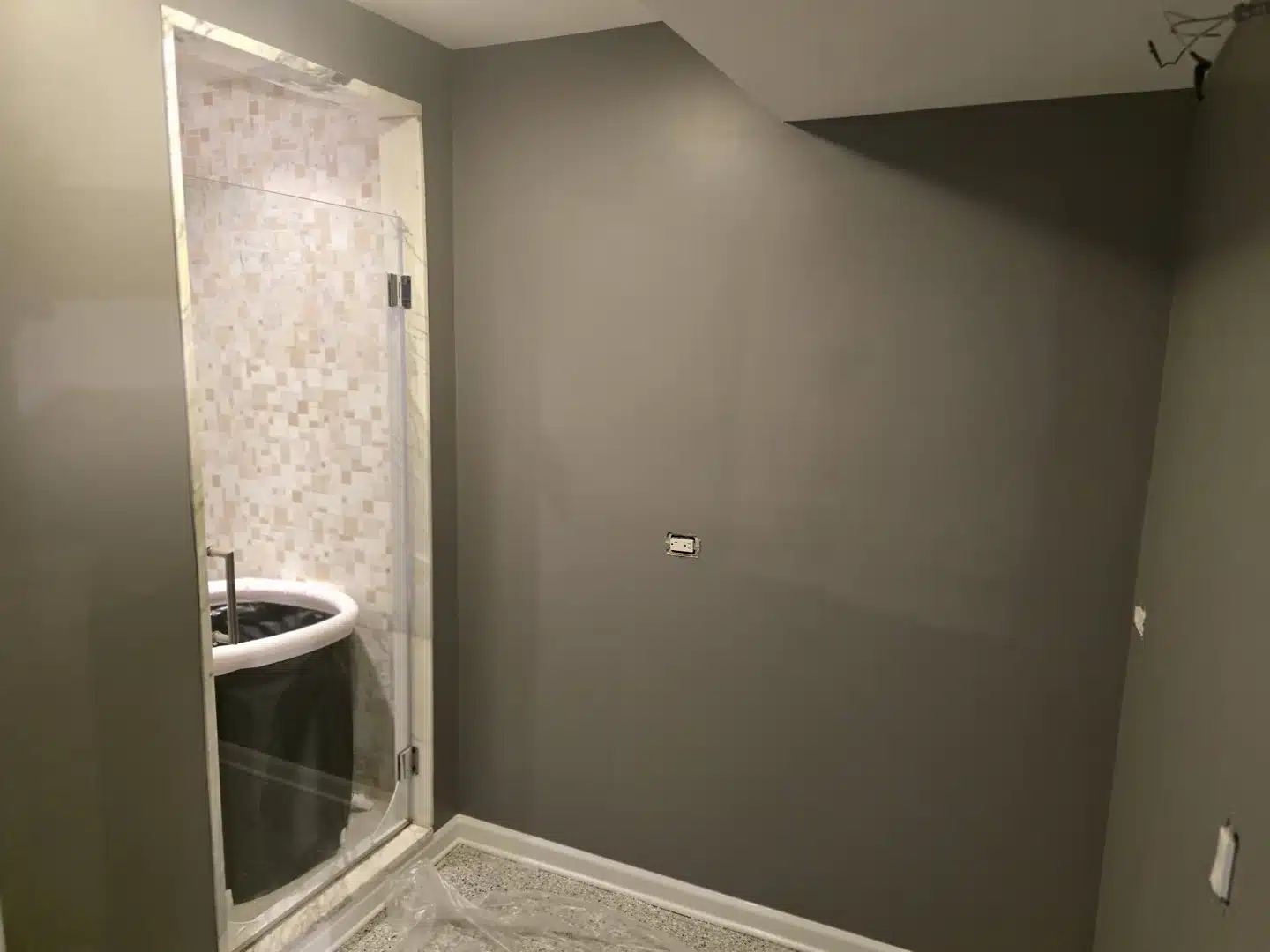
Best Paint Finish for Bathroom Walls Without the Glare
For most bathrooms with a shower, the best paint finish for bathroom walls is satin. It stands up to moisture and regular cleaning without the stronger glare of semi-gloss. Choose semi-gloss if the walls need frequent wiping, or a bathroom-rated matte paint if you want very little shine. Eggshell is better suited to a powder room without a shower.
Ventilation matters, too. Even a durable finish can struggle if steam stays trapped after every shower.
I’m Tomasz Niemotko, owner and founder of T&Z Interior And Exterior Painting, a licensed and insured painting contractor founded in 2009 and based at 1101 S Columbine Ave, Lombard, IL 60148. With over 15 years of interior painting experience, I help Lombard homeowners choose the best paint finish for bathroom walls based on moisture, cleaning needs, and glare.
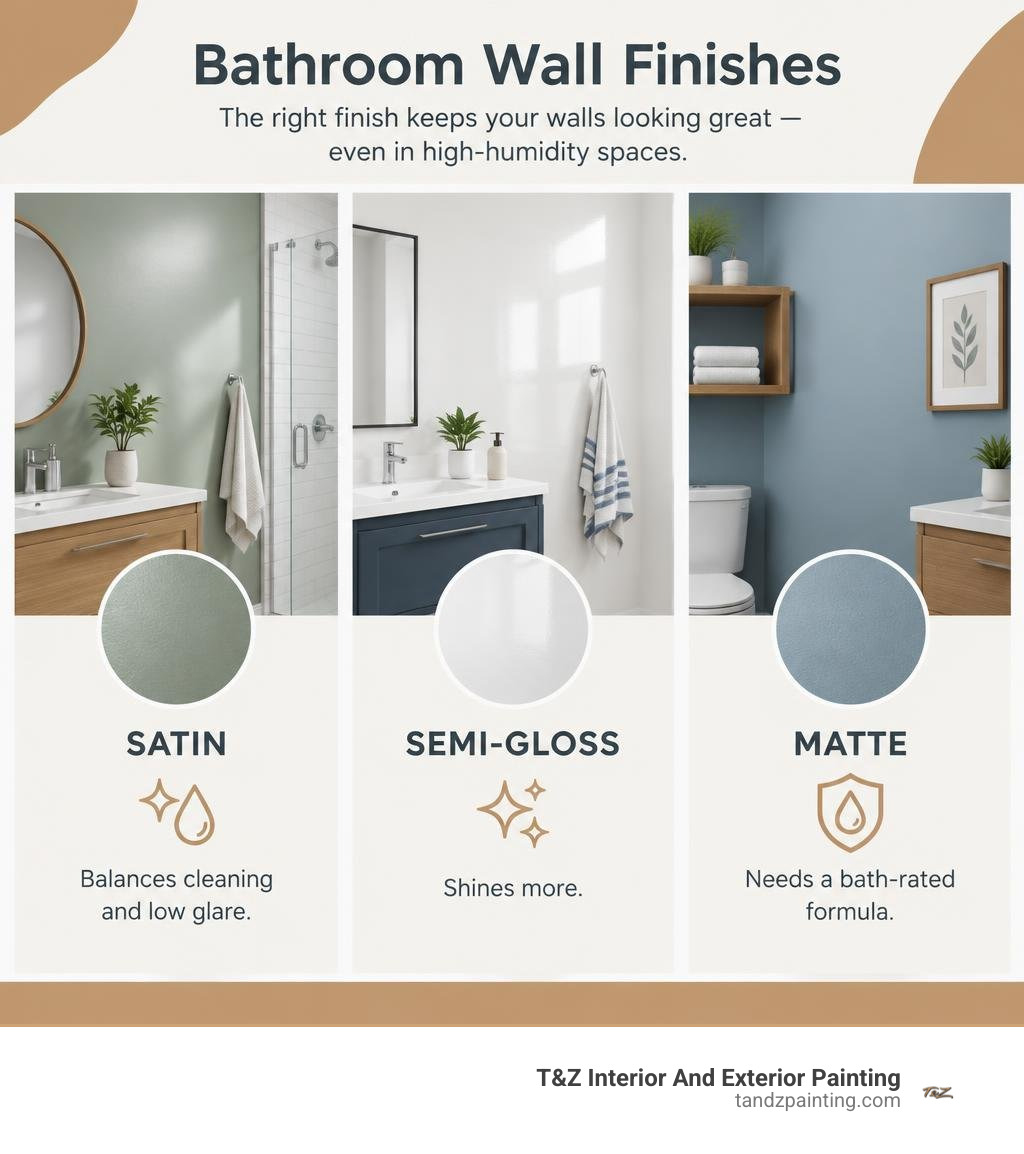
Best paint finish for bathroom walls vocab explained:
Understanding Sheens: How Paint Finish Affects Bathroom Moisture and Glare
Bathrooms are among the most demanding environments in any home. Daily exposure to hot water creates clouds of steam, raising ambient humidity and depositing condensation directly onto wall surfaces. Choosing the right paint sheen is not just an aesthetic design decision; it directly dictates how well your walls resist moisture penetration, fungal growth, and daily wear.
When you look at paint, the sheen level corresponds to its resin-to-pigment ratio. Paints with higher gloss levels contain a denser concentration of resin binders. When the paint cures, these binders lock together to form a hard, non-porous film. Water droplets sit on top of this tight surface instead of soaking into the drywall beneath. Because the surface is smooth and non-porous, light bounces straight off it, creating shine. Conversely, paints with lower sheens contain more pigment particles and fewer binders. This leaves microscopic irregularities on the dried surface that scatter light in multiple directions, eliminating glare while creating tiny pores where steam and moisture can settle.
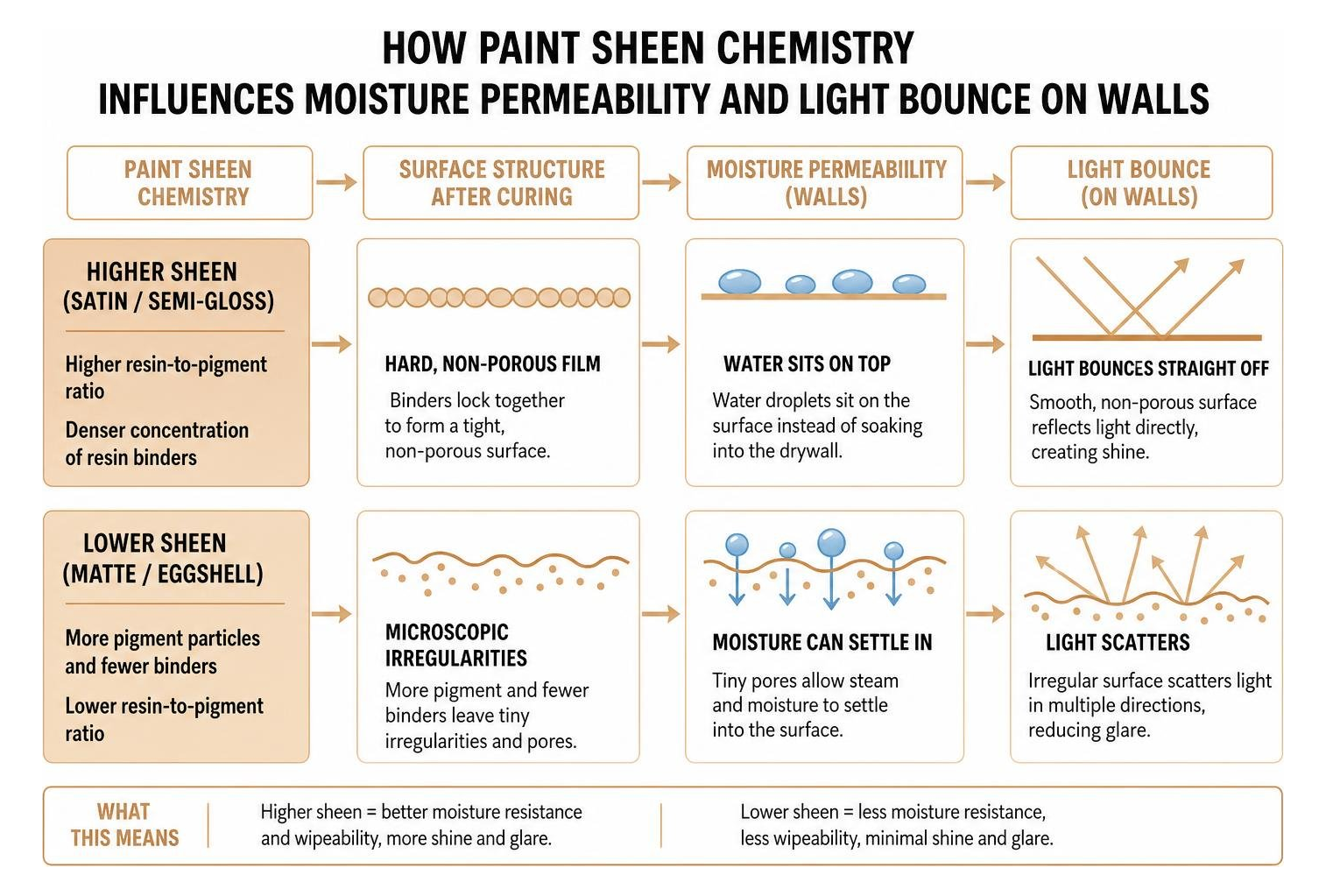
When selecting the best paint finish for bathroom walls, homeowners must balance two competing factors:
- Moisture Permeability and Wipeability: Glossier surfaces shed water and endure frequent scrubbing with household cleaners without burnishing (turning shiny in rubbed spots) or peeling.
- Light Reflection and Imperfection Visibility: High-sheen paints act like mirrors under bright vanity lights. Any slight drywall patch, seam, or ding will cast a distinct shadow and stand out noticeably.
Modern washable formulations with the right sheen balance provide long-term stain and humidity resistance. Finding the sweet spot means getting maximum moisture defense while maintaining a soft, comfortable visual look.
Comparing Sheens to Find the Best Paint Finish for Bathroom Walls
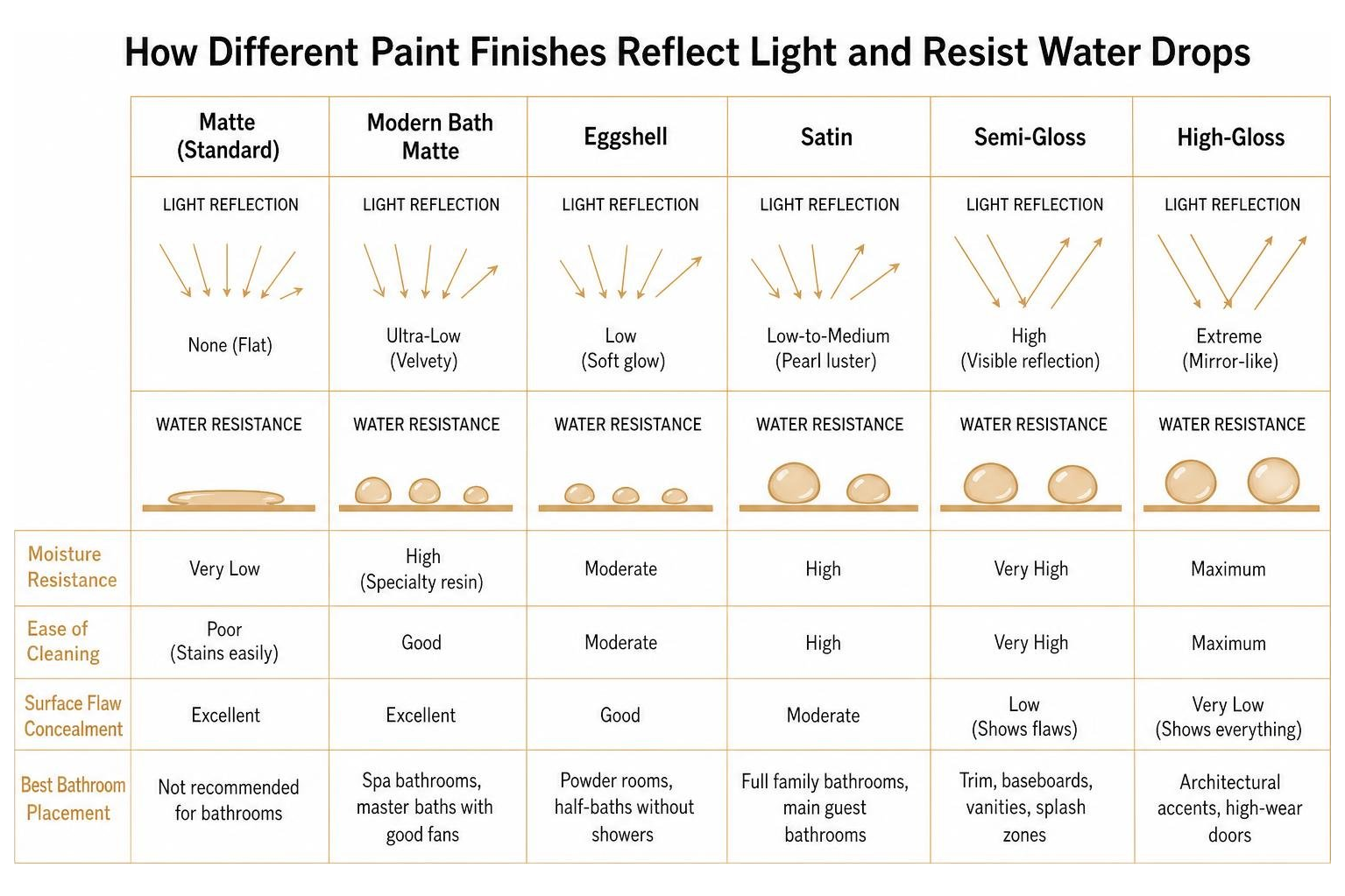
Every sheen category offers distinct performance characteristics. Understanding these trade-offs helps you pinpoint the right option based on your bathroom layout, lighting configuration, and traffic volume.
| Paint Finish | Moisture Resistance | Glare & Light Bounce | Ease of Cleaning | Surface Flaw Concealment | Best Bathroom Placement |
|---|---|---|---|---|---|
| Matte (Standard) | Very Low | None (Flat) | Poor (Stains easily) | Excellent | Not recommended for bathrooms |
| Modern Bath Matte | High (Specialty resin) | Ultra-Low (Velvety) | Good | Excellent | Spa bathrooms, master baths with good fans |
| Eggshell | Moderate | Low (Soft glow) | Moderate | Good | Powder rooms, half-baths without showers |
| Satin | High | Low-to-Medium (Pearl luster) | High | Moderate | Full family bathrooms, main guest bathrooms |
| Semi-Gloss | Very High | High (Visible reflection) | Very High | Low (Shows flaws) | Trim, baseboards, vanities, splash zones |
| High-Gloss | Maximum | Extreme (Mirror-like) | Maximum | Very Low (Shows everything) | Architectural accents, high-wear doors |
When choosing the right sheen, evaluate who uses the space and how much steam is generated daily.
Satin: The Best Paint Finish for Bathroom Walls Balancing Durability and Low Sheen
For standard residential bathrooms, satin is widely regarded by painting professionals as the top all-around choice. Satin delivers a pearl-like luster that elevates wall color without creating harsh, distracting hot spots under overhead lighting.
Satin paints contain enough resin to resist moisture penetration from daily hot showers. Water beads up on the surface, allowing you to wipe away soap residue, water marks, or makeup splashes using a damp cloth without lifting the paint film. Because it diffuses ambient light smoothly, satin hides minor wall imperfections far better than semi-gloss while offering superior scrub resistance compared to traditional flat or eggshell paints.
Semi-Gloss: High Moisture Defense with Higher Reflectivity
Semi-gloss has historically served as the traditional standard for moisture-heavy rooms. Its tight molecular surface makes it practically water-repellent, allowing water to roll straight down into drains without penetrating the wall board.
However, semi-gloss reflects substantial light. In a small bathroom equipped with bright vanity bulbs, semi-gloss walls can feel glaring, cold, and overly reflective. Furthermore, every joint compound seam or textured roller stipple becomes highlighted. For this reason, we often recommend reserving semi-gloss for wood trim, window sills, door frames, and bathroom vanities, where high-contact touchpoints demand superior washability.
Eggshell and Modern Matte: Can Low Sheen Work in Bathrooms?
Standard eggshell paint offers a soft, low-sheen look that many homeowners love in bedrooms and living rooms. In half-baths or powder rooms where no shower or bathtub exists, standard eggshell performs reliably. However, in a full bathroom, standard eggshell is micro-porous; recurring steam can soften the binder over time, resulting in surfactant leaching (sticky brown or glossy streaks) and mildew growth.
If you love a zero-glare, velvety aesthetic in a full bathroom, standard flat or eggshell paints should be avoided in favor of modern, specialized kitchen-and-bath matte formulas.
Moisture, Ventilation, and Paint Chemistry: Choosing Beyond the Sheen
The physical sheen is only half of the equation; paint chemistry plays an equally critical role in how well your walls perform over time.
Standard interior paints use vinyl-acrylic binders that can break down under frequent temperature swings and condensation. Premium bathroom paints rely on 100% acrylic latex resins. Acrylic polymers dry into a tight, flexible matrix that moves with humidity changes without cracking, bubbling, or losing adhesion.
In addition to resin density, bathroom-grade coatings contain specialized antimicrobial additives and mildewcides. These chemical agents prevent mold spores from feeding on the paint film or organic matter on the wall. For homeowners sensitive to fumes, many leading manufacturers produce low-VOC or zero-VOC formulations that deliver high mildewcide protection without heavy off-gassing, keeping indoor air clean and healthy. You can learn more about these options in our guide to low-VOC wall finishes.
Ventilation works hand-in-hand with paint chemistry. An exhaust fan rated with sufficient cubic feet per minute (CFM) should run during every shower and remain on for 20 to 30 minutes afterward. If your bathroom lacks mechanical ventilation or has a weak fan, moisture sits on the wall for hours, eventually challenging even the strongest finishes.
Formulations That Make Matte the Best Paint Finish for Bathroom Walls in Spa Settings
In recent years, paint manufacturers have engineered premium matte coatings tailored specifically for high-humidity environments. Products such as Benjamin Moore Aura Bath & Spa demonstrate how resin technology has evolved. By utilizing advanced waterborne acrylic resins and heavy mildewcide loads, these specialized matte finishes achieve the water repellency and scrub resistance of a satin paint while maintaining an ultra-flat, glare-free aesthetic.
If you are designing a master bathroom suite with bold, deep colors or moody tones, a dedicated bathroom matte paint eliminates reflective glare across large wall expanses, delivering a rich, saturated appearance that holds up against steam.
Wall Preparation and Priming for a Flawless, Long-Lasting Finish
Even the highest quality paint finish will fail prematurely if the drywall underneath is not prepared correctly. Bathrooms accumulate invisible layers of hairspray, soap scum, body oils, and talcum powder that prevent paint from adhering.
To ensure a smooth, durable finish, follow this step-by-step preparation process:
- Deep Surface Cleaning: Wash all walls with a solution of water and mild detergent or tri-sodium phosphate (TSP) substitute. If mildew spots are present, clean them with a diluted bleach solution (three parts water to one part household bleach) and allow the area to dry completely. Never paint directly over active mold or mildew.
- Surface Repair and Patching: Fill all nail holes, gouges, and loose joints with a moisture-resistant setting-type joint compound. Sand smooth once dry, feathering the edges flush with the surrounding wall.
- Dust Removal: Wipe down the entire room with a damp microfiber cloth or tack cloth to capture fine drywall dust.
- Moisture-Resistant Priming: Apply a dedicated stain-blocking, mold-killing primer. If you are painting over old glossy enamel, use a bonding primer to prevent peeling. Priming seals porous drywall patches, ensuring uniform sheen and color across the entire wall.
- Proper Application and Curing: Apply two full coats of your selected finish using a high-density, shed-resistant roller cover. Allow the primer and initial coat to dry according to manufacturer specifications. Most importantly, wait at least 24 to 48 hours before using the shower to give the paint film time to cure before facing heavy steam.
Frequently Asked Questions About Bathroom Paint Finishes
Can regular flat paint be used on bathroom ceilings or walls?
Standard flat paint should not be used on bathroom walls or shower ceilings. Regular flat paint is porous, meaning it readily absorbs airborne moisture, traps dirt, and provides a damp breeding ground for mildew. Scrubbing flat paint removes the coating or leaves burnished shiny spots. On bathroom ceilings, use either a dedicated moisture-resistant ceiling paint or a satin finish to block steam absorption. You can explore more on low-sheen dynamics in our breakdown of the pros and cons of matte paint.
Do I need a special primer before applying bathroom wall paint?
Yes, priming is critical in bathroom applications. A high-quality, mold- and mildew-resistant primer creates an impermeable barrier over bare drywall or repaired patches. It prevents moisture from reaching the paper backing of the drywall and guarantees that your topcoat adheres firmly. If you are repainting a wall that previously had mildew issues, a specialized mold-killing primer encapsulates and neutralizes lingering spores.
What is the most durable finish for a bathroom with poor ventilation?
In bathrooms without an exhaust fan or with limited airflow, condensation lingers on surfaces for extended periods. In these conditions, semi-gloss is the most durable choice because its non-porous surface prevents water from penetrating the film. If you prefer to minimize glare, use a premium 100% acrylic satin finish combined with an antimicrobial formulation like Zinsser Perma-White to provide lasting mildew resistance. For damp areas or below-grade powder rooms, reviewing strategies for waterproofing paint for interior walls can provide additional protection.
Conclusion
Finding the ideal paint finish for your bathroom comes down to balancing moisture resistance, cleanability, and comfortable lighting. While semi-gloss provides high water protection for trim and vanities, satin remains the premier choice for bathroom walls, giving you reliable durability and easy cleaning without harsh glare. If you prefer a modern, shine-free aesthetic, specialized kitchen-and-bath matte formulas offer high-tech moisture protection without the reflective sheen.
Achieving a clean, long-lasting bathroom paint job requires careful surface prep, proper primer selection, and precise application. If you are planning a bathroom refresh or a full home update, our local team is here to help.
T&Z Interior And Exterior Painting was founded in 2009 by owner Tomasz Niemotko. As a fully licensed and insured painting contractor based at 1101 S Columbine Ave, Lombard, IL 60148, we bring over 15 years of dedicated experience to every project. We are BBB accredited, maintain a 5.0 Google rating with 85+ reviews, and back all our work with a dependable 2-year warranty.
We proudly serve homeowners throughout Lombard, Glen Ellyn, Villa Park, Oak Brook, Oakbrook Terrace, Downers Grove, Wheaton, Elmhurst, Addison, Itasca, Roselle, Bloomingdale, Carol Stream, Wood Dale, Westmont, Bensenville, Berkeley, Hillside, Schiller Park, Glendale Heights, Schaumburg, and Chicago. Whether you need single-room updates or comprehensive interior painting services, we deliver beautiful, lasting results with top-tier materials and clean craftsmanship.
Ready to transform your bathroom? Request a free estimate on tandzpainting.com or call us directly at (224) 240-0054 today.