
Drywall Installation & Replacement in Lombard, IL
Every renovation, addition, and damage repair project in Lombard eventually reaches the same point — the walls need to be built or rebuilt before anything else can happen. Drywall Installation & Replacement in Lombard is where T&Z Interior and Exterior Painting starts when the scope requires it. We handle board hanging, taping, floating, finishing, and priming for additions, renovations, water-damaged sections, full room builds, and ceiling replacements — and then we paint. One contractor handles the complete sequence from bare framing to finished wall. Call us for a free on-site assessment. Installation scope and timeline are confirmed before scheduling so your renovation sequence is planned from the start. We’re a licensed Painter and drywall contractor with 15+ years of experience, and we deliver walls and ceilings finished to a paint-ready standard.

What Professional Drywall Installation and Replacement Involves in Lombard Homes
Phase 1 — Assessment and board selection:
Before any board is cut, the space is assessed. Wall and ceiling dimensions are measured. Framing spacing is confirmed. The application — standard living space, bathroom, garage, basement — determines which drywall product is correct for each surface. A bathroom wall and a bedroom wall require different products even in the same home. A garage ceiling requires a different product than a dining room ceiling. T&Z confirms product selection at the estimate so the correct materials are on-site on day one.
Phase 2 — Cutting and hanging:
Boards are scored and snapped to dimension, then fastened to framing with drywall screws at the correct spacing — typically 16 inches on center for walls and 12 inches for ceilings. Ceiling boards are hung first, walls second, so wall board edges cover ceiling board edges at the corner rather than the reverse. Boards are staggered so vertical seams don’t align between adjacent boards, which would create a continuous weak point in the surface.
Phase 3 — Joint tape application:
Paper tape is embedded in a thin bed of compound over every seam and inside corner. Metal or plastic corner bead is fastened to all outside corners. This is the phase that most directly determines whether seams are visible under finished paint. Tape that isn’t fully embedded in compound produces hollow spots — sections where the tape bridges across a gap rather than bonding to both board edges. These hollow spots crack under normal building movement.
Phase 4 — First coat of compound:
Joint compound is applied over all tape, corner bead, and screw heads in the first coat. The first coat’s job is coverage — filling the tape and beginning to build the feathered edge that blends the seam into the surrounding flat surface. First coat compound is allowed to dry fully — 24 hours minimum at normal indoor temperature and humidity conditions — before sanding and the next coat.
Phase 5 — Second and third coats with sanding between:
Each subsequent compound coat is applied wider and thinner than the previous, feathering the edge further into the flat wall surface. The seam becomes progressively less visible as each coat extends the transition zone. Sanding between each coat knocks down ridges and tool marks before the next application. Three coats is the standard for a paint-ready surface — some applications with tight tolerances require a fourth skim coat.
Phase 6 — Final sanding and drywall prime:
The fully dried three-coat surface is sanded with a long board sander or pole sander to achieve a flat, smooth surface with no ridges, tool marks, or compound buildup visible in raking light. After final sanding, a drywall-specific primer is applied to the full surface before any finish paint. Without this primer coat, fresh drywall produces flashing — uneven sheen visible across the painted surface where paper and compound absorb the topcoat at different rates.
Lombard homes built in the 1950s through 1970s have original plaster walls in many spaces. When renovation or damage requires new wall surfaces in these homes, drywall is installed over or in place of the original plaster. The transition between plaster and new drywall — where the two materials meet — requires specific treatment to read as a continuous surface under paint rather than a visible boundary. T&Z handles this transition as part of every plaster-to-drywall installation project.
When to Replace Drywall Instead of Repairing It in a Lombard Home
When repair is appropriate:
Repair is right when the damage is localized — a single impact hole, a small crack, a section damaged by a minor water event that has been fully resolved. The diagnostic criteria for a repairable section are:
The damaged area is under 12 inches in any dimension. Small patches can be cut out and replaced with a patch piece or filled with compound without affecting the structural integrity or surface continuity of the surrounding board.
The surrounding drywall is sound. The boards adjacent to the damage area are firm, flat, and undamaged. They pass a simple press test — they don’t flex, feel soft, or crumble under firm thumb pressure.
Moisture is not the cause, or the moisture source has been fully resolved and the board has dried completely without losing structural integrity. A board that was briefly wet from a spill but dried out before absorbing significantly may repair cleanly. A board that absorbed moisture from a chronic leak has compromised integrity that repair doesn’t restore.
When replacement is required:
Replace rather than repair when:
The damage is large. A hole or damaged section over 12 inches in any dimension involves too much of a single board section for a patch to blend invisibly. The repaired area reads through paint regardless of technique. Replacing the full board section from stud to stud produces a seam at the edge that finishes cleanly rather than a patch in the field of the board that doesn’t.
Moisture has compromised board integrity. Drywall that has absorbed significant moisture loses the bond between the gypsum core and the paper facing. The paper delaminates, the core becomes soft and crumbly, and the board can no longer support compound or paint without the surface failing. This board must come out. Patching over compromised drywall produces a repair that re-fails — the patch may hold temporarily while the surrounding compromised board continues to fail around it.
Mold is present. Any drywall with visible mold growth on the surface or in the paper facing must be removed and replaced — not cleaned and recoated. Mold in drywall grows through the paper and into the gypsum core. Cleaning the surface removes visible growth but not the mycelium in the board’s material. Painting over treated mold produces a surface that looks clean and grows back through the paint within one to two humid seasons. The board comes out.
Previous repairs have accumulated. A wall section that has been patched multiple times — visible as compound buildup, slight surface variation, or a history of cracks reopening in the same locations — often reaches a point where additional repair produces a worse result than replacement. The layer history of previous repairs affects how new compound bonds and behaves. Replacement gives a clean substrate that finishes correctly.
Lombard homes in Westmore and Maple Knoll with original 1960s and 1970s construction see the highest rate of moisture-related drywall replacement in the city. Aging roof flashings, original window seals, and decades-old plumbing all produce the chronic moisture intrusion that compromises drywall beyond repair. T&Z assesses damage at the on-site inspection and gives a clear repair-versus-replace recommendation before quoting either scope.
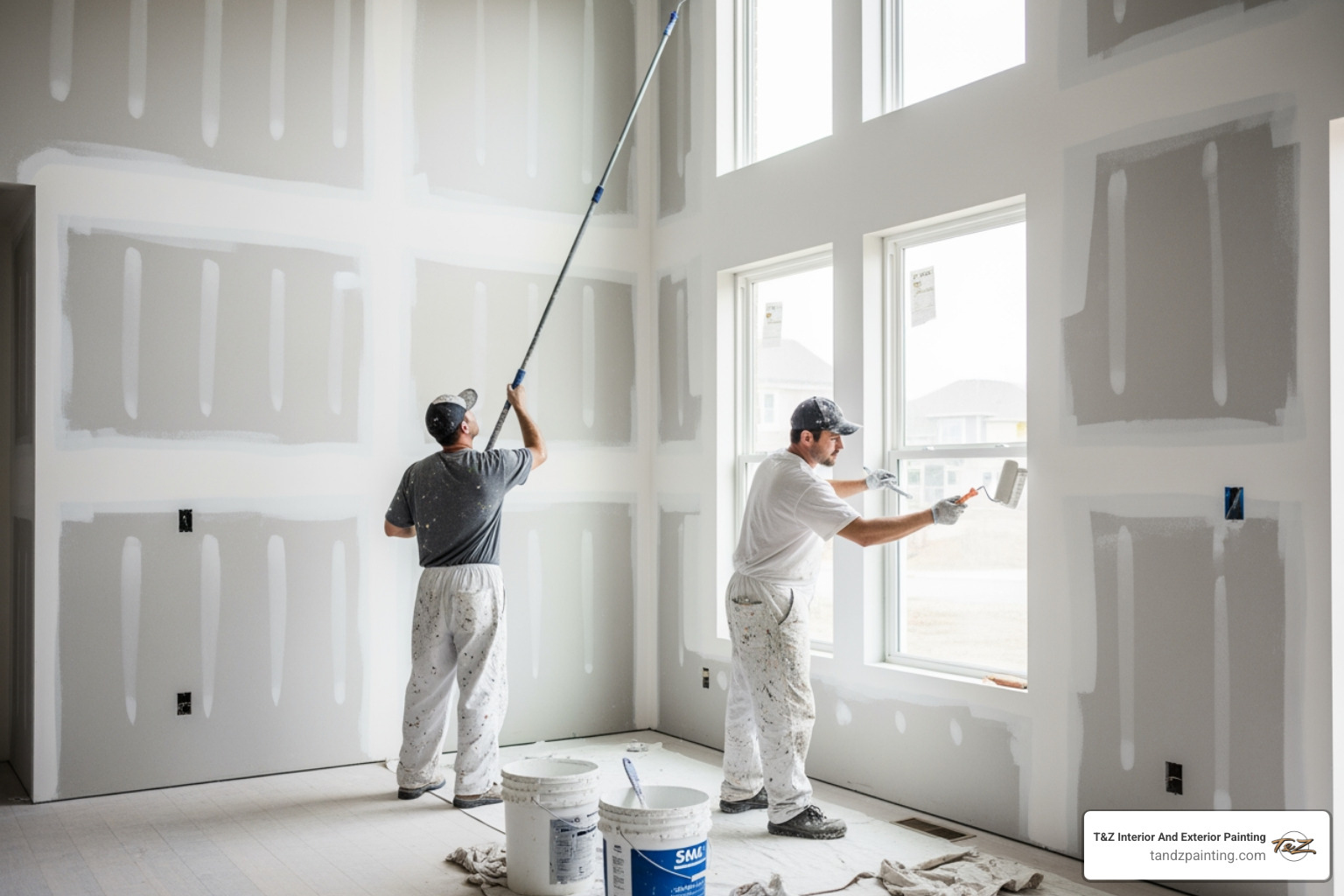
How Long Drywall Installation Takes in Lombard — and What Affects the Timeline
Single room drywall installation:
Hang day: boards cut and hung in a single room in one day for most residential rooms. Bedroom, living room, bathroom, and kitchen wall installations of standard dimensions are typically a one-day hang.
Tape and first coat: one day. The tape is embedded and the first compound coat is applied. Then the room waits.
Dry time between coats: 24 hours at 70°F with normal indoor humidity. This is the minimum. In Lombard’s humid spring and summer months — when indoor humidity runs higher in naturally ventilated spaces — dry time extends to 36 or 48 hours. Compound applied over partially dried compound shrinks unevenly, produces soft spots, and cracks. This dry time is the variable that renovation timelines most commonly underestimate.
Second coat, dry, sand, third coat, dry, sand: two to three additional days for the coat-and-sand sequence, accounting for dry time.
Final sand and prime: one day. Full surface sand, vacuum, and drywall prime coat.
Total for a single room: three to five days. This is realistic. A contractor who quotes a single room in two days is compressing the dry time between coats. The surface will show it within months.
Multi-room renovation:
Hang phase for a multi-room interior: one to two weeks depending on scope. Board hanging moves efficiently through multiple rooms.
Tape and float phase: one to two additional weeks accounting for coat dry times between rooms. This phase can move through multiple rooms in sequence while early rooms are drying — the schedule overlaps but doesn’t compress dry time in any individual room.
Total for a multi-room interior renovation: two to four weeks from hang start to paint-ready surface. T&Z provides a room-by-room schedule at the estimate so flooring installers, painters, and trim carpenters can plan their phases accurately.
What accelerates timeline:
Temperature-controlled, ventilated spaces dry faster. Running heat and a dehumidifier in a newly drywalled space during fall and winter, or running air conditioning during humid summer conditions, reduces dry time toward the 24-hour minimum. T&Z advises on ventilation and climate management during the drywall phase on every Lombard renovation project.
What extends timeline:
Cool or damp conditions extend compound dry time significantly. A garage or basement renovation in October or November without climate control can see 48 to 72 hours of dry time between coats, adding days to the schedule. Lombard’s spring rain season — when indoor humidity stays elevated from May through June — consistently extends dry times in naturally ventilated renovation spaces.
Home additions and gut-renovated rooms in Yorkshire Woods and Summit at Yorktown — where renovation projects routinely involve both new drywall across multiple rooms and full interior painting afterward — benefit most from a realistic drywall timeline built into the renovation schedule from the start. T&Z provides room-by-room schedules at the estimate so every subsequent trade knows when their phase can begin.
How T&Z Handles Drywall Installation as Part of a Complete Painting Project in Lombard
The single-contractor advantage:
When T&Z installs the drywall and paints the finished space, the transition between phases is a scheduling decision within a single project — not a handoff between two contractors with separate schedules, separate availability windows, and separate views of who is responsible for surface quality.
The drywall finisher and the painter are the same team. The person who applied the final compound coat and sanded it smooth is the same person who applies the primer and sees exactly what that surface looks like before topcoat. Any area that needs additional attention — a seam that isn’t quite flat enough, a screw dimple that didn’t fully fill, a corner bead edge that needs one more pass — is caught and corrected at the primer inspection stage, before topcoat goes on.
When drywall and painting are two separate contractors, this inspection happens at the handoff — if it happens at all. A painter who didn’t install the drywall has no professional stake in the quality of the finishing. A finisher who won’t be painting has no visibility into how the surface will read under paint. These misaligned incentives produce surfaces that look acceptable from a distance and show seams under direct light after painting.
No scheduling gap:
The gap between a drywall contractor finishing and a painting contractor arriving is one of the most common causes of renovation delays in Lombard. The drywall contractor completes on a Thursday. The painting contractor’s next available slot is two weeks out. The renovation sits with primed but unpainted walls for two weeks while the homeowner waits, the renovation schedule slips, and downstream trades are rescheduled.
When T&Z handles both phases, the painting schedule is continuous with the drywall schedule. The prime coat goes on the same day final sanding is complete. Topcoats follow as the prime cures. The entire sequence from hung boards to painted walls moves on a single schedule without gaps.
Single point of accountability:
If a surface issue appears after the project is complete — a visible seam under raking light, a screw dimple that shows through the topcoat — there is no question about whether the problem originated in the drywall phase or the painting phase. T&Z is responsible for both. There is no contractor-to-contractor dispute. There is a problem and T&Z resolves it.
This accountability structure changes how the work is done. A contractor responsible for both phases has every reason to get the finishing right before paint goes on — because the finish quality under paint is visible in the final result that T&Z is responsible for delivering.

The Types of Drywall T&Z Installs in Lombard Homes — and Which Applications Each One Serves
Standard drywall — 1/2 inch:
The baseline product for most residential walls and ceilings in living rooms, bedrooms, dining rooms, and hallways. Where moisture, fire rating, and sound transmission are not concerns, 1/2-inch standard drywall is the correct choice. It’s available in 4 by 8 and 4 by 12 foot sheets — longer sheets reduce the number of seams and the number of seam finishing passes required.
Moisture-resistant drywall — green board or blue board:
Required in bathrooms, laundry rooms, mudrooms, and any space where the wall surface will be exposed to regular humidity and moisture. The moisture-resistant facing prevents the paper from absorbing water and losing bond to the gypsum core — the failure mode that compromises standard drywall in wet spaces within a few years.
Moisture-resistant drywall is not waterproof. It is moisture-tolerant — it handles the humidity and incidental moisture contact of a bathroom environment far better than standard drywall. For walls that will be tiled in a shower or tub surround, a cement board or a dedicated tile backer is the correct product, not moisture-resistant drywall.
Type X fire-rated drywall — 5/8 inch:
Required by building code in specific assemblies — garage walls and ceilings that share a boundary with the living space, mechanical rooms, and any wall or ceiling assembly specified to achieve a fire-resistance rating. In Lombard, garage-to-living-space separation is the most common application. The Illinois Residential Code requires a minimum fire separation between an attached garage and the living space that Type X drywall satisfies.
5/8-inch Type X is also frequently used on ceilings in other applications because its additional thickness and weight reduce the tendency of ceiling drywall to sag over time. Many professional drywall contractors use 5/8-inch on all ceilings regardless of fire rating requirements for this reason.
Mold-resistant drywall:
Fiberglass-faced rather than paper-faced, mold-resistant drywall eliminates the organic material that mold requires to grow. Paper-faced drywall in a below-grade space — a Lombard basement with any history of moisture intrusion — is a substrate that mold can colonize over time even without visible water damage. Mold-resistant drywall in these spaces removes that risk.
Required whenever there is a history of moisture in the space — basement renovations, below-grade additions, and any room where previous drywall was removed due to mold. In Lombard homes with chronic basement moisture — a common condition in older housing stock throughout the city — mold-resistant drywall is the standard specification for any basement finish or renovation work.
Soundboard and acoustic specialty products:
For home offices, media rooms, and bedroom walls where sound transmission reduction is a project goal, T&Z installs soundboard — a dense fiberboard product used in combination with drywall to reduce sound transmission through the wall assembly — and acoustic specialty panels designed to reduce both transmission and room reverb. These are not standard drywall products and not every drywall application requires them. T&Z advises on whether acoustic treatment makes sense for a specific room based on the room’s use, its adjacent spaces, and the homeowner’s acoustic goals.
Lombard‘s variable seasonal humidity and the older housing stock’s known moisture patterns make product selection a genuine technical decision on every project. T&Z identifies the correct drywall type for each specific room and surface at the estimate — not a standard package applied regardless of what the room actually needs.
Drywall Installation and Replacement for Lombard Commercial Properties — Offices, Retail, and Beyond
Tenant improvement build-outs:
New commercial tenants moving into Lombard office and retail spaces routinely need new partition walls, updated ceiling configurations, and surface replacements from previous tenant improvements. T&Z handles the full scope of tenant improvement drywall — new partition wall framing and board, ceiling installation and repair, and the paint-ready finish that every new commercial space needs before occupancy.
New partition walls:
Adding or relocating partition walls within a commercial space — to create private offices from an open floor plan, to add a conference room, to divide a retail floor into distinct zones — requires framing, board hanging, taping, and finishing at a commercial quality standard. T&Z frames, hangs, and finishes commercial partition walls to code-compliant specifications, including fire-rated assemblies where the code requires separation between specific occupancy types.
Fire-rated assemblies in commercial spaces:
Commercial building codes specify fire-resistance requirements for wall and ceiling assemblies based on occupancy type, building height, and the spaces the assembly separates. These requirements are more complex and more rigorously inspected than residential applications. T&Z installs commercial fire-rated assemblies to the specifications required for each application — the correct board type, the correct thickness, and the correct number of layers for the specified fire-resistance rating.
Water and fire damage replacement:
Commercial properties that experience water damage from plumbing failures, roof leaks, or fire suppression system activation need rapid assessment and drywall replacement. T&Z handles commercial damage remediation drywall — board removal, substrate assessment, and replacement installation — coordinated with the painting phase so the space is restored to operational condition as quickly as the scope allows.
After-hours scheduling:
Commercial drywall installation is scheduled after business hours and on weekends for active commercial properties where daytime operations cannot accommodate construction activity. Drywall dust and noise are the two primary disruption factors. T&Z contains dust with plastic barrier walls and negative pressure where the construction zone borders active spaces, and schedules the noisiest phases — board cutting and screw driving — during off-hours.
Commercial tenant improvements along Lombard’s Main Street and Finley Road corridor frequently require new partition walls, updated ceiling installations, and drywall replacement after previous tenant build-outs. T&Z coordinates the drywall and painting phases of these projects as a single engagement — eliminating the between-trade gap that delays commercial renovation completion and tenant move-in dates.
Send Us a Message
Ready to start your renovation from the walls up? Contact T&Z Interior and Exterior Painting today for a free on-site assessment. We serve Lombard and all of Chicagoland — and we handle everything from bare framing to finished, painted walls in a single engagement.
FAQ
Does T&Z install drywall as well as paint — or only painting?
T&Z handles the complete sequence — drywall installation and finishing through to painting. One contractor manages both phases, eliminating the scheduling gap between drywall and painting contractors and providing single-point accountability for surface quality from bare board to finished wall.
When should I repair drywall versus replace it in my Lombard home?
Repair for localized damage under 12 inches on structurally sound surrounding drywall where moisture is not the cause. Replace when the damage is large, moisture has compromised board integrity, mold is present in the board or paper, or repeated patch repairs have failed. T&Z assesses the specific damage at the on-site inspection and gives a clear recommendation before any scope is committed.
What type of drywall is needed for a Lombard bathroom renovation?
Moisture-resistant drywall — green board or blue board — for bathroom walls receiving paint or tile in standard wet areas. Cement board or dedicated tile backer for shower and tub surround walls that will be tiled. Mold-resistant drywall for any below-grade bathroom or space with a history of moisture intrusion. T&Z confirms the correct product for each surface at the estimate.
How long will drywall installation take for my Lombard renovation?
Three to five days for a single room — board hanging is fast, but compound requires 24-hour dry time between coats that cannot be compressed. Two to four weeks for a multi-room interior renovation. Lombard’s humid spring and summer seasons extend compound dry times to 36 to 48 hours in naturally ventilated spaces. T&Z provides a room-by-room schedule at the estimate so subsequent trades can plan accurately.
Does T&Z handle commercial drywall installation and replacement in Lombard?
Yes — tenant improvement build-outs, new partition walls, ceiling installations, water and fire damage replacement, and fire-rated assemblies for offices, retail, and commercial properties throughout Lombard. After-hours scheduling is standard for active commercial properties. The drywall and painting phases are handled as a single engagement to eliminate the between-trade scheduling gap.