
Why Getting Your Basement Colors Ideas Right Changes Everything
If you’ve been searching for basement colors ideas, here’s a quick answer before we dive deep:
Best basement paint colors at a glance:
| Goal | Best Color Choices | Finish |
|---|---|---|
| Brighten a dark space | White Dove, Agreeable Gray, Chantilly Lace | Satin |
| Create a cozy retreat | Deep navy, charcoal, forest green | Eggshell |
| Add warmth | Cream, greige, soft beige | Satin |
| Home theater / gaming | Peppercorn, Iron Ore, Cyberspace | Eggshell |
| Playroom / office | Sea Salt, soft lavender, pale sage | Semi-gloss |
Basements are tricky. No natural light. Potential moisture. Low ceilings. It’s the one room in the house where the rules you learned upstairs simply don’t apply.
Most homeowners pick a color they love in the store — then watch it look flat, cold, or gloomy once it hits the basement wall. The problem isn’t the color itself. It’s that basements have different lighting conditions, different humidity levels, and different needs than any other room in your home.
The good news? The right paint color — chosen with those conditions in mind — can completely transform the space. Light-colored walls alone can make a basement feel up to 30% brighter by reflecting artificial light. And warm undertone colors are preferred by 70% of designers for basements precisely because they push back against that cold, cave-like feel.
Whether you want a bright home office, a moody home theater, or a cozy family hangout, color is the single most powerful tool you have.
I’m Tomasz Niemotko, owner of T&Z Interior And Exterior Painting, with over 15 years of professional interior painting experience — including helping homeowners in Lombard and surrounding communities find the right basement colors ideas that work with their lighting, layout, and lifestyle. In the sections ahead, I’ll walk you through everything I’ve learned so you can choose with confidence.
Simple basement colors ideas glossary:
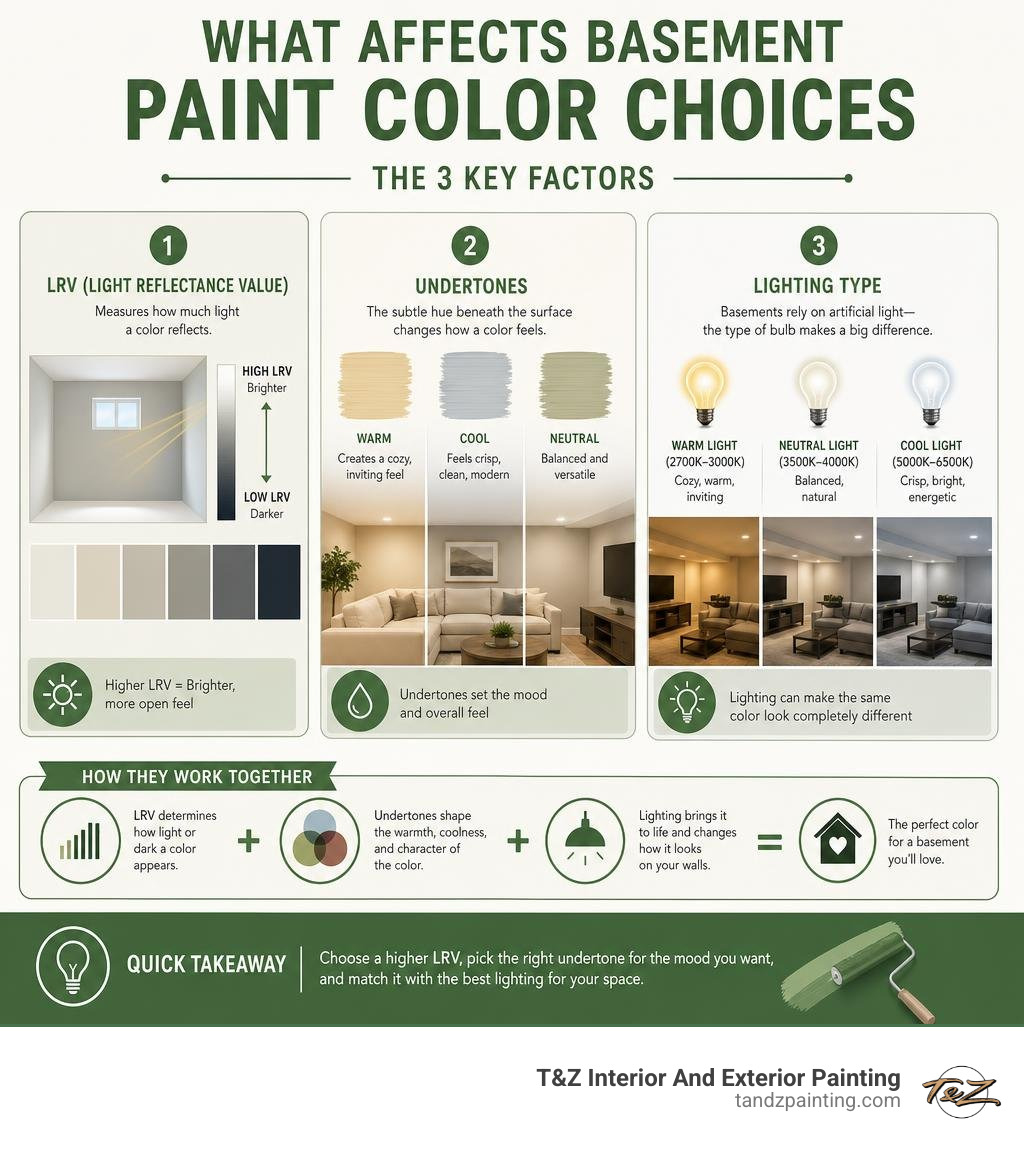
The Science of Basement Lighting: LRV and Undertones
To understand why a paint color looks stunning in a sunlit living room but resembles a chilly concrete bunker in the basement, we have to look at the science of light. When we paint upstairs, we rely on a shifting mix of direct and indirect natural sunlight. Downstairs, we are almost entirely dependent on artificial light.
This lack of natural daylight exaggerates how our eyes perceive color psychology, light reflectance, and undertones. If you choose a cool gray with a blue undertone for a windowless room, the lack of warm sunlight will make that blue undertone take over, leaving you with a space that feels clinical and cold.
When planning your palette, it helps to understand how colors interact across your entire home. For a seamless transition from your main levels down to your lower level, check out The Ultimate Guide to the Best Paint Combination for House Interiors to establish a cohesive color flow.
Understanding Light Reflectance Value (LRV) in Basements
Light Reflectance Value (LRV) is a scale from 0 to 100 that measures the percentage of light a paint color reflects. Absolute black is 0, and pure white is 100.
For basements, LRV is your secret weapon:
- High LRV (60 to 85+): These are your soft whites, creams, and light pastels. Because over 60% of homeowners choose neutral or light paint colors for basements to offset the lack of natural light, these shades are highly popular. They bounce artificial light around the room, making a low-ceilinged space feel taller and visually expanding the room’s footprint.
- Low LRV (under 20): These are your deep charcoals, rich navies, and moody forest greens. While you might worry that a low LRV will make a room feel tiny, dark paint colors actually make the corners of a room recede into the shadows, creating an illusion of endless depth. In fact, dark paint colors with a low LRV (under 20) are used in about 25% of home theater or gaming basements to reduce distracting screen glare.
How Artificial Lighting Alters Your Basement Colors Ideas
Because artificial light is the primary light source downstairs, the type of bulbs you choose will completely transform your basement colors ideas.
The key factors to look at are the Color Rendering Index (CRI) and the color temperature (measured in Kelvins):
- Warm Lighting (2700K – 3000K): Warm LED bulbs emit a cozy, yellow-orange glow. This is excellent for making cool spaces feel inviting, but it will make creamy whites look yellow and can make light grays look muddy.
- Cool Lighting (4000K – 5000K): Cool daylight bulbs emit a crisp, blue-white light. While this mimics natural daylight and keeps whites looking clean, it can make cool tones feel incredibly icy.
If a color you love looks slightly “off” after we apply your swatches, we always recommend testing different light bulbs before abandoning the color. Swapping a cool bulb for a warmer one (or vice versa) is a simple way to neutralize unwanted paint undertones.
Choosing the Perfect Palette: Top Basement Colors Ideas
Now that you know how light behaves below ground, let’s look at the actual palettes that designers use to bring these spaces to life.

One of our favorite design techniques for low-ceilinged basements is color drenching. This involves painting the walls, trim, baseboards, and even the ceiling in the exact same color (often using a flat finish on the ceiling and a satin finish on the walls). By eliminating the sharp contrast line between the walls and a bright white ceiling, you trick the eye into seeing the walls as infinitely tall.
Bright and Airy Neutrals
If your goal is to make your lower level feel like a natural, sunny extension of your main floor, stick to warm-toned neutrals. Avoid stark, blue-toned whites, which tend to look dingy and gray in low light. Instead, opt for whites and greiges with subtle yellow, peach, or pink undertones that maintain their warmth under artificial bulbs.
Here are the top designer-approved bright neutrals:
- Benjamin Moore White Dove (OC-17): A classic, creamy off-white with an LRV of 83.16. It holds its warmth beautifully under artificial lights without ever looking yellow.
- Sherwin-Williams Agreeable Gray (SW 7015): The ultimate greige with an LRV of 60. It adapts incredibly well to shifting light, though it has a sneaky green undertone that can pop up near dark wood furniture.
- Behr Swiss Coffee (DC-45): A warm, cozy white with an LRV of 84. It makes windowless rooms feel bright and inviting without looking clinical.
- Benjamin Moore Edgecomb Gray (HC-173): A soft, sandy taupe-greige that pairs perfectly with warm wood flooring and stone accents.
For more inspiration on how to use these versatile shades throughout your home, take a look at our guide on Neutral House Paint Ideas That Are Anything But Boring.
Bold and Moody Basement Colors Ideas
Sometimes, trying to force a dark basement to look bright is a losing battle. Instead of fighting the darkness, why not embrace it? Saturated, moody colors can turn an ordinary basement into a high-end, custom-designed sanctuary.
According to professional design trends highlighted in 13 Best Basement Paint Colors You’ll Love (2026), deep shades can add incredible drama when balanced with warm lighting and light-colored furnishings.
Consider these rich, dramatic options:
- Benjamin Moore Hale Navy (HC-154): A deeply saturated, sophisticated navy that feels classic rather than juvenile.
- Sherwin-Williams Iron Ore (SW 7069): A warm, soft charcoal black (LRV 6) that adds instant luxury to media rooms and lounges.
- Farrow & Ball Hague Blue (No. 30): A rich, deep blue with subtle green undertones that feels incredibly upscale.
- Backdrop Surf Camp: A moody, deep sapphire blue that brings an enveloping, cozy vibe to reading nooks and bar areas.
For a look at how other design professionals tackle bold, dark spaces creatively, you can read about this unique project in Before & After: This Basement Reno Embraces the Darkness—And Lime Green | domino.
To see how designers use these exact colors to solve tricky layout and lighting issues, browse through 22 Basement Paint Color Ideas That Designers Use – and 5 Designer-Loved Paint Colors That’ll Make Your Basement Feel More Inviting.
If you want to see how specific shades perform in subterranean environments, the design experts in 6 paint colors that make basements feel like real rooms share excellent case studies on making lower levels feel like natural, integrated rooms.
Tailoring Color Schemes to Your Basement’s Function
How you plan to use your basement should dictate your color choices. A space meant for high-energy workouts requires a completely different visual atmosphere than a quiet, dark room built for movie nights.

Active Spaces: Gyms, Playrooms, and Offices
Active spaces thrive on energy, focus, and clarity.
- Home Offices: To keep your mind sharp and minimize eye strain, look for soft, balancing colors like Sherwin-Williams Sea Salt (SW 6204). This gentle green-blue-gray shifts beautifully throughout the day and brings a calm, natural vibe downstairs.
- Home Gyms: Energetic spaces can handle bold accents. Consider painting a crisp white foundation and adding a dynamic accent wall or playful diagonal stripes in a vibrant shade like burnt orange or citrus green.
- Kids’ Playrooms: Playrooms are the perfect place to experiment with fun, cheerful colors. Soft lavenders, mint greens, or warm yellows bring essential joy to windowless rooms. Because playrooms see a lot of wear and tear, we highly recommend pairing these colors with a durable, easy-to-clean semi-gloss finish.
Cozy Retreats: Home Theaters and Living Rooms
If your basement is destined to be a cozy lounge, family den, or dedicated media room, focus on intimacy and relaxation.
- Home Theaters: To mimic a commercial cinema experience, choose ultra-dark, low-reflectance colors like Sherwin-Williams Peppercorn (SW 7674) or Benjamin Moore Slate Teal (2115-20). These colors absorb light from your TV screen, eliminating distracting reflections and making the picture pop.
- Family Living Rooms: If you want a warm, conversational space, look for rich, comforting colors. Combining a deep charcoal wall with natural wood accents, plush rugs, and warm brass light fixtures creates a welcoming, high-contrast look that feels modern yet cozy.
For more ideas on balancing cozy elements with smart design layouts, check out Basement Color Scheme Ideas That Brighten Dark Spaces.
Demystifying Paint Finishes and Moisture Protection
Selecting the right color is only half the battle; choosing the correct paint finish and protective coatings is what ensures your basement walls look stunning for years to come. Because basements are naturally prone to higher humidity levels and cooler temperatures, standard wall paints can occasionally fall victim to moisture damage or mold if the walls aren’t properly prepared.
Before applying any decorative topcoats, it is vital to address any underlying dampness. Applying a high-quality primer and moisture barrier is the best way to protect your investment. To understand how to seal your walls against subterranean dampness, read our detailed guide on Waterproofing Paint for Interior Walls: Your Shield Against Damp Basements.
Once your walls are prepped and dry, selecting the right sheen is crucial. Different sheens reflect light differently and offer varying levels of moisture resistance and cleanability. In fact, satin and semi-gloss finishes are chosen for basements 55% more often than flat finishes due to their superior moisture resistance and ease of cleaning.
| Finish / Sheen | Light Reflection | Moisture Resistance | Best Use Case | Cleanability |
|---|---|---|---|---|
| Flat / Matte | None (Absorbs light) | Low | Ceilings, very low-traffic media rooms | Difficult to clean |
| Eggshell | Low, soft glow | Moderate | Family living areas, guest bedrooms | Moderate |
| Satin | Medium (Gentle bounce) | High | High-traffic walls, hallways, offices | Easy to wipe down |
| Semi-Gloss | High (Bright reflection) | Very High | Trim, baseboards, playrooms, bathrooms | Extremely durable |
To dive deeper into how sheens affect color perception and wear, explore our articles on Demystifying Paint Finishes: How to Choose the Right Sheen for Every Room and Everything You Need to Know About Wall Paint Finishes. Additionally, if you are looking for eco-friendly, low-odor options that keep your indoor air clean during a basement project, check out Your Guide to Guilt-Free Hues: Choosing Sustainable Interior Paints.
How to Test and Preview Paint Colors Effectively
Never buy basement paint based on how a color swatch looks under the fluorescent lights of a retail store. Because basement lighting is so unique, you must test the colors in the actual room.
The most effective way to test colors is by using large-format, peel-and-stick paint samples made with real paint, such as those from Samplize. You can read more about how to use these handy tools in 10 Basement Paint Color Ideas – Samplize.
Our step-by-step color testing method:
- Stick samples on multiple walls: Light hits different walls at different angles. Place one sample on a wall directly facing your main light source and another in a darker corner.
- Observe throughout the day: Check the samples in the morning, afternoon, and night.
- Turn your lights on and off: See how the colors change when you switch from your overhead recessed can lights to cozy table lamps.
- Compare against your flooring: Hold the samples down near your carpet, luxury vinyl plank, or tile to ensure the undertones don’t clash.
Frequently Asked Questions about Basement Painting
Should basement walls be painted light or dark?
There is no single correct answer, as it depends entirely on your goals for the space. Light walls are ideal if you want to maximize light reflection, make a small space feel larger, or create a bright, multi-purpose family room. Dark walls are perfect if you want to lean into the basement’s natural coziness, eliminate screen glare in a media room, or create a sophisticated, high-end lounge.
If you are located in the local area, you can see how different neighborhood homes handle these choices by checking out 5 Paint Colors for Your Basement in Naperville & Plainfield.
Can I use bold colors in a basement without making it feel smaller?
Absolutely. The key to using bold colors without making a room feel cramped is balance. Instead of painting all four walls in a saturated shade, use the bold color on a single focal wall — such as behind a TV console, a bar, or a desk. Balance the rest of the room with warm white or light greige walls, light-colored furniture, and plenty of warm, layered lighting.
What is the best way to prevent mold on painted basement walls?
Preventing mold requires a three-step approach:
- Control the environment: Use a dehumidifier to keep the basement’s relative humidity below 50%.
- Proper preparation: Fix any active leaks or foundation cracks, and apply a specialized waterproofing primer to bare concrete walls.
- Choose the right paint: Use high-quality, moisture-resistant paint formulas that contain anti-microbial additives to prevent mold and mildew growth on the paint film.
Conclusion
Transforming a dark, forgotten basement into your family’s favorite room in the house is all about making smart color and lighting choices. By understanding LRV, choosing the right undertones, selecting a durable finish, and testing your swatches in real-world conditions, you can create a beautiful space that makes you completely forget you are underground.
If you are ready to take your basement to the next level, let our experienced team of professional painters handle the hard work. At T&Z Interior And Exterior Painting, we have spent over 15 years delivering stunning, long-lasting results to homeowners in Lombard, IL, and surrounding Chicago suburbs like Glen Ellyn, Wheaton, Oak Brook, and Downers Grove.
As a fully licensed and insured contractor with a 5.0 Google Reviews rating, we pride ourselves on exceptional craftsmanship, meticulous prep work, and clean, reliable service.
Contact us today to schedule your professional color consultation and let us bring your basement colors ideas to life. To learn more about our services, visit the T&Z Interior And Exterior Painting interior painting page.