
Why Choosing the Right Small Cabin Exterior Paint Colors Changes Everything
The best small cabin exterior paint colors work with nature, not against it. Here’s a quick guide to the most popular options:
| Color Family | Best For | Example Colors |
|---|---|---|
| Forest Greens | Wooded settings | Benjamin Moore Black Forest Green, SW Evergreen Fog |
| Warm Neutrals | Any landscape | SW Greek Villa, Farrow & Ball Pointing |
| Earth Tones | Mountain & rural | SW Urbane Bronze, Farrow & Ball Mouse’s Back |
| Deep Blues | Lakeside & coastal | Benjamin Moore Evening Dove, Farrow & Ball Barrow Blue |
| Charcoal & Black | Modern-rustic | SW Iron Ore, SW Greenblack |
Picking the wrong color is an expensive mistake. Exterior painting is labor-intensive and the results stick around for years — so getting it right the first time matters.
Small cabins have a unique challenge. Every color choice is amplified because the facade is compact and visible all at once. A shade that looks subtle on a large home can feel overwhelming — or flat — on a small cabin.
The good news? A nature-rooted palette almost always works. Colors drawn from the surrounding landscape — bark browns, lichen greens, granite grays — blend the structure into its setting while giving it real character.
And it’s not just about looks. Color affects heat absorption, how fast paint fades, how much dirt shows, and even how large or small the cabin feels from the outside. All of that matters when you’re working with a small footprint.
I’m Tomasz Niemotko, founder of T&Z Interior and Exterior Painting, and over 13+ years of professional exterior painting work — including many small and compact homes across the Lombard area — I’ve helped homeowners navigate the exact decisions around small cabin exterior paint colors that we’ll walk through in this guide. Let’s get into it.
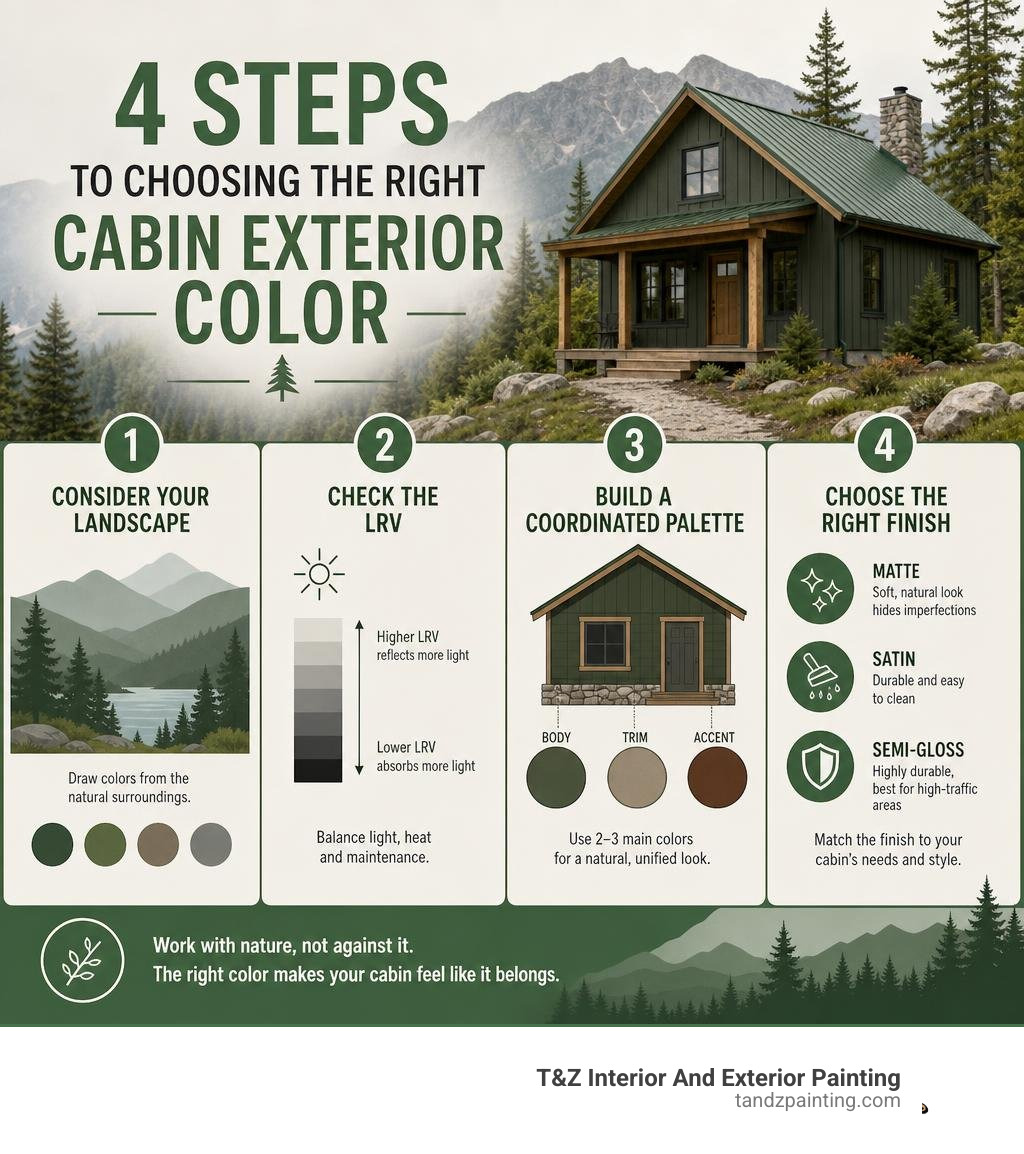
Small cabin exterior paint colors vocab explained:
Why Small Cabin Exterior Paint Colors Matter for Curb Appeal and Space
When painting a small cabin, the exterior paint color does more than just protect the wood; it defines the building’s visual mass. In architecture, “visual mass” refers to how heavy or prominent a structure looks within its environment. A massive, stark white mansion stands out boldly, whereas a dark green cabin nestled under pine trees visually recedes.
For a compact property, managing this visual mass is key. If your cabin is under 1,000 square feet, visitors will view almost the entire facade at once. Research shows that color saturation appears 15% to 25% more intense on small facades than it does on larger, sprawling homes. A color that seems like a subtle sage green on a paint swatch can easily look like a bright neon lime when applied across an entire small cabin. This is why understanding color behavior on compact structures is essential, as detailed in this guide on Tiny House Color Selection: How the Right Paint Makes 350 Sq Ft Feel Spacious – Tiny House & Small Apartment Living.
Additionally, the right color combination can accentuate cozy architectural lines without making the home look cluttered. Utilizing smart, nature-inspired palettes is the best way to lean into the charm of a smaller footprint. For inspiration on maximizing the curb appeal of smaller properties, you can read about Cute Cottage Vibes and the Best Exterior Paint Colors for Small Homes.
How Light Reflective Value (LRV) Affects Small Cabin Exterior Paint Colors
Light Reflective Value (LRV) is a scale from 0 to 100 that measures the percentage of light a paint color reflects. Pure black has an LRV of 0, while pure white has an LRV of 100. When choosing small cabin exterior paint colors, LRV plays an important role in both aesthetics and practical performance:
- High LRV (70-85): Soft whites, creams, and light pastels reflect the most light. These shades make a small cabin look brighter and slightly larger, which is excellent for shaded, heavily wooded lots.
- Medium LRV (40-60): Earthy mid-tones, like warm grays and soft olives, provide a balanced, grounded look that hides dirt and pollen exceptionally well.
- Low LRV (under 30): Deep forest greens, dark charcoals, and rich browns absorb light, helping the cabin blend seamlessly into dark wooded backdrops.
However, low-LRV dark colors absorb more heat. In the peak of summer, a dark-painted exterior can transfer significant heat to the interior, potentially increasing your cooling needs if the cabin lacks central air conditioning. Darker paints are also more prone to fading under intense UV exposure and can show road dust or pollen more clearly than lighter shades. Conversely, very bright whites can look clinical and out of place in a natural setting. Finding a balance—such as a warm, creamy white with an LRV in the 70s—can coordinate beautifully with soil tones and tree bark without creating a stark glare. You can explore a real-world journey of choosing the perfect balanced exterior shade in this article on Choosing Our Exterior Paint Color — The Tiny Canal Cottage .
Balancing Siding and Trim with Small Cabin Exterior Paint Colors
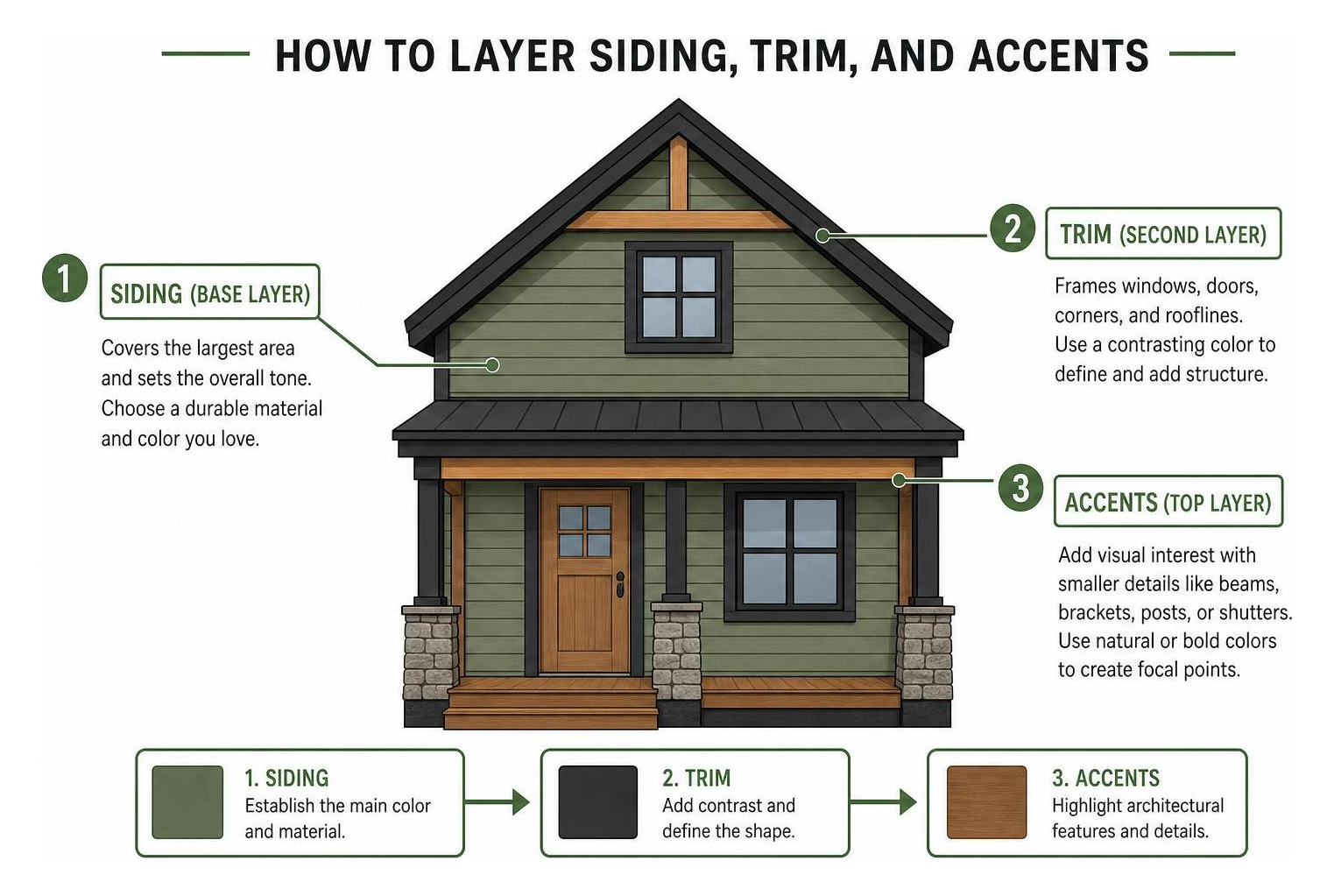
To prevent a small cabin from looking like a single, solid block of color, we recommend using a classic three-color system:
- The Field Color: This is the dominant color used on the siding, covering roughly 60% of the exterior.
- The Trim Color: Used on window frames, roof trim, fascia, and railings, accounting for about 30% of the palette.
- The Accent Color: Reserved for high-impact areas like the front door, shutters, or window boxes, making up the final 10%.
For small cabins, keeping the trim color slightly lighter or darker than the field color provides clean definition without creating distracting, high-contrast lines that visually chop up the small facade. If your cabin features beautiful natural wood soffits or large windows, you can let those natural elements act as your trim, keeping the painted elements simple and cohesive. To ensure your selected colors hold up against the elements, it is vital to choose high-quality products, as discussed in Don’t Let Your Walls Down with These High-Quality Exterior House Paints.
Top Nature-Inspired Color Palettes for Small Cabins

Nature is the ultimate color coordinator. When you choose a palette inspired by your cabin’s immediate surroundings, the building naturally feels cohesive and inviting. Whether your property is nestled in a dense pine forest, perched on a rocky hillside, or situated near a lake, drawing inspiration from the local flora, rocks, and water is a foolproof strategy. Designers often recommend nature-rooted palettes to create a cozy, grounded retreat, as detailed in 6 Best And Most Cozy Exterior Paint Colors For A Cabin.
Earthy Greens and Forest Hues
Earthy greens are a classic choice for cabins because they mirror the surrounding canopy, making the structure feel like a natural extension of the forest.
- Sherwin-Williams Evergreen Fog (SW 9130): A beautiful, soft green-gray with warm undertones that feels organic and calm.
- Benjamin Moore Black Forest Green (PM-12 / 2127-10): A rich, ultra-dark green that borders on black. It connects a cabin to the deep shadows of surrounding woods like no other color, providing a classic and dramatic backdrop.
When using deep greens, pairing them with warm wood accents (such as a cedar-stained front door) or a soft off-white trim keeps the look cozy rather than gloomy. For more ideas on green-based palettes, check out the options in the Sherwin Williams Cabin Exterior Paint Colors – Paint Colors collection.
Warm Neutrals and Creamy Whites
If you want your cabin to feel bright and airy without looking like a stark suburban home, warm neutrals and antiqued whites are the perfect solution.
- Sherwin-Williams Greek Villa (SW 7551): A warm, rich white with a subtle amber undertone. It avoids the clinical, blinding look of pure white in open sunlight, offering a soft, historic cottage feel.
- Farrow & Ball Pointing (No. 2005): A warm, creamy white that brings light into shaded forest lots while coordinating beautifully with natural soil and tree bark.
Warm neutrals pair wonderfully with deep forest green or charcoal trim, creating a timeless, historic look that feels right at home in lakeside or beachside settings. You can read a case study on using warm white and deep green on a historic cottage in this article on Beach Cabin Exterior Paint Colors: White and Green – Mackinaw Road .
Deep Blues and Lakeside Grays
For cabins located near water or perched on rocky ridges, deep blues and cool slates reflect the natural tones of the sky and water.
- Benjamin Moore Evening Dove (2128-30): A rich, slate-toned navy blue that looks incredibly sophisticated against natural stone and wood.
- Farrow & Ball Barrow Blue (No. GR14): A muted, dusty blue-gray that keeps things cool and grounded, working exceptionally well with winter light.
These shades look stunning when contrasted with crisp, light gray or warm white trim, highlighting the cabin’s architectural features. You can find more visual inspiration for lakeside and mountain palettes on this curated Small Cabin Exterior Paint Colors – Pinterest board.
Paint vs. Stain: Choosing the Right Finish for Wood Cabins
Before dipping your brush into a can of paint, it is crucial to decide whether paint or stain is the right choice for your cabin’s wood siding. Both options offer excellent protection, but they create completely different visual styles and require different maintenance cycles.
| Feature | Exterior Paint | Exterior Wood Stain |
|---|---|---|
| Wood Grain Visibility | Completely masked | Ranges from fully visible (clear) to masked (solid) |
| Moisture Protection | High (creates a protective film) | High (penetrates wood fibers or breathes) |
| UV Resistance | Excellent (pigments block sun) | Good (depends on opacity/pigmentation) |
| Typical Lifespan | 7 to 10 years | 3 to 7 years (depends on opacity) |
| Failure Mode | Peeling, cracking, blistering | Fading, wearing away gradually |
| Prep Work for Re-coating | High (scraping and sanding required) | Low to Medium (cleaning and light sanding) |
To learn more about how to choose the right products for your home’s exterior, read our Expert Tips for Stunning Exterior House Painting in 2026.
The Pros and Cons of Exterior Paint
Exterior paint forms a thick, protective barrier over the wood surface, shielding it from moisture, wind, and harsh UV rays.
- The Pros: Paint offers a virtually unlimited selection of colors and finishes. High-quality acrylic latex paints provide outstanding UV protection, meaning colors stay vibrant longer. A professional paint job can easily last 7 to 10 years before needing a refresh.
- The Cons: Paint completely hides the natural grain and texture of the wood. If moisture gets trapped behind the paint film, it can cause the paint to bubble, crack, and peel. Scraping off old, peeling paint during prep work is highly labor-intensive.
For cabins with older siding or mixed-material facades, paint is often the best choice to unify the surfaces and provide long-lasting protection. Read more about how professional painting can revitalize your siding in Give Your Home a Facelift with Professional Exterior Painting.
The Pros and Cons of Exterior Wood Stain
Unlike paint, wood stain penetrates deep into the wood fibers, protecting the siding from within while allowing the natural beauty of the wood to shine through.
- The Pros: Stain highlights the natural grain and texture of cedar, pine, or redwood. Because it does not form a hard film on top of the wood, stain will not peel or blister. When it’s time to re-apply, the prep work is much simpler, usually requiring only a thorough cleaning and light sanding.
- The Cons: Stain generally has a shorter lifespan than paint, requiring re-application every 3 to 5 years (though solid stains can last longer). It also offers fewer color choices compared to paint.
Stains come in four main opacities: clear (shows all grain and weathers naturally), semi-transparent (adds subtle color while showing grain), semi-solid (hides most grain but shows texture), and solid (looks like paint but behaves like stain). If you are looking to preserve the rustic, natural texture of your wood, stain is the ideal option. Learn more about our staining and painting services on our Services: Exterior Painting page.
Architectural Elements and Materials That Enhance Small Cabin Facades
A small cabin does not need a massive footprint to make a big impression. By combining strategic paint colors with different textures and materials, you can create a highly detailed, custom look that makes your cabin feel cozy and curated.
Using Mixed Materials to Add Depth
One of the best ways to elevate a small cabin’s exterior is by mixing materials. Instead of covering the entire cabin in a single type of siding, consider blending two or three elements:
- Shou Sugi Ban (Charred Wood): This traditional Japanese technique involves charring wood siding to make it resistant to rot, insects, and fire. The rich, textured black finish visually recedes, making surrounding trees and windows pop.
- Stone Plinths or Skirting: Wrapping the bottom 12 to 24 inches of your cabin’s foundation in natural stone veneer grounds the structure and protects the lower walls from moisture splashback.
- Board-and-Batten Accent Walls: Using vertical board-and-batten siding on gables or entryways creates vertical lines that draw the eye upward, making a small cabin appear taller.
Combining these materials with a cohesive paint color scheme ensures your cabin looks visually rich without feeling cluttered. For a complete guide on boosting your cabin’s curb appeal, explore The Ultimate Guide to Exterior Painting: Boost Your Home’s Curb Appeal.
Bold Accent Doors and Trim Details
Because a small cabin has limited surface area, minor details can make a major impact. The front door is the perfect place to inject personality and color into your exterior scheme.
- Bold Accent Doors: Consider painting your front door in a vibrant, nature-inspired accent color. A classic barn red (like Benjamin Moore Caliente), a warm mustard yellow (like Farrow & Ball India Yellow), or a rich plum can add a touch of fairytale charm to a green or neutral cabin.
- Dutch Doors: A Dutch door—where the top and bottom halves open independently—adds instant cottage charm and allows fresh air to circulate through your cabin.
- Window Boxes and Planters: Adding painted window boxes filled with local flowers or trailing greenery softens the sharp lines of your cabin and connects it directly to the landscape.
To see how these small details fit into a complete exterior project, check out our Exterior Painting Service Complete Guide.
Best Practices for Surface Preparation and Application
No matter how beautiful your chosen paint color is, the final result will only be as good as the preparation work underneath. Cabins in wooded or rural areas face unique challenges, including high humidity, pollen, mold, insect activity, and intense sun exposure. Proper preparation ensures your new paint or stain adheres perfectly and lasts for years.
Essential Prep Steps for Long-Lasting Results
Before opening a single paint can, we perform several critical preparation steps:
- Thorough Cleaning: Power wash the entire exterior to remove dirt, mold, mildew, pollen, and loose paint. Let the wood dry completely (usually 24 to 48 hours) before proceeding.
- Scraping and Sanding: Scraping off loose, peeling paint is essential. Sanding the edges of the remaining paint creates a smooth, flat surface for the new coat.
- Wood Rot Repair: Wood cabins are prone to moisture damage, especially near the ground or under gutters. Any soft, rotted wood must be repaired or replaced before painting.
- Caulking and Sealing: Apply high-quality exterior caulk around window frames, door trim, and joints to prevent moisture from seeping behind the siding.
Investing time in these steps prevents premature peeling and protects your cabin’s structure. Learn more about choosing a professional who prioritizes prep work in Find the Best Exterior Painter for Your Home Improvement Project.
Professional Application Techniques
Applying exterior paint to a cabin requires specific techniques to ensure durability:
- Avoid Direct Sunlight: Painting in direct, hot sunlight can cause the paint to dry too quickly, leading to brush marks, blistering, and poor adhesion. We always track the sun and paint in the shade whenever possible.
- Back-Brushing: When spraying paint or stain onto textured wood siding, “back-brushing” (running a brush over the freshly sprayed area) forces the product deep into the wood’s pores and grain, ensuring an even, highly durable coat.
- Using High-Quality Primers: Applying a high-quality, specialty primer to bare wood prevents natural wood tannins from bleeding through and discoloring your beautiful new paint.
By using professional tools and techniques, we deliver a finish that stands up to harsh Midwestern winters and humid summers. For an in-depth look at our professional process, check out our Your Neighborhood Guide to Residential Exterior Painting Services.
Frequently Asked Questions About Cabin Painting
How often should a small cabin exterior be repainted or restained?
The maintenance interval for your cabin depends heavily on its exposure to the elements and the type of finish used. Generally, high-quality exterior paint on a well-prepared cabin will last 7 to 10 years. Solid stains typically last 5 to 7 years, while semi-transparent or clear stains require a refresh every 3 to 5 years. Cabins with heavy tree cover may experience more moisture and mold buildup, requiring annual power washing to maximize the lifespan of the finish.
Do dark exterior paint colors make a small cabin feel smaller?
Not necessarily! While dark colors inside a small room can sometimes make it feel enclosed, dark colors on a cabin’s exterior often have the opposite effect. Dark colors like charcoal, deep forest green, or black absorb light and blend into the surrounding shadows. This “visual receding” effect makes the cabin’s boundaries melt into the landscape, often making the structure feel like a natural, unobtrusive part of the forest rather than a cramped box.
How do local climate and HOA rules affect cabin color choices?
Even in rural or wooded communities, local guidelines can play a significant role in your color choices. Many cabin communities or homeowners associations (HOAs) have rules requiring exterior colors to remain within a specific palette of earth tones to maintain neighborhood cohesiveness. Additionally, your local climate should influence your choice: if your cabin is in an open area with intense, direct sunlight, choosing a lighter color with a higher LRV will prevent excessive heat absorption and slow down UV-induced fading.
Conclusion
Choosing the perfect small cabin exterior paint colors is all about finding harmony between your personal style, your cabin’s unique architecture, and the natural beauty of the surrounding landscape. Whether you opt for a deep, dramatic forest green, a warm, historic creamy white, or a natural wood stain, the right choice will protect your property and provide welcoming curb appeal for years to come.
At T&Z Interior and Exterior Painting, we bring 15+ years of professional experience, a 5.0 Google Reviews rating, and licensed, insured craftsmanship to every project. Based in Lombard, IL, we proudly serve homeowners in Wheaton, Downers Grove, Addison, Elmhurst, Glenview, and surrounding communities, delivering stunning, long-lasting results using top-brand materials.
If you are ready to transform your cabin or small home with a fresh, professional coat of paint, let our experienced team handle the hard work. For more insights on the unique aspects of painting compact properties, explore our guide on small house painting challenges. Contact us today to discuss your project and bring your dream cabin palette to life!