
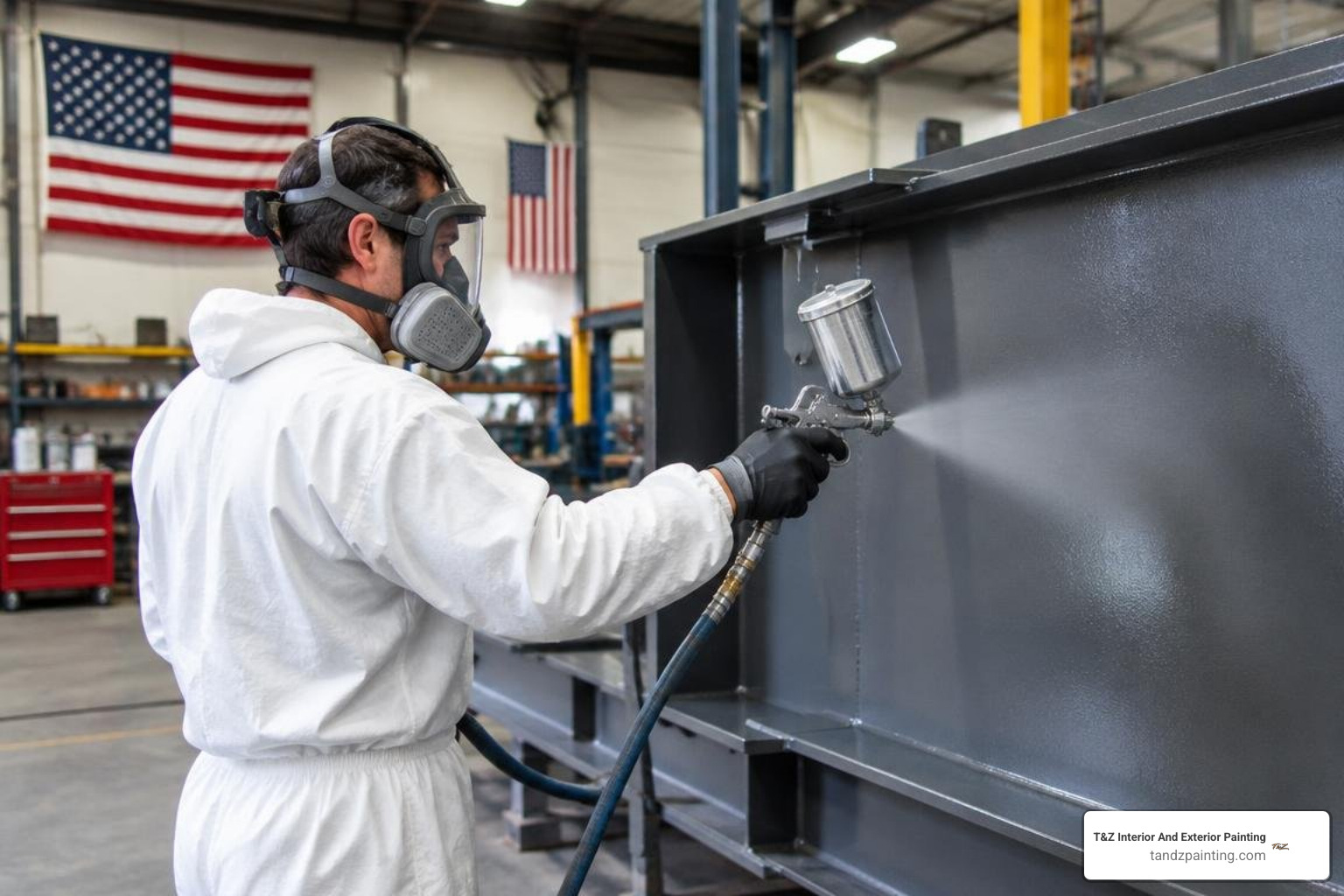
Choosing the Right Metal Spray Coating Near Downers Grove
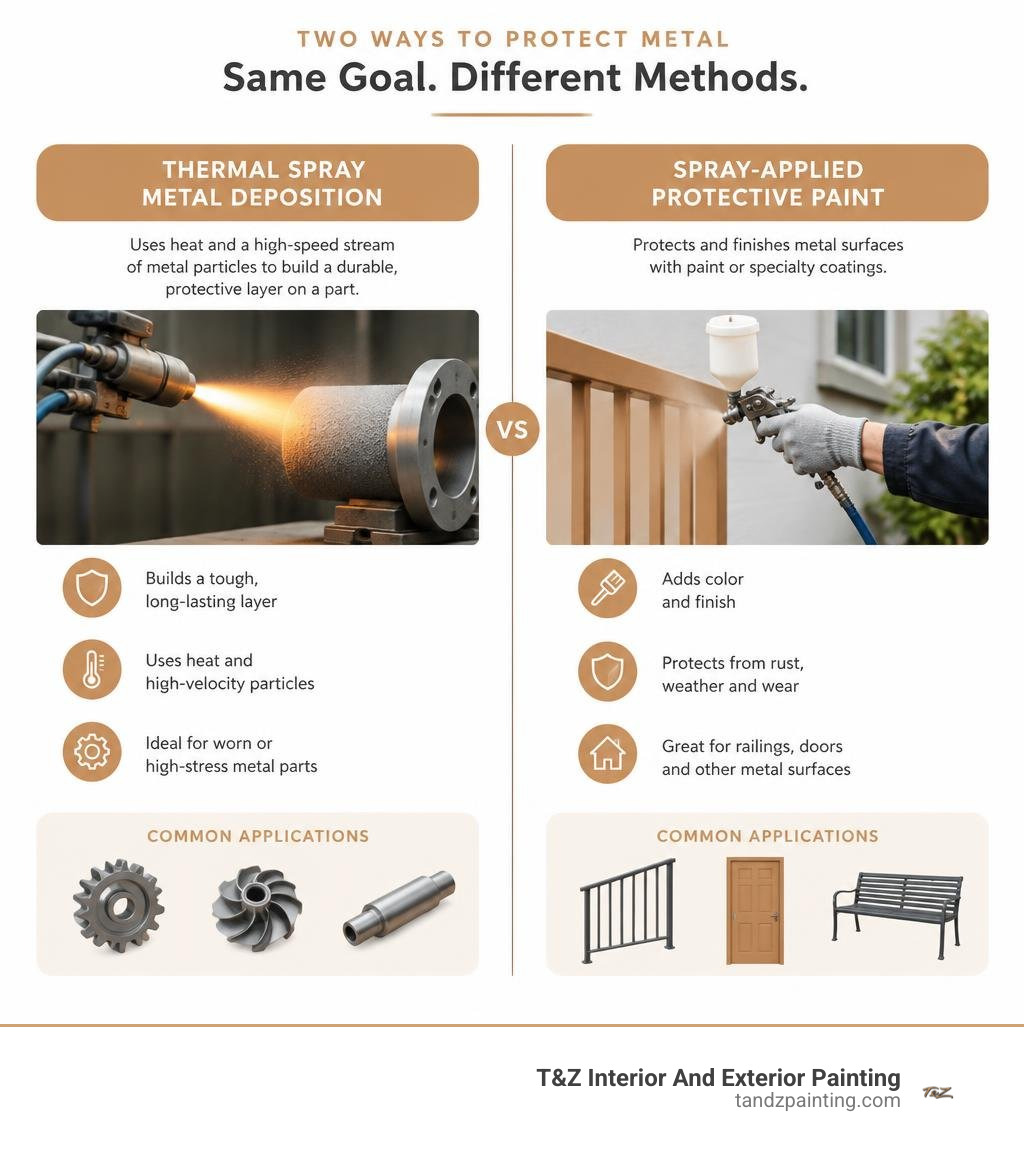
Metal spray coating can mean two different things. Industrial thermal spray uses heat and a high-speed stream of metal particles to build a protective layer on a part. Spray-applied paint or specialty coatings protect and finish metal surfaces such as railings, doors, and commercial fixtures. If you need to restore a worn machine part, ask a thermal spray specialist. If you want to protect or refresh painted metal at a home or business near Downers Grove, ask a professional painter about surface prep and a suitable coating. For property owners researching metal spray coating Downers Grove, the right choice depends on whether you need industrial deposition or a protective architectural finish.
I’m Tomasz Niemotko, and my 15+ years of painting and surface-preparation work around Lombard help me explain the choices for people researching “metal spray coating Downers Grove.” The key is to match the coating method to the metal surface and what you need it to do.
Glossary for metal spray coating Downers Grove:
Understanding Metal Spray Coating Downers Grove Commercial and Industrial Applications
Protecting metal surfaces in the western suburbs of Chicago demands a clear understanding of the environmental stresses and mechanical wear your equipment or architectural features face daily. From freezing DuPage County winters to high-humidity summer afternoons, exposed metal requires high-performance surface barriers. Whether your project involves structural beams, manufacturing machinery, or architectural facades, understanding how different application methods work ensures your property remains protected and visually appealing.
Industrial deposition methods propel fine metallic or composite materials directly onto a target component. In heavy manufacturing, methods like high-velocity oxy-fuel (HVOF) or plasma spraying accelerate molten or semi-molten particles between 1,800 and 2,600 feet per second. When these particles hit the prepared surface, they flatten and interlock mechanically, building dense protection. For commercial architectural surfaces, facilities managers often choose advanced, spray-applied barrier finishes that offer continuous defense against corrosion and surface degradation. Our team regularly assists facilities through commercial metal spray application to ensure lasting durability.
Comparing Thermal Spray, Mechanical Plating, and Electroplating
Selecting the ideal surface treatment requires evaluating mechanical bond strength, coating density, and processing constraints across standard finishing options.
| Coating Method | Deposition Mechanism | Typical Thickness Range | Hydrogen Embrittlement Risk | Substrate Thermal Impact |
|---|---|---|---|---|
| Thermal Spray | High-velocity kinetic impact of molten/semi-molten metal powder | 2 to 50+ mils | None (Dry, non-electrolytic) | Minimal (Surface remains relatively cool) |
| Mechanical Plating | Physical tumbling impact using glass beads in chemical slurry | 0.2 to 5.0 mils | None (No current or acid immersion) | None (Ambient liquid process) |
| Electroplating | Electrochemical bath reduction depositing dissolved ions | 0.1 to 2.0 mils | High (Requires post-process de-embrittlement baking) | None (Liquid bath process) |
| High-Performance Spray Paint | Atomized spray transfer of cross-linking polymer/zinc matrices | 1.5 to 10+ mils | None (Non-immersion surface cure) | None (Ambient cure) |
Traditional electroplating immerses parts in liquid baths to form a chemical bond. While it provides uniform thin layers, the electrolytic reaction can introduce atomic hydrogen into high-strength steels, causing structural failure under stress.
In contrast, thermal spray and mechanical impact methods avoid aggressive acid immersion and electrical currents. Thermal spray gives operators complete control over deposition thickness, making it ideal for rebuilding worn shafts, restoring pump housings, or applying heavy-duty corrosion barriers.
Evaluating Metal Spray Coating Downers Grove Substrates and Thickness Needs
Proper coating adhesion begins with knowing your substrate’s metallurgical makeup. Carbon steel, structural iron, cast alloys, and aluminum each react differently to surface prep and thermal application. For heavy industrial facilities in surrounding areas, choosing the right industrial metal coating solutions helps maintain dimensional tolerances on moving equipment and structural supports.
Operating temperatures also determine the best coating formulation:
- Light Architectural & Commercial Steel: Requires resilient polyurethane, epoxy, or zinc-rich coatings applied between 3 and 8 mils dry film thickness (DFT).
- High-Temperature Process Equipment: Demands specialized thermal metallic layers (such as aluminum-bronze, nickel-chrome, or stainless alloys) capable of handling continuous operational temperatures over 800°F.
- Machinery Wear Components: Built up with high-hardness metallic matrices applied in multi-pass layers exceeding 15 to 30 mils to restore worn dimensions.
Core Advantages: Preventing Porosity, Oxidation, and Hydrogen Embrittlement
The greatest threat to metal integrity in the greater Downers Grove area is micro-scale permeability. When moisture, oxygen, and industrial pollutants penetrate a coating’s microscopic pores, under-film corrosion quickly spreads.
Advanced surface preparation and modern spray application prevent these failures. For example, high-velocity thermal spray technology—such as the patented high-density thermal spray process—uses an inert gas shroud to shield the spray stream from ambient air. This cuts total coating porosity and oxide inclusions to under 1%, producing a solid barrier that resists harsh chemicals, such as 1.0% hydrochloric acid solutions at elevated temperatures, without breakdown.
For commercial buildings and manufacturing plants, investing in high-performance metal spraying stops rust from taking hold, keeping structural metal sound for years.
Advanced Low-Oxide and High-Density Barrier Protection
When molten metal particles travel through ambient air without protection, they react rapidly with oxygen. This creates internal brittle oxides that weaken bond strength and leave micro-channels for moisture.
By introducing inert gas shrouds (using argon or nitrogen) with helical flow patterns, technicians keep ambient air away from the molten stream. This ensures:
- Dense particle packing with powder distributions between 10 and 45 microns.
- Micro-porosity kept below 2%, creating a true chemical barrier.
- Complete protection against water ingress and road salt pitting.
Wear Resistance, Hardness, and Friction Control
Beyond stopping rust, high-velocity spray finishes can be customized for specific mechanical needs:
- High Rockwell Hardness: Coatings engineered with nickel-boron, chrome complexes, or ceramic blends can achieve hardness ratings from 45 RC up to 85 RC, protecting against abrasive slurry, sand, or mechanical friction.
- Low Friction Coefficients: Specialized metal-fluoropolymer or nickel-composite coatings lower surface friction down to coefficients between 0.05 and 0.15, improving part release on molds and sliding assemblies.
- Rust Prevention on Structural Elements: For exterior railings, gates, structural framing, and metal panels, learning how our professional painters protect steel from rust prevents oxidation before it damages the underlying metal.
Professional Application Process and Quality Standards
Consistent, long-lasting metal coating results require disciplined process control. Applying coatings without the right surface profile or clean conditions leads directly to peeling and adhesion failure.
Whether working on manufacturing parts in a controlled facility or spray-coating architectural metal on site, technicians follow proven regional and national standards, such as Illinois thermal spray coating standards.
Step-by-Step Metal Spray Coating Downers Grove Surface Prep and Application
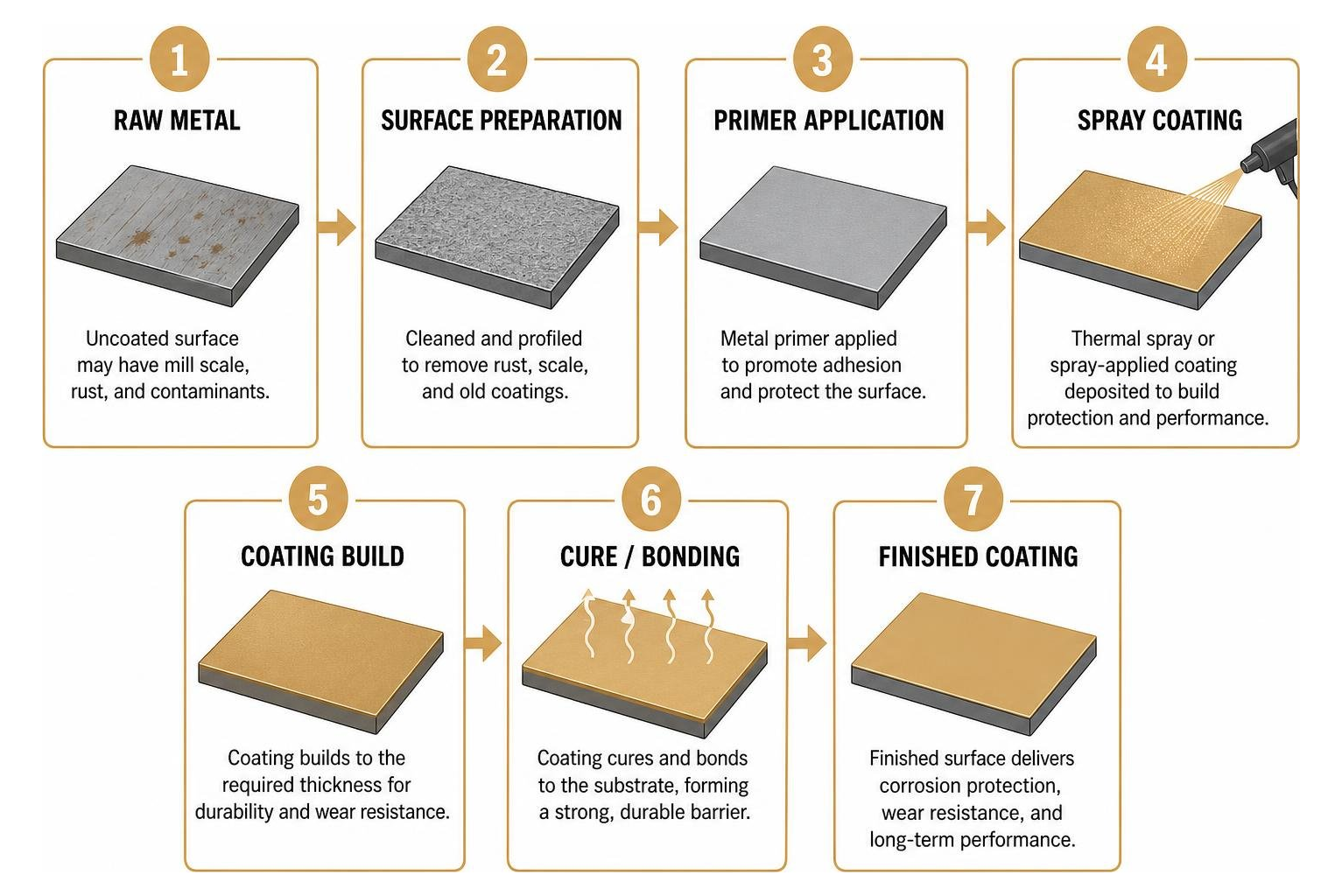
A reliable coating system follows a precise five-step workflow:
- Chemical Decontamination: Thorough solvent washing and degreasing remove all oils, cutting fluids, and dirt.
- Abrasive Blasting: High-pressure blasting using aluminum oxide, chilled iron grit, or crushed glass cuts away mill scale and rust, creating a clean white-metal surface with a sharp 2.0 to 3.5 mil anchor profile. You can see how critical this step is in our guide on how to prep metal for spray painting.
- Precision Masking: High-temperature, abrasion-resistant tapes and custom silicone plugs protect threaded holes, bearing seats, and critical machined surfaces.
- Multi-Pass Deposition: The coating is applied in overlapping, calibrated passes to build the exact target thickness without overheating the substrate.
- Protective Sealing: For porous thermal deposits, an epoxy or silicone sealer fills any micro-voids; for architectural work, a high-solids topcoat seals the surface against UV rays.
Post-Coating Inspection, Masking, and Tolerance Control
Once application is complete, thorough quality control confirms the coating’s integrity:
- Mil Thickness Verification: High-precision magnetic or eddy-current gauges ensure uniform dry film thickness across all surfaces.
- Adhesion Testing: Cross-hatch and pull-off tests verify high mechanical bonding strength.
- Dimensional Verification: Machined components are checked with micrometers to confirm they meet exact operational tolerances.
For commercial and residential property owners wanting durable curb appeal and weather protection, our Downers Grove exterior painting team applies these same high standards to architectural metalwork.
Frequently Asked Questions About Metal Spray Protection
How does thermal metal spraying eliminate the risk of hydrogen embrittlement?
Hydrogen embrittlement happens when high-strength steels absorb atomic hydrogen during chemical pickling, acid cleaning, or electroplating. When the part is placed under mechanical load, the trapped hydrogen creates internal stress, causing sudden cracks. Thermal spray is a dry, physical process that uses no electric currents or acid baths. This eliminates hydrogen generation and removes the need for time-consuming post-process baking.
What metals and substrates can undergo high-velocity spray deposition?
Almost all structural and industrial metals can receive spray coatings, including mild carbon steel, alloy steels, cast iron, stainless steel, aluminum, brass, and bronze. Because the spray gun moves quickly and only transfers localized kinetic heat, the overall part stays relatively cool. This prevents distortion, metallurgical changes, or loss of temper in the base metal.
How do environmental conditions in DuPage County affect coating performance?
Chicagoland’s seasonal climate places heavy demands on metal coatings. Winter temperatures bring freeze-thaw cycles and heavy road salt exposure, while humid summers cause condensation on outdoor surfaces. Without a properly prepped surface and high-solids coating, moisture quickly works its way beneath the finish. Using a specialized primer and durable topcoat keeps the barrier tight against salt, moisture, and temperature swings.
Conclusion
Whether you need to rebuild industrial machine parts or revitalize commercial railings, siding, and architectural fixtures, choosing the right coating method is essential. Proper surface preparation, precise application, and top-tier materials protect your metal investments and prevent costly structural repairs down the road.
At T&Z Interior And Exterior Painting, we bring over 15 years of hands-on expertise to every residential, commercial, and specialty coating project across Lombard, Downers Grove, Addison, Elmhurst, Glen Ellyn, and surrounding communities. As a licensed, fully insured team backed by hundreds of 5.0-star reviews and an ironclad 2-year labor warranty, we take pride in delivering clean, reliable, and visually stunning results on every project.
Ready to restore, transform, and protect your commercial or residential property? Explore our full range of spray painting solutions today to schedule your on-site consultation with our experienced team.