
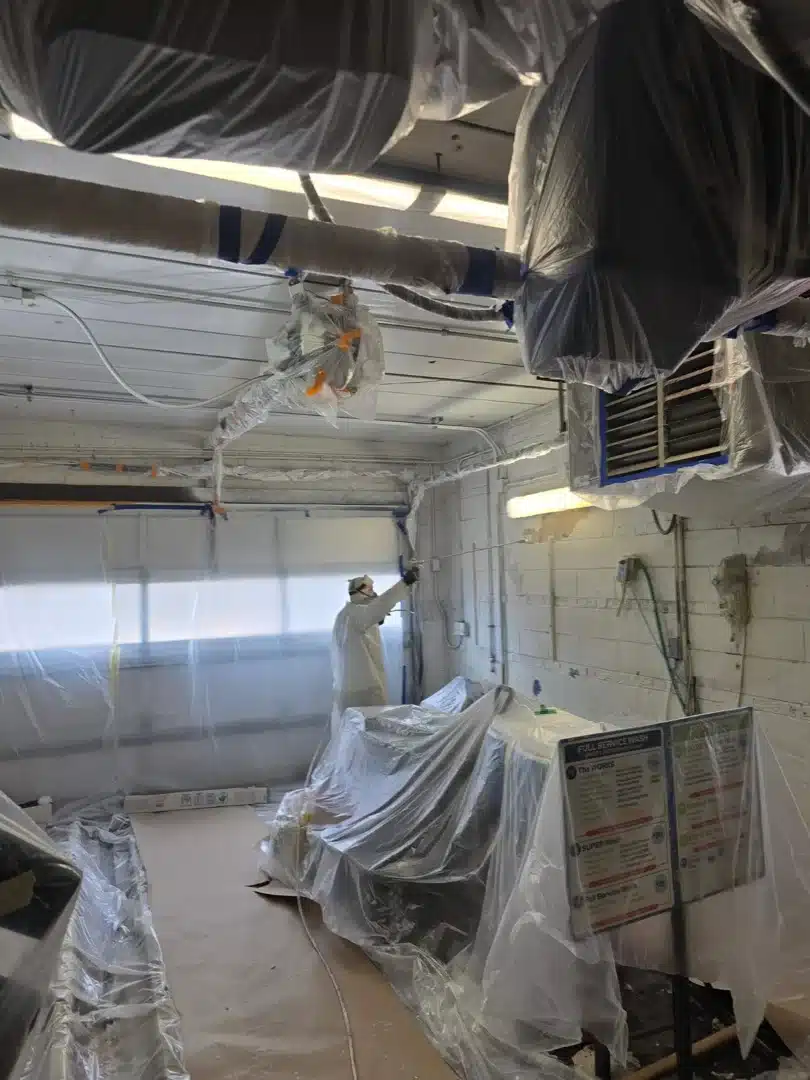
Industrial Metal Coating in Wheaton: Protecting Commercial Metal Surfaces
For commercial facilities in Wheaton and nearby DuPage County communities, industrial metal coating means choosing a protective finish that fits the metal, the environment, and the job. Epoxy and polyurethane systems can help control rust and weathering, while powder, PTFE, plating, and thermal-spray coatings may address factory-based needs such as abrasion, heat, chemical exposure, or low friction. The right choice begins with surface preparation, clear performance requirements, and a qualified provider.
Metal coatings can extend the useful life of railings, doors, equipment housings, structural steel, fixtures, and other exposed assets. They create a barrier against moisture, chemicals, UV exposure, impact, and wear – but only when the coating is compatible with the substrate and applied correctly.
For buildings and commercial properties, field-applied specialty coatings are often practical for maintenance and renewal. Some advanced processes, including vacuum metallizing, thermal diffusion, and certain plating systems, are generally completed in specialized production facilities. This guide explains where each option fits, what standards matter, and how to evaluate a coating plan before work begins.
I am Tomasz Niemotko of T&Z Interior And Exterior Painting, with more than 15 years of experience in commercial painting, specialty coatings, and detailed surface-preparation work across Lombard, Glen Ellyn, Wheaton, and surrounding towns. While industrial metal coating Wheaton projects can require specialized processes, our experience helps commercial property owners understand practical coating, maintenance, and protection options for painted metal surfaces.
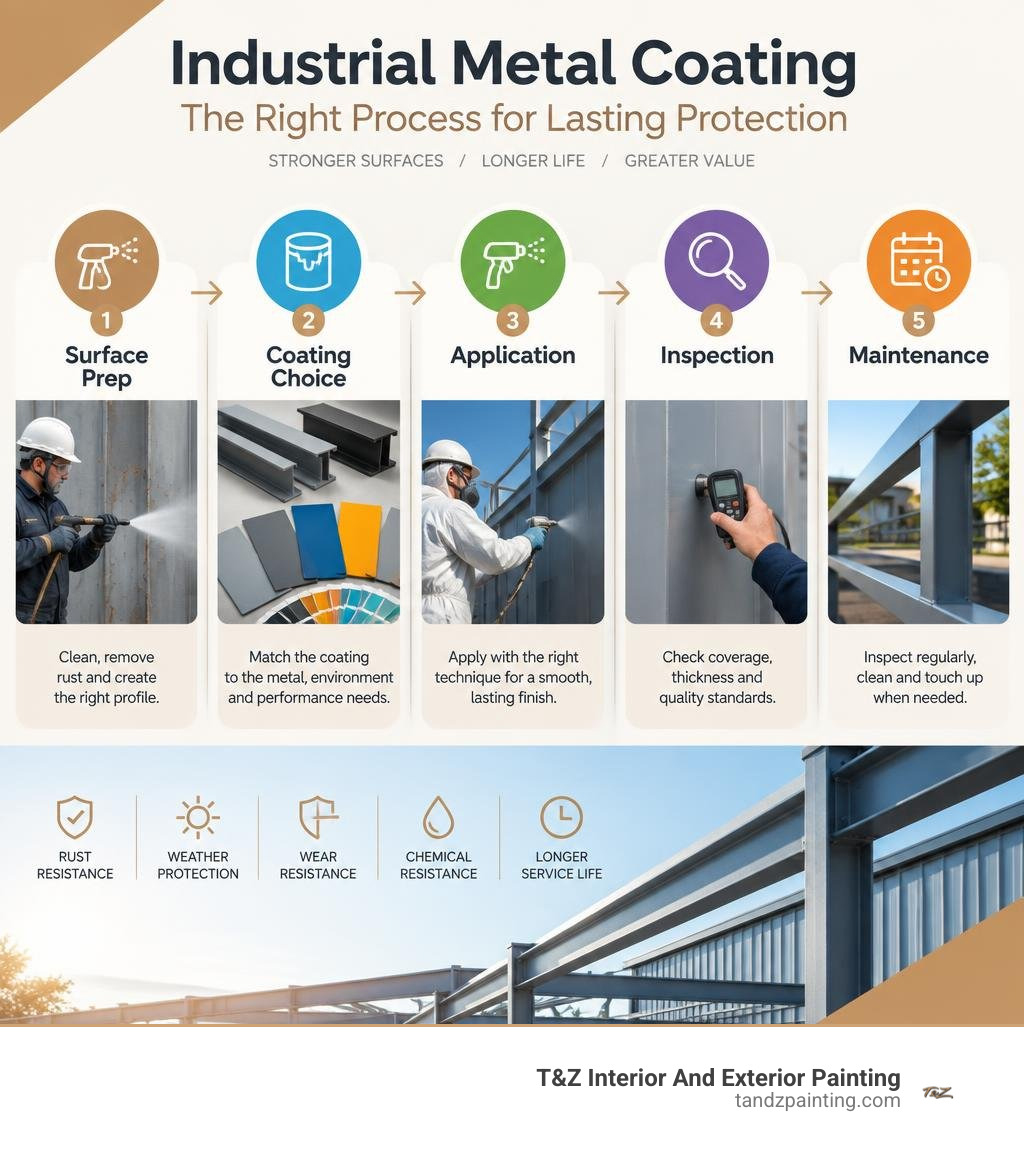
Important industrial metal coating Wheaton terms:
- high quality industrial metal spray Addison
- metal spray painting
- durable metal protection spraying Lombard
Core Types of Industrial Metal Coatings and Application Processes
Industrial metal finishing involves a broad spectrum of chemistries and application technologies. Choosing the proper system requires matching functional demands—such as extreme corrosion resistance, high operating temperatures, low friction, or chemical containment—with the geometric and structural realities of the workpiece.
To help navigate these options, commercial facility operators can consult comprehensive resources like our guide where industrial spray painting and finishing solutions are explained in detail.
The primary categories of industrial coatings include:
- High-Build Liquid Spray Coatings: Multi-layer systems combining zinc-rich primers, epoxy barrier midcoats, and aliphatic polyurethane or fluoropolymer topcoats. Ideal for structural steel, architectural metalwork, and stationary facility equipment.
- Thermoset Powder Coatings: Polymer powders electrostatically sprayed onto conductive metals and cured in convection ovens at 350°F to 400°F. They yield uniform, impact-resistant films without solvent emissions.
- Fluoropolymer and PTFE Formulations: Specialized coatings engineered for extreme chemical resistance, dry-film lubrication, non-stick release properties, and broad operational temperature ranges.
- Thermal Diffusion Coatings: Vapor-phase zinc diffusion processes (such as ArmorGalv®) that form metallurgical zinc-iron alloy layers within the substrate, delivering 2,000 to 5,000 hours of Neutral Salt Spray (NSS) corrosion resistance and continuous heat tolerance up to 1,202°F (650°C).
- Electroless Plating & Hard Chrome: Chemical reduction deposition providing uniform coverage on complex geometries. Specialized treatments, including Diamond Chrome or co-deposited diamond/PTFE formulations, achieve surface hardness ratings of 85+ RC with friction coefficients at or below 0.15.
- Vacuum Metallizing & Physical Vapor Deposition (PVD): Chamber-based thermal evaporation depositing ultra-thin metal layers (0.05 to 2.0 µm) across 3D substrates for functional EMI/RFI shielding, optical reflectivity, or decorative metal finishes.
| Coating Technology | Typical Application Method | Primary Strengths | Operating Temperature Limits | Ideal Commercial/Industrial Use Case |
|---|---|---|---|---|
| High-Build Epoxy / Polyurethane | Airless / HVLP Liquid Spray (Field or Shop) | Corrosion defense, UV resistance, color stability, on-site maintainability | Up to 250°F – 300°F continuous | Structural steel, exterior building metals, storage tanks, equipment housings |
| Powder Coating | Electrostatic Spray + Thermal Bake | Impact toughness, uniform edge wrap, zero-VOC formulation | Up to 300°F – 400°F continuous | Railings, commercial ductwork, light fixtures, architectural metal panels |
| Fluoropolymer (PTFE / FEP / PFA) | Liquid Spray + High-Bake Sintering | Dry-film lubricity, chemical barrier, non-stick release | Up to 500°F continuous | Fasteners, chemical processing valves, food-grade processing equipment |
| Thermal Diffusion (Zinc Alloy) | Sealed Drum Thermal Evaporation | 2,000–5,000 hrs NSS protection, no hydrogen embrittlement | Up to 1,202°F (650°C) | Threaded fasteners, marine hardware, heavy structural connections |
| Electroless Nickel / Hard Chrome | Immersion Chemical / Electro-Bath | Extreme hardness (up to 85+ RC), wear resistance, low friction | Up to 600°F – 1,400°F (formulation dependent) | Machined tooling, molds, hydraulic pistons, shafts |
| Vacuum Metallizing | Vacuum Chamber Thermal Deposition | Ultra-thin profile, EMI/RFI shielding (70–100+ dB attenuation) | Substrate dependent (plastics/metals) | Electronic housings, optical reflectors, precision shielding |
High-Performance Liquid and Spray Metal Coatings
Liquid spray coatings remain the standard for large-scale commercial facilities, structural building envelopes, and on-site asset maintenance. Unlike oven-cured powders or chemical immersion baths, multi-coat liquid systems can be applied directly in the field to protect fixed infrastructure from aggressive Midwestern weather cycles.
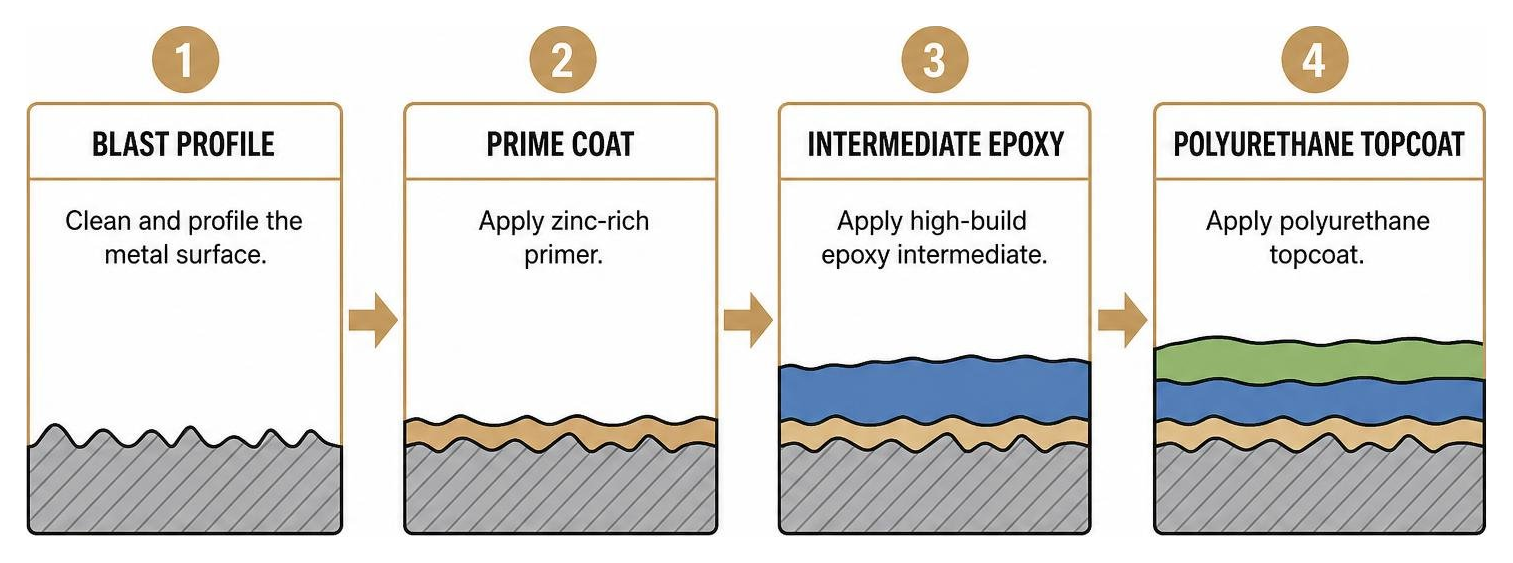
A high-performance liquid coating specification typically relies on a three-tier defense:
- Zinc-Rich Primer: Serves as a sacrificial anode, providing galvanic protection that stops corrosion creep if the top layers are gouged.
- Polyamide or High-Build Epoxy Intermediate Coat: Acts as an impermeable physical barrier against water, oxygen, and chemical vapors, adding dry-film thickness (DFT).
- Aliphatic Polyurethane or Polysiloxane Topcoat: Provides excellent gloss and color retention, UV blocking, and resistance to chemical washdowns and atmospheric pollution.
Commercial facility owners seeking to preserve interior logistics infrastructure or exterior facades can learn more about preventing rust on commercial steel to avoid costly structural steel replacements down the road.
Advanced Functional and Chemical Barrier Coatings
Demanding manufacturing and processing facilities often require coatings that perform mechanical or chemical tasks beyond basic rust prevention. When components face extreme friction, caustic chemical exposure, or continuous thermal cycling, functional barrier coatings are specified.
Technologies like thermal diffusion and fluoropolymer coatings create non-wetting, ultra-low-friction surfaces. For instance, PTFE and related fluoropolymer matrices (such as Xylan® or Halar®) provide chemical inertness across pH 1 through 14 while reducing mechanical drag on moving metal parts.
Regional industrial benchmarks, like those documented in the Illinois industrial coating industry directory, demonstrate how advanced metallurgy and chemical engineering intersect to protect critical processing equipment across the Midwest.
Selecting the Right Industrial Metal Coating in Wheaton for Commercial Facilities
Selecting an appropriate coating specification requires evaluating five technical parameters: substrate chemistry, environmental severity, mechanical wear, thermal profile, and application environment (shop versus field). Facilities in DuPage County face seasonal freeze-thaw cycles, high summer humidity, and exposure to deicing salts, making environmental evaluation essential.
Engineers and property managers planning a facility upgrade can review commercial metal spraying solutions to evaluate coating systems against specific facility parameters.
Key selection criteria include:
- Substrate Compatibility: Carbon steel, cast iron, hot-dip galvanized steel, and aluminum each require distinct surface profiles and priming chemistries. Applying liquid epoxies over un-profiled galvanized metal or aluminum without a proper tie-coat results in premature delamination.
- Operating Atmosphere: Facilities must be categorized according to ISO 12944 atmospheric corrosivity categories, ranging from C1 (very low risk, heated interior spaces) to C4/C5 (industrial environments with high humidity and aggressive chemical atmospheres).
- Mechanical Stress and Impact: Structural metal exposed to vehicular traffic, forklifts, or abrasive particulate requires ductile coatings with high tensile strength and Taber abrasion resistance.
- Chemical and Thermal Exposure: Metal assets exposed to routine high-pressure washdowns, solvent splashes, or high temperatures require cross-linked phenolic epoxies, silicone-based coatings, or fluoropolymers.
Performance Benefits of Industrial Metal Coating in Wheaton Facilities
Applying an engineered industrial coating system protects commercial metal assets against premature structural failure and expensive downtime.
When evaluating high-performance coatings, engineers measure performance through standardized ASTM testing methods, particularly ASTM B117 Neutral Salt Spray (NSS) exposure. While standard commercial paints show blistering within 250 to 500 hours of salt spray exposure, industrial-grade multi-coat epoxy systems achieve 1,500 to 3,000 hours, and thermal diffusion systems exceed 5,000 hours without red rust development.
The core performance advantages include:
- Galvanic and Barrier Corrosion Protection: Prevents oxidation and structural loss on metal decking, support columns, and utility framing.
- Operational Friction Reduction: Functional dry-film lubricants reduce mechanical wear, noise, and energy consumption in mechanical linkages.
- Thermal Stability: Specialized coatings maintain adhesion and color stability at sustained temperatures up to 1,202°F (650°C).
- Extended Maintenance Lifecycles: Durable industrial coatings significantly extend intervals between major maintenance overhauls.
Commercial property managers can discover additional metal surface protection benefits that help preserve capital assets across local commercial facilities.
Substrate Preparation and Surface Pretreatment Requirements
No industrial metal coating can perform effectively without proper surface preparation. Over 80% of all premature coating failures stem directly from inadequate surface cleanliness or improper anchor profiles.
Before applying coatings to non-ferrous surfaces, teams must follow proper galvanized metal preparation techniques to remove zinc salts and ensure permanent topcoat adhesion.
Key Industries and Commercial Applications Across DuPage County
Commercial and light industrial facilities across Wheaton, Carol Stream, Addison, Elmhurst, and Downers Grove utilize specialized metal coatings to safeguard equipment, infrastructure, and architectural envelopes.
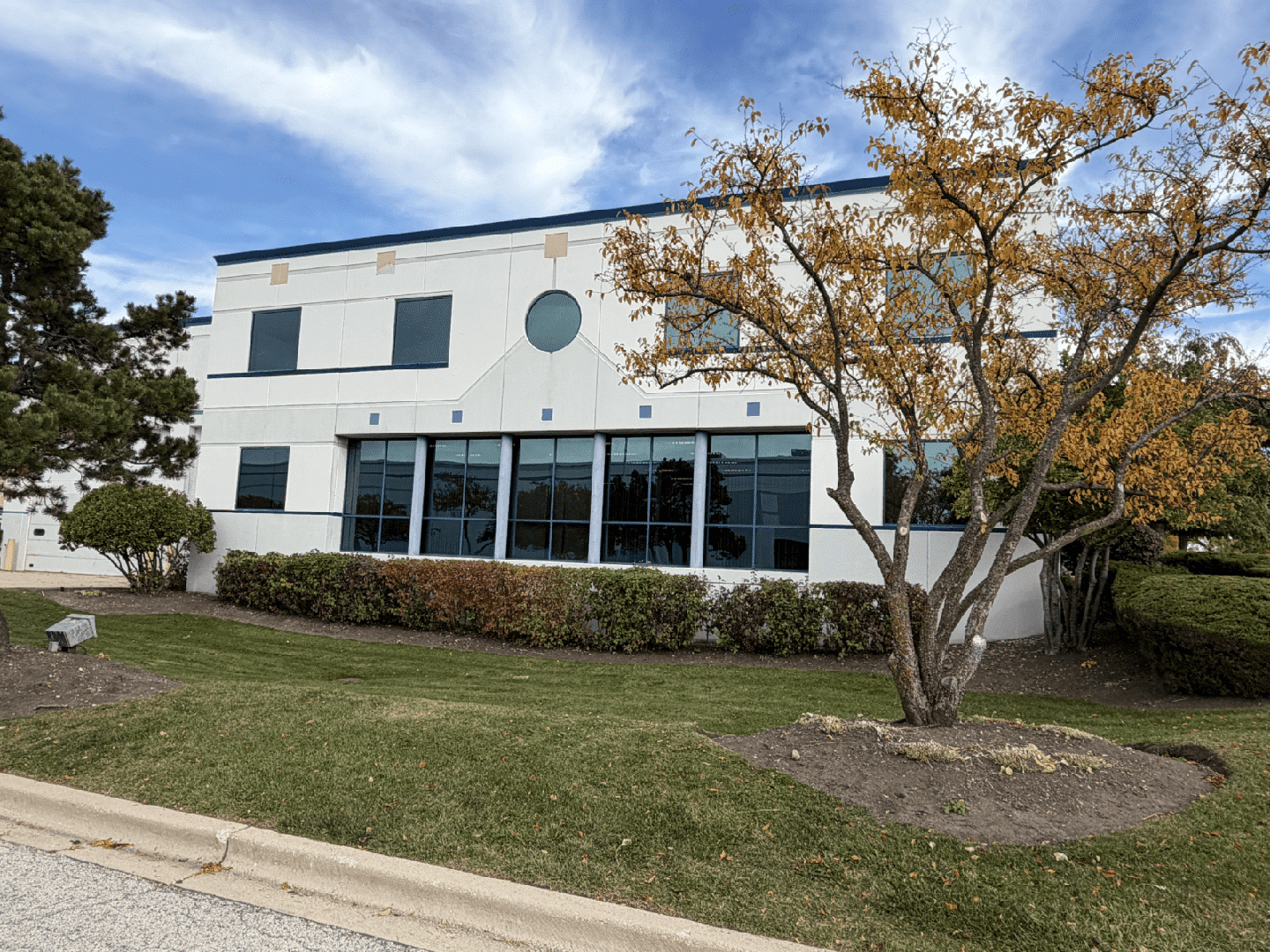
Architectural Metal and Structural Steel Protection
Commercial retail properties, corporate offices, distribution centers, and educational buildings feature substantial architectural metal that demands protection against weather and UV degradation. Architectural elements—including structural canopies, exterior insulated metal panels, curtain wall extrusions, metal roofing, and ornamental railings—require durable finishes.
Fluoropolymer liquid formulations, such as polyvinylidene fluoride (PVDF) and silicone-modified polyesters (SMP), have set the standard for exterior building products for nearly 60 years. These coatings offer exceptional color retention and resistance to chalking, thermal shock, and airborne pollutants.
Property managers can review the commercial spray painting advantages that high-performance architectural spray finishes offer for commercial properties.
Machinery, Tooling, and Heavy Equipment Coatings
In manufacturing facilities, warehousing hubs, and material processing centers, metal coatings protect production equipment from friction and aggressive environments.
Key industrial machinery applications include:
- Hydraulic Cylinders and Actuator Housings: Treated with hard chrome or electroless nickel to achieve Rockwell hardness values up to 85+ RC, resisting score marks and seal wear.
- Conveyor Framing, Racks, and Material Chutes: Coated with high-build polyurethanes or low-friction dry films to handle continuous impact and abrasive throughput.
- Air Handling Units and Rooftop HVAC Equipment: Coated with epoxy-polysiloxane systems to resist acidic atmospheric condensation and severe weather.
Facilities seeking local, professional spray application services can explore our specialized metal spray painting services in Wheaton tailored to commercial equipment and architectural metal maintenance.
Quality Standards, Certifications, and Environmental Regulations
Industrial metal coating specifications require strict adherence to quality assurance standards, verified testing methods, and state environmental laws.
Key industry quality frameworks include:
- ISO 9001:2015: Ensures systematic quality management, traceability of chemical batches, and calibrated inspection tools.
- AS9100D: Governs tight-tolerance aerospace and defense metal finishing processes.
- MIL-Spec Standards: Military standards specifying exact salt spray hours, chemical agent resistance, and low-reflectivity performance.
- SSPC / NACE (AMPP) Standards: Guides surface cleanliness standards (such as SSPC-SP 10 Near-White Metal) and dry-film thickness measurements (SSPC-PA 2).
Illinois environmental regulations, enforced through the Illinois Environmental Protection Agency (IEPA) and Title 35 of the Illinois Administrative Code, regulate industrial metal finishing operations. These regulations limit volatile organic compound (VOC) emissions, require solvent recovery procedures, and govern the safe handling and disposal of hazardous waste streams.
Modern high-performance coatings comply with these environmental limits through high-solids liquid formulations, waterborne cross-linking polymers, closed-loop coil recovery systems, and low-VOC solvent blends.
Key Evaluation Standards for Industrial Metal Coating in Wheaton Projects
Commercial facility managers should verify several quality checkpoints during any metal coating project:
- Anchor Profile Depth (ASTM D4417): Verification that abrasive blast surface profiling creates a mechanical anchor pattern between 1.5 and 3.0 mils.
- Dry Film Thickness (DFT) Inspection (SSPC-PA 2): Calibrated magnetic or eddy-current gauge testing to ensure coating layers meet specified mil thicknesses without thin spots or excessive buildup.
- Cross-Hatch Adhesion Testing (ASTM D3359): Quality verification testing the bond between primer, intermediate coats, topcoats, and the underlying metal.
- Environmental Parameter Monitoring: Real-time logging of substrate temperature, ambient air temperature, relative humidity, and dew point during application and curing.
Property managers can consult our comprehensive expert guide to metal spray painting for additional insights on quality inspection procedures and service standards.
Frequently Asked Questions about Industrial Metal Coatings
What coating offers the highest corrosion resistance for outdoor metal in Illinois?
For outdoor structural steel, ornamental metalwork, and building fixtures in Illinois, multi-coat liquid systems combining a zinc-rich primer, a high-build epoxy intermediate coat, and an aliphatic polyurethane topcoat deliver reliable, long-lasting corrosion protection.
On existing or weathered metals where minor surface corrosion is present, applying durable rusty metal primers passivates oxidation and creates an adherent foundation for protective topcoats. For factory-manufactured fasteners and sub-assemblies, thermal diffusion coatings (such as ArmorGalv®) provide 2,000 to 5,000 hours of Neutral Salt Spray resistance.
How do liquid spray coatings compare to factory-applied powder coatings?
Powder coatings provide a tough, impact-resistant finish with zero VOC emissions, making them ideal for shop-manufactured components, light poles, and modular architectural railings that fit into high-temperature curing ovens.
However, high-performance liquid spray coatings provide greater field versatility. They can be applied on-site to existing structural steel, building facades, and large machinery without dismantling assets or exposing them to high oven cure temperatures. Liquid systems are also easier to inspect, feather-edge, and touch up during routine facility maintenance.
Facility managers can review our commercial spray painting guide to compare shop-applied versus field-applied spray processes.
What local environmental regulations apply to industrial coatings in DuPage County?
Industrial and commercial metal coating applications in DuPage County must comply with Illinois EPA air quality regulations under Title 35 of the Illinois Administrative Code. These rules mandate strict VOC emission limits on architectural, commercial, and industrial maintenance coatings.
Professional applicators meet these environmental standards by using high-solids epoxy and polyurethane formulations, advanced HVLP (High Volume Low Pressure) spray equipment that maximizes transfer efficiency, and compliant solvent handling procedures.
Conclusion
Protecting commercial metal assets across Wheaton, Lombard, and DuPage County requires selecting coating formulations engineered for environmental durability, mechanical wear, and chemical exposure. Whether safeguarding structural steel frameworks, architectural panels, rooftop mechanical housings, or interior logistics infrastructure, proper surface preparation and professional application are critical for lasting asset protection.
At T&Z Interior And Exterior Painting, we bring over 15 years of hands-on commercial painting and specialty coating expertise to properties across Lombard, Wheaton, Glen Ellyn, Itasca, Addison, Oak Brook, and surrounding communities. As a licensed and insured painting contractor with a 5.0 Google Reviews rating, our team is dedicated to expert craftsmanship, rigorous surface preparation, and using top-brand materials to protect and elevate commercial properties.
To plan your next facility maintenance or architectural metal coating project, explore our professional spray painting services or contact our team today to discuss your project requirements.