
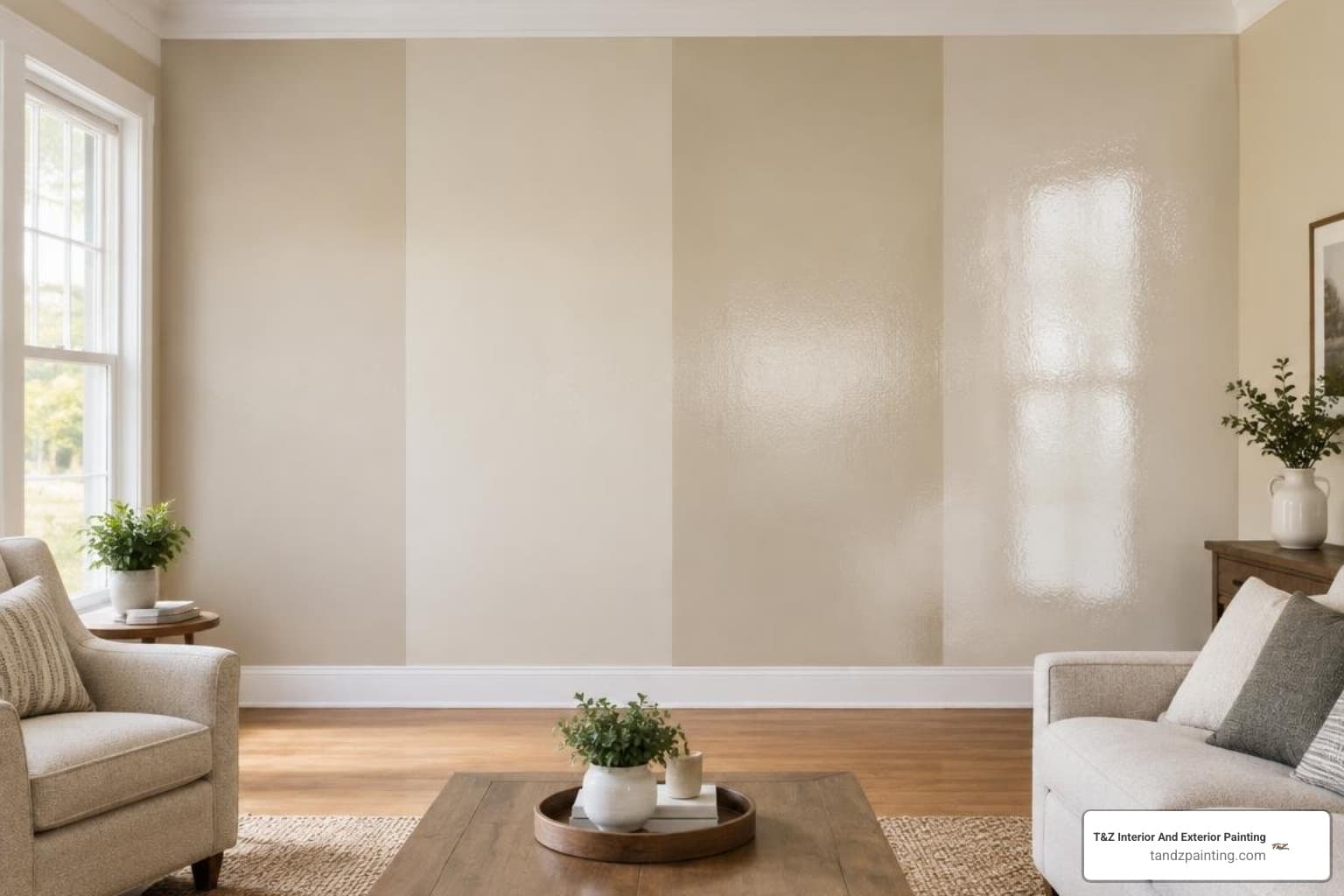
Types of Interior Paint Sheens at a Glance
The five common types of interior paint sheens are flat or matte, eggshell, satin, semi-gloss, and high-gloss, from least to most shiny. Choose flat or matte for ceilings and walls with minor flaws, eggshell for living rooms and bedrooms, satin for busy walls and kitchens, and semi-gloss for bathrooms, trim, and doors. High-gloss works best on smooth cabinets and details where you want shine.
Sheen affects more than appearance: it changes how light plays on a color, how clearly wall flaws show, and how easily you can clean the paint.
I’m Tomasz Niemotko, owner and founder of T&Z Interior And Exterior Painting, a licensed and insured contractor founded in 2009 and based at 1101 S Columbine Ave, Lombard, IL 60148. With over 15 years of experience painting interiors, I help homeowners choose among the types of interior paint sheens for each room and surface.
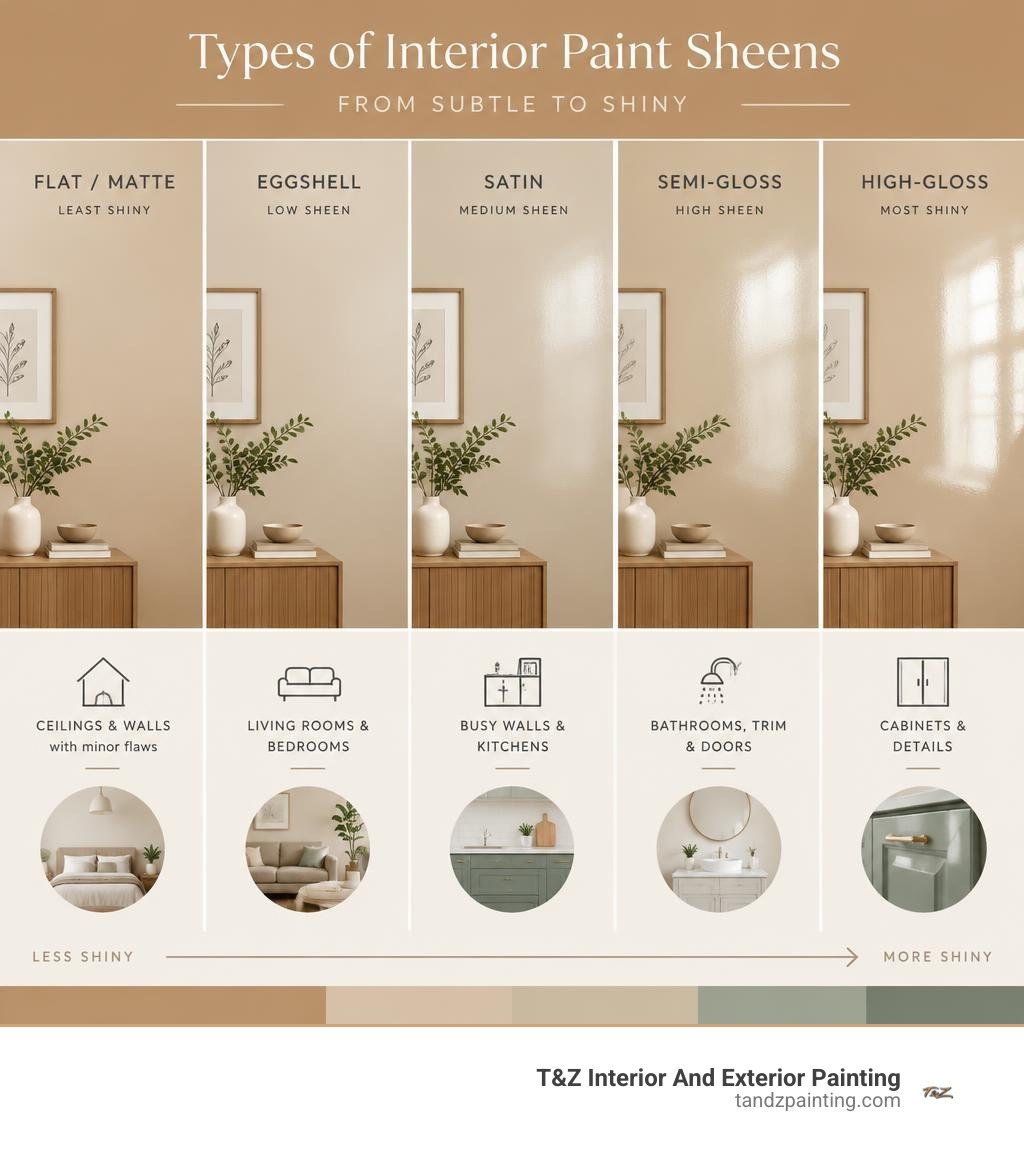
Types of interior paint sheens vocabulary:
- how to choose the best kitchen paint finish
- best paint finish for bathroom walls
- durable paint finish guide
Types of Interior Paint Sheens: From Flat to High-Gloss
Sheen describes how much light a painted surface reflects. Low-sheen paint absorbs light and looks soft. High-sheen paint bounces light back and looks shiny. Paint makers describe the same idea in a manufacturer’s guide to interior paint sheen, which ties sheen to traffic, moisture, and surface type.
Sheen comes from the paint’s makeup. Higher-sheen paints contain more resin (the binder that forms a hard, smooth film), which makes them shinier, tougher, and easier to wipe clean. Lower-sheen paints carry more pigment, so they look deeper and more even but resist scrubbing less well. Higher-sheen paint also tends to cost more.
How the types of interior paint sheens differ
- Flat: No shine at all. It hides minor flaws and touches up well, but it is the least durable and stains are harder to remove. Rubbing can leave shiny, burnished spots.
- Matte: A touch more life than flat, with a low luster. It still hides imperfections and is often more washable than flat.
- Eggshell: A soft, velvety look with a slight glow. It balances flaw hiding with decent cleanability.
- Satin: A smooth, pearl-like finish. It is more stain resistant and durable than eggshell, but it shows flaws more.
- Semi-gloss: Sleek and reflective. It handles moisture, scrubbing, and wear well, and it shows every bump.
- High-gloss: Mirror-like and the most durable and wipeable. It highlights every imperfection, so it needs careful prep.
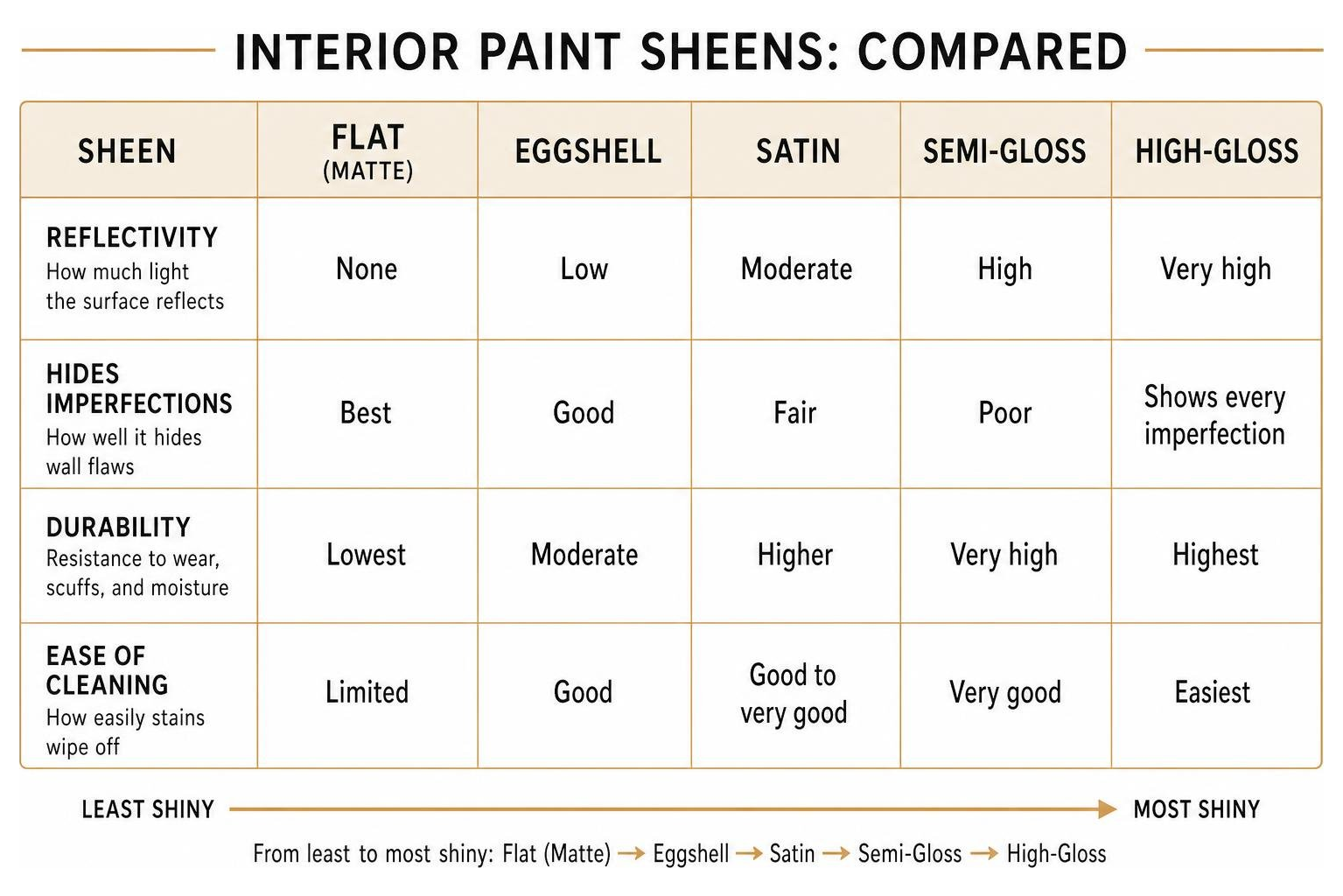
| Sheen | Reflectivity | Hides imperfections | Durability | Ease of cleaning |
|---|---|---|---|---|
| Flat | None | Best | Lowest | Limited |
| Matte | Very low | Very good | Low to moderate | Fair |
| Eggshell | Low | Good | Moderate | Good |
| Satin | Medium | Fair | Moderate to high | Very good |
| Semi-gloss | High | Poor | High | Excellent |
| High-gloss | Highest | Poorest | Highest | Excellent |
Specialty names and sheen labels across paint lines
Many paint lines add extra names between the main five. You may see pearl (a subtle shimmer between eggshell and semi-gloss), velvet (a flat finish with a hint of sheen), low-lustre, medium-lustre, or flat enamel. Low-lustre is smooth and fairly durable. Medium-lustre is a higher-gloss option often used on doors and trim. Flat enamel looks non-reflective but offers some washability.
There is no universal naming standard. One company’s satin can look like another’s eggshell. A manufacturer’s interior sheen and finish guide explains that finishes fall into broad groups: flat, eggshell-type (including low sheen, satin, and velvet), semi-gloss-type (including pearl), and gloss. Use the product label as your guide, not the name alone.
How sheen changes color in different lighting
The same color looks different in different sheens. Light colors in a glossy finish look brighter and sharper. Dark colors in a glossy finish look deeper. Matte colors can look darker from an angle or in low light, and flat straight on. Glossy paint can look blotchy on rough or uneven walls.
Consider these factors:
- Natural light: Strong sun makes shiny walls glare and exposes flaws. Low-sheen finishes look calmer in bright rooms.
- Artificial light: Lamps and recessed lights create hot spots on glossy walls.
- Viewing angle: Hallways are seen from many angles, so choose a finish that looks consistent as you walk past.
- Wall texture: Textured or uneven walls look better in lower sheens.
Always brush out a sample patch and look at it morning, afternoon, and evening. Painting three strips of the same color in different sheens and viewing them from several angles shows the difference quickly.
Choosing Among Types of Interior Paint Sheens for Each Room
Match sheen to traffic, moisture, cleaning needs, and wall condition. This table gives a quick starting point.
| Room or surface | Recommended sheen |
|---|---|
| Ceilings | Flat |
| Bedrooms | Matte or eggshell |
| Living and dining rooms | Eggshell, matte, or satin |
| Home offices | Eggshell or satin |
| Kitchens | Satin or semi-gloss |
| Bathrooms and laundry rooms | Satin or semi-gloss |
| Kids’ rooms | Satin or eggshell |
| Hallways | Eggshell or satin |
| Trim and doors | Semi-gloss or satin |
| Cabinets | Semi-gloss or high-gloss |
Living rooms, bedrooms, dining rooms, and home offices
These rooms see lighter wear, so you can favor a calm look. Matte is a popular choice for bedrooms because its soft, non-reflective surface feels cozy. Eggshell is a strong all-around pick for living rooms and offices, since it resists furniture scuffs better than flat while staying gentle on the eyes. Satin suits family rooms where kids and pets are active.
Low sheen also makes touch-ups easier. If you have uneven drywall, low-sheen finishes for hiding wall imperfections are worth a close look, and the eggshell benefits for living rooms explain why that finish is so common.
Kitchens, bathrooms, laundry rooms, and kids’ rooms
These spaces deal with humidity, splashes, grease, and sticky fingers, so choose a washable finish. Satin and semi-gloss both stand up to moisture and scrubbing. Semi-gloss is the toughest, while satin looks less harsh on large wall areas.
Good ventilation matters just as much as the paint. Run exhaust fans during and after showers and cooking so moisture does not wear down the finish. For bathrooms, read about the bathroom wall finish without excess glare, and for kitchens, see the pros and cons of satin paint on kitchen walls.
Hallways, ceilings, trim, doors, and cabinets
Hallways take constant brushes from shoulders, bags, and hands, so eggshell or satin works well. Ceilings are best in flat paint, which hides roller marks and flaws and resists splatter. See our take on the best sheen for living room walls if you are matching adjoining spaces.
Trim, doors, and cabinets are touched often and define a room’s architectural details. Semi-gloss is the standard choice, with high-gloss for a striking look on very smooth surfaces. Contrasting glossy trim with softer walls adds depth. Our guide on the sheen for trim paint goes deeper. Prep quality matters most here, because gloss shows every dent and drip.
How to Choose, Maintain, and Troubleshoot a Paint Sheen
Start with room function, traffic, moisture, wall smoothness, and lighting. Then test sample boards in the actual room. Our durable finishes for walls guide helps narrow the choice.
Balance imperfection hiding, durability, and cleaning
Every sheen is a trade-off.
- Flat and matte hide flaws and have low glare, but scuffs and stains show more, and scrubbing can burnish the surface. Some modern washable flat formulas clean better than older ones, so check the label.
- Eggshell and satin offer a middle path, with better scrub resistance but more visible flaws.
- Semi-gloss and high-gloss resist stains and scrubbing best, but they create glare and exaggerate bumps.
Read more in our look at the matte paint pros and cons.
Prepare and apply paint for an even finish
Preparation decides how good any sheen looks. Our team follows these basics:
- Clean walls to remove dust, grease, and grime.
- Patch holes and cracks, then sand smooth. Drywall repair is part of our work.
- Prime where needed. Primer helps adhesion, evens out absorption, and blocks stains.
- Apply paint consistently with a steady technique, keeping a wet edge to avoid lap marks.
- For semi-gloss and high-gloss, use multiple thin coats rather than one thick coat.
Follow the manufacturer’s instructions for drying and recoat times.
Handle sheen changes and uneven or dull paint
Paint can dull over time from wear, cleaning, and exposure. Uneven sheen often appears where touch-ups were done or where a wall was scrubbed. Repainting the whole affected wall, corner to corner, with the same product blends best. When changing sheen, use a compatible topcoat, make sure the surface is clean, and test a small patch for adhesion first. Gloss additives exist, but results can vary, so follow the product’s directions.
Frequently Asked Questions About Interior Paint Sheens
Can you change the sheen after paint has been applied?
Yes. Clean the surface, lightly sand if the existing finish is glossy, and apply a compatible topcoat in the new sheen. Test a patch first to check adhesion and appearance, then repaint the full surface.
Are eggshell and satin the same across paint brands?
No. Names vary by brand and product line, and one maker’s eggshell can look closer to another’s satin. Compare finish samples and the technical data sheets, and judge actual product performance rather than the name.
What are the pros and cons of flat or matte paint in a high-traffic area?
The pros are strong flaw hiding, low glare, and easy touch-ups. The cons are scuffs, stains, and limited cleaning, since scrubbing can burnish the paint. Washable matte options improve this, but eggshell or satin is often safer in busy areas.
Conclusion
Choose sheen by room use, wall condition, lighting, and cleaning needs, and test your selected color and finish before painting the full surface.
T&Z Interior And Exterior Painting was founded in 2009 by Tomasz Niemotko, and our local team brings over 15 years of experience. We are a licensed and insured painting contractor at 1101 S Columbine Ave, Lombard, IL 60148, BBB accredited, with a 5.0 Google rating from 85+ reviews and a 2-year warranty on our work. We paint walls, ceilings, trim, and doors, and we handle kitchen cabinet painting too. Learn more about our interior painting services.
Request a free estimate on tandzpainting.com or call (224) 240-0054. Our hours are Monday–Friday 8 AM–7 PM, Saturday 8 AM–3 PM, and closed Sunday.