
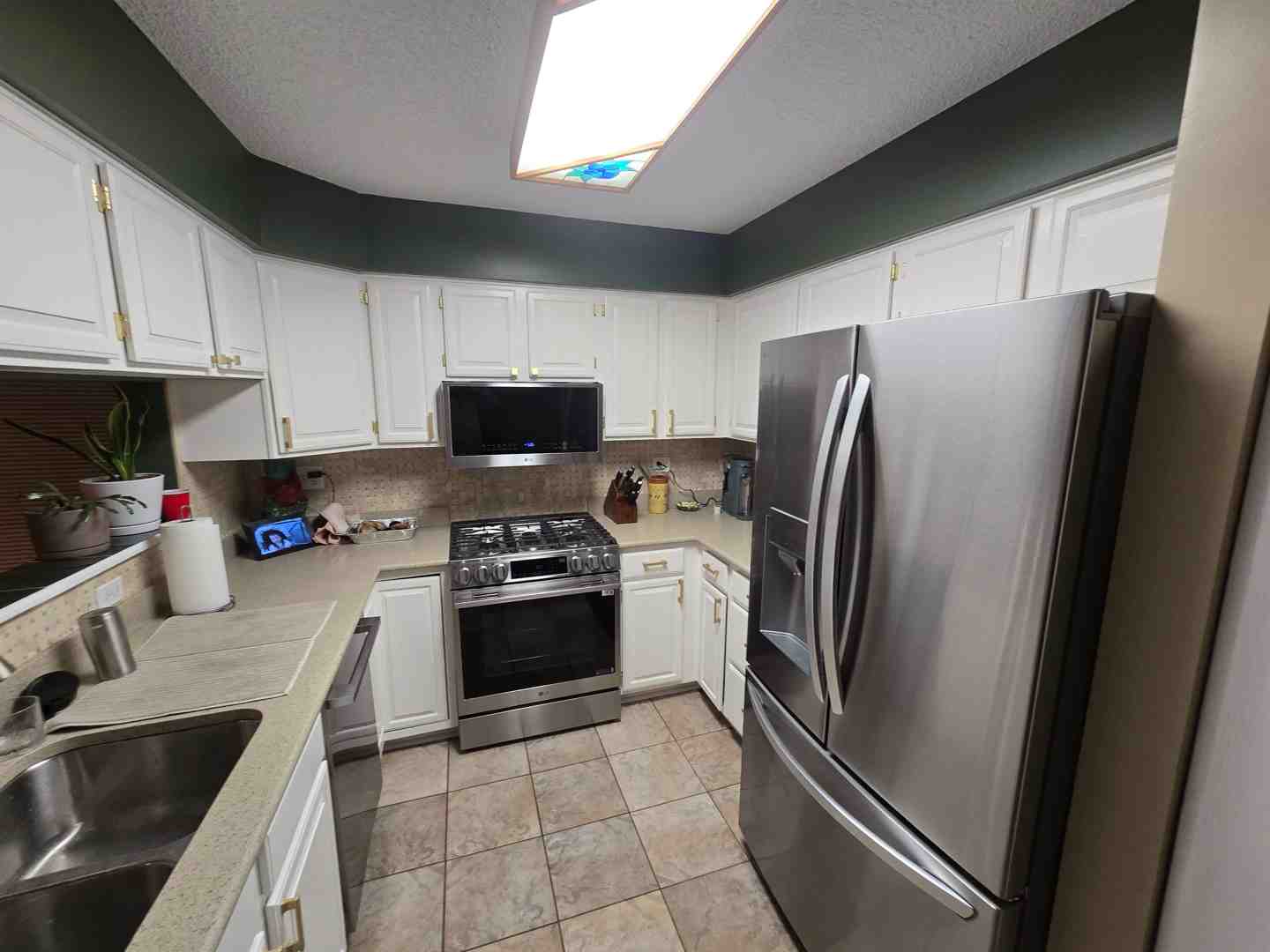
Is Eggshell Paint a Smart Choice for Kitchen Walls?
Yes, eggshell paint for kitchen walls can be an excellent choice when you select a durable, washable interior formula and prepare the surface well. It has a soft, low sheen that is easier to clean than flat paint while hiding wall flaws better than satin or semi-gloss.
Use eggshell if you want:
- A subtle finish with less glare than satin or semi-gloss
- Better resistance to everyday scuffs, food splatters, and light cleaning than flat paint
- A practical wall finish for a kitchen with normal cooking steam and traffic
The important detail is the paint product, not just the sheen label. A kitchen-grade eggshell coating with strong scrub resistance and mold-resistant additives can handle regular wipe-downs. But eggshell is not the best choice for cabinets, trim, or areas that receive constant direct splashing. Those high-contact surfaces usually need a tougher semi-gloss finish.
Eggshell also asks more of the wall and the painter. Its slight sheen can reveal drywall patches, roller marks, and uneven texture that flat paint disguises. Good cleaning, patching, sanding, priming, and careful application make the difference between a smooth finish and one that shows flaws in kitchen lighting.
I am Tomasz Niemotko of T&Z Interior And Exterior Painting, a licensed and insured painting company with 15+ years of experience serving homeowners in Lombard, Itasca, Addison, Glen Ellyn, Oak Brook, and nearby suburbs. Our 5.0 Google Reviews rating reflects our focus on reliable service, detailed preparation, and professional results with eggshell paint for kitchen walls.
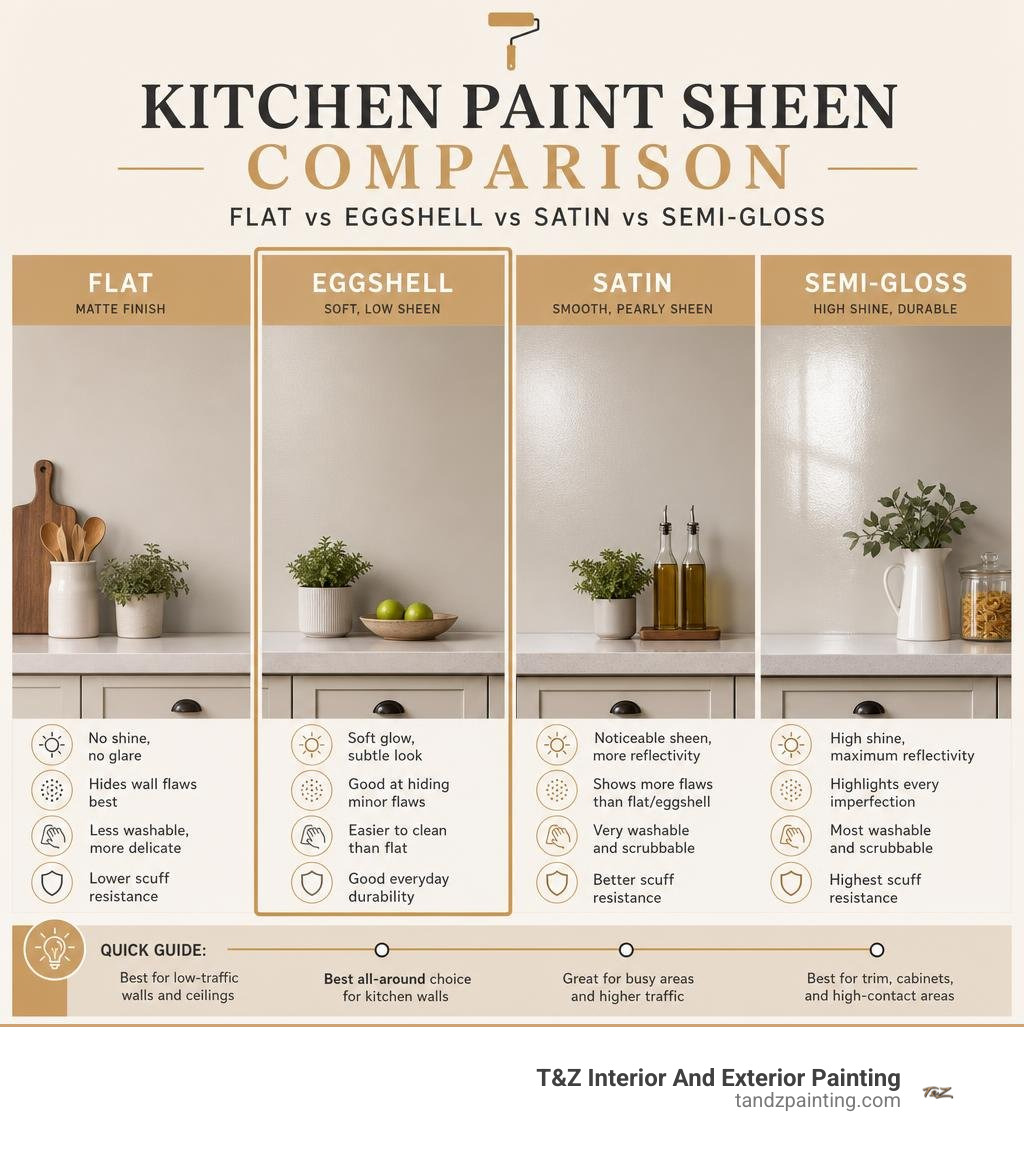
Key eggshell paint for kitchen walls vocabulary:
Understanding Sheen: How Eggshell Compares to Flat, Satin, and Semi-Gloss
Understanding light reflectance is key when selecting the right coating for any room in your home. Light bounces off smooth surfaces and scatters on rough ones. When paint dries, the ratio of resin binders to pigment particles determines its sheen level. Higher resin content creates a tighter, smoother surface film that reflects more direct light, making it inherently more resistant to water and scrubbing.
To make an informed decision for your culinary space, explore everything you need to know about wall paint finishes. Choosing a sheen is always a balancing act between aesthetics and durability. Check out paint sheens 101 the official guide to choosing the right finish for broader context on how sheens function across residential spaces.
The table below outlines how common paint sheens compare in terms of light reflectance, durability, and practical maintenance:
| Sheen Level | Sheen Percentage | Light Reflectance | Scrub Resistance | Hiding Power (Imperfections) | Ideal Kitchen Placement |
|---|---|---|---|---|---|
| Flat / Matte | 0% – 5% | Very Low (Non-reflective) | Low (Prone to burnishing) | Exceptional | Ceilings only |
| Eggshell | 10% – 25% | Low-to-Medium (Soft glow) | Moderate to High (Grade dependent) | Good | Main kitchen walls, dining nooks |
| Satin | 25% – 35% | Medium (Velvety luster) | High | Fair | High-moisture walls, splash zones |
| Semi-Gloss | 35% – 70% | High (Noticeable shine) | Very High | Poor (Shows every bump) | Baseboards, trim, doors, cabinets |
Eggshell vs. Satin and Flat Finishes
When comparing finishes side by side, eggshell provides an elegant middle ground. Flat paint offers zero glare and hides rough drywall patches effortlessly, but standard flat coatings absorb grease, food spatters, and moisture like a sponge. Scrubbing flat paint usually results in burnishing—a shiny, ruined patch on an otherwise matte wall.
On the opposite end, satin paint provides enhanced durability and moisture barrier properties. Homeowners often weigh the pros and cons of using satin paint on your kitchen walls before committing to a final look. While satin stands up to frequent cleaning, its higher sheen reflects direct lighting, which can create visual glare under under-cabinet spotlights or large kitchen windows.
Eggshell delivers a distinct visual softness. With a typical luster rating between 10% and 25%, it creates a warm, non-reflective backdrop that enhances your kitchen’s cabinetry, stone countertops, and tile backsplashes. For walls with minor dings, settling ridges, or patched drywall seams, choosing a low sheen interior paint the secret to hiding wall imperfections allows you to maintain cleanability without putting every structural flaw on display.
Evaluating Eggshell Paint for Kitchen Walls: Durability and Performance
Kitchen walls face unique challenges that living rooms and bedrooms never encounter. Daily exposure to aerosolized cooking oils, steam, temperature fluctuations, and accidental sauce splatters means your wall coatings must deliver genuine washability.
Professional kitchen wall painting requires premium formulas engineered for cleanability. High-performance coatings are rigorously evaluated using standardized tests. For example, trade-grade architectural paints like Dulux Trade Durable Kitchen & Bathroom Eggshell achieve Class 1 ISO 11998 and Type C BS 7719 scrub ratings. A Class 1 wet scrub rating proves the dried paint film withstands repeated, vigorous cleaning without thinning, peeling, or degrading.
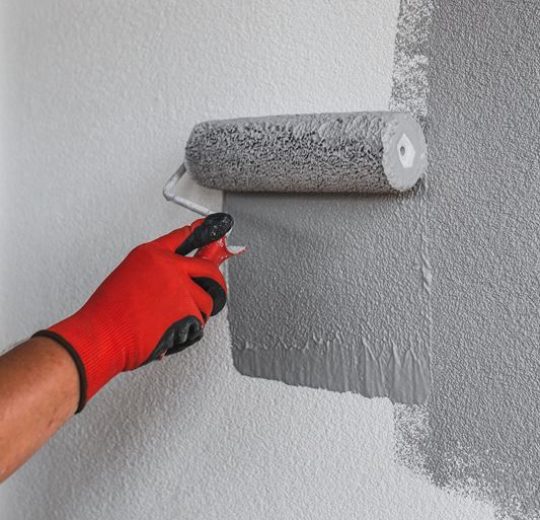
When food splatters hit premium eggshell paint, the hard polymer binder prevents oils and acids from penetrating deep into the substrate. As long as the paint has fully cured, stains can be lifted using mild dish soap, warm water, and a soft microfiber cloth without leaving unsightly shiny burnish marks behind.
Why Contractors Sometimes Advise Against Eggshell Paint for Kitchen Walls
Homeowners occasionally consult painters who strongly recommend sticking to flat paint throughout the entire home, including the kitchen. While some suggest this is merely to hide imperfect drywall seams, there are practical technical reasons behind contractor hesitation.
Modern architectural coatings have evolved. Due to strict low-VOC environmental standards, modern waterborne paints dry much faster than older formulations. This accelerated drying time significantly reduces “open time”—the window of time a painter has to roll over a wet edge before the paint begins to set.
When applying a sheen-bearing paint like eggshell:
- Working too slowly causes the roller to pull at tacky paint, resulting in visible lap marks and roller texture.
- Uneven roller pressure or improper dry film thickness leads to “flashing,” where sheen levels appear splotchy under angled natural sunlight or ceiling can lights.
- Flaws in drywall taping, sanding ridges, and uneven joint compound stand out when light catches the reflective surface.
A professional contractor needs the technical skill and pace to maintain a wet edge across large spans. Discouraging eggshell can sometimes be a contractor’s way of avoiding the extra labor needed to prep walls to a smooth Level 4 or Level 5 drywall finish.
Touch-Up Feasibility and Long-Term Maintenance
One major consideration for busy households in Lombard, Elmhurst, and Downers Grove is long-term touch-up performance. Life happens in the kitchen—chairs bump the drywall, grocery bags scuff the corners, and grease splatters over time.
Touching up an eggshell wall is more complex than touching up flat paint, but modern high-grade products have made the process substantially easier. Formulations like Ben® Interior Paint – Eggshell are specifically engineered with extended open times and scuff-resistant technology. This advanced leveling capability helps localized touch-ups blend into the surrounding wall film without creating obvious flashing halos.
To maintain eggshell walls over years of use:
- Always keep leftover paint from the original batch tightly sealed in a climate-controlled room between 60°F and 80°F.
- Use the original application tool (such as a matching 3/8-inch nap roller) and feather the edges outward from the center of the touch-up.
- Clean scuffs promptly using non-abrasive methods to avoid scratching the microscopic resin matrix of the paint film.
Moisture, Mildew, and VOC Safety in Modern Kitchen Coatings
Boiling pasta, running dishwashers, and simmering soups release substantial moisture into the air. In poorly ventilated kitchen layouts, humidity condenses on cold exterior walls, creating a breeding ground for surface mold and mildew spores.
Quality eggshell formulations designed for moisture-prone zones contain built-in, non-leaching fungicidal agents. These specialized additives inhibit mold and fungal growth directly within the dried paint film, preventing dark spotting and structural paint failure.

At the same time, indoor air quality is a top priority for health-conscious homeowners. Older high-durability paints often relied on heavy volatile organic compounds (VOCs) to achieve stain resistance and open working time. Today, advanced non-toxic and zero-VOC technologies prove you do not have to compromise indoor air safety for commercial-grade durability.
Leading eco-friendly lines, such as Ecos Organic VOC free Wall Paints EGGSHELL WALLPAINT and Neutral Eggshell Interior Wall Paint | YesColours, offer virtually zero VOC emissions while delivering high washability. In fact, advanced formulations can achieve high coverage rates up to 560 sq. ft. per gallon while remaining 99.9% VOC-free. This allows your family to use the kitchen immediately after painting without lingering chemical odors or respiratory irritation.
Application, Prep, and Maintenance Checklist
Achieving an immaculate, durable finish on kitchen walls requires methodical surface preparation. Glossy existing coats, residual cooking grease, and unnoticed drywall flaws will compromise both adhesion and appearance.
Before picking up a roller, review stop the shine how to pick the best paint finish for kitchen walls to confirm your design goals. Proper preparation guarantees your new eggshell paint adheres firmly and resists moisture for years to come.

Checklist: Preparing and Applying Eggshell Paint for Kitchen Walls
Follow this practical checklist to ensure long-lasting results:
Deep Degreasing & Cleaning
- Wash all walls thoroughly with a degreasing cleaner (such as mild TSP substitute or warm soapy water) to eliminate airborne cooking grease, oil residues, and grime.
- Rinse thoroughly with clean water and let dry completely. Paint cannot bond to oily drywall surfaces.
Patching & Mechanical Sanding
- Fill nail holes, dents, and surface cracks with a premium, non-shrinking spackling compound.
- Once dry, sand patched areas flush using 150- to 220-grit sandpaper.
- Lightly scuff-sand existing glossy or semi-gloss finishes to establish a mechanical profile for optimal adhesion.
Targeted Priming
- Apply a dedicated stain-blocking primer over grease stains, water spots, or dark existing colors.
- Prime all bare drywall patches or newly plastered areas to prevent uneven paint absorption (which causes dull, blotchy patches called suction flashing).
Tool Selection & Application Protocol
- Use a premium 3/8-inch to 1/2-inch shed-resistant synthetic roller cover and an angled synthetic brush for crisp cutting-in.
- Maintain an ambient application temperature between 50°F and 90°F.
- Apply two full coats, maintaining a wet film thickness of 3.6 to 4.0 mils.
- Work systematically in 3- to 4-foot sections, rolling from ceiling to floor in a continuous pattern to maintain a wet edge.
Drying, Recoating, and Curing Guidelines
- Allow 2 to 4 hours of drying time between coats under standard humidity conditions.
- Avoid exposing freshly painted walls to heavy cooking steam or condensation for at least 48 hours.
- Respect the Full Curing Cycle: Paint feels dry to the touch in 1 to 2 hours, but takes 10 to 14 days to fully cure and harden. Do not scrub or wash walls during this critical 14-day window.
Long-Term Cleaning Care
- For routine maintenance, use a soft microfiber cloth dampened with warm water and mild dish soap.
- Avoid abrasive scouring pads, harsh bleach solutions, or aggressive scrubbing, which can damage the paint finish.
Frequently Asked Questions About Kitchen Paint Finishes
Can eggshell paint handle grease and food splatters near stoves?
Yes, high-quality eggshell paint is formulated with tight acrylic resins that resist cooking grease and food splatters. However, for the area directly behind a cooktop or high-heat stove, a solid tile or stone backsplash is always the best primary defense. For painted perimeter walls, wipe away fresh grease splatters promptly using a soft cloth and mild liquid dish soap to protect the finish.
How long should eggshell paint cure before washing kitchen walls?
There is an important distinction between drying time and curing time. While waterborne eggshell paint dries to the touch within 1 to 2 hours and can be recoated in 2 to 4 hours, it requires a full 10 to 14 days to achieve maximum film hardness and chemical cure. Subjecting freshly painted walls to wet scrubbing or aggressive cleaners before this 14-day window can soften the latex resin and ruin the finish.
Should eggshell paint be used on kitchen cabinets or trim?
No. We do not recommend eggshell paint for kitchen cabinetry, baseboards, window sills, or interior doors. Architectural trim and cabinets experience heavy friction, direct hand oils, and frequent physical impact. These high-contact surfaces require a dedicated cabinet coating or a durable semi-gloss finish, which cures to an ultra-hard, non-porous surface built for heavy daily handling.
Conclusion
Choosing eggshell paint for kitchen walls gives you the ideal blend of practical durability, washability, and soft interior aesthetics. By opting for a quality, low-VOC formulation, ensuring thorough degreasing and surface prep, and respecting the full 14-day curing cycle, you can enjoy clean, vibrant kitchen walls that handle daily family life with ease.
When you want flawless, long-lasting results without the stress of managing fast-drying sheens, lap marks, or extensive drywall preparation, our seasoned craftsmen are here to help. T&Z Interior And Exterior Painting brings over 15 years of industry experience to homeowners across Lombard, Itasca, Addison, Glen Ellyn, Oak Brook, and the surrounding Chicago suburbs. As a fully licensed and insured contractor with a 5.0 Google Reviews rating, we take pride in clean job sites, meticulous surface preparation, and lasting finishes.
Ready to transform your home with professional craftsmanship? Connect with our team today to explore our expert interior painting services and bring your kitchen vision to life.