
Spray Painting Aluminum Soffit and Fascia: The Quick Answer
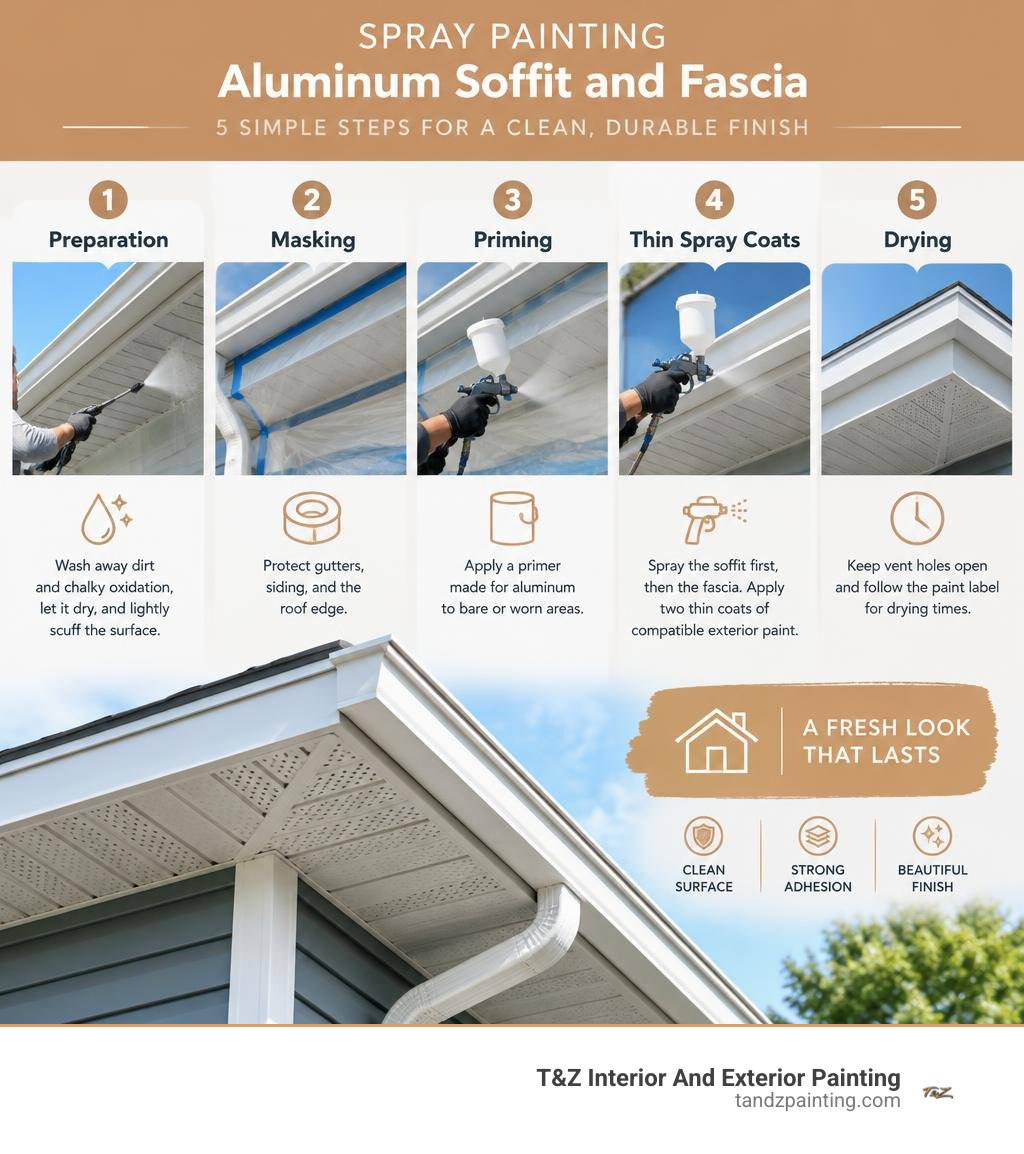
For spray painting aluminum soffit and fascia, wash off dirt and chalky oxidation, let the metal dry, and lightly scuff the finish. Prime bare or worn areas with a primer made for aluminum. Mask the gutters, siding, and roof edge. Then spray the soffit first and the fascia second, applying two thin coats of compatible exterior paint. Keep vent holes open and follow the paint label for drying times.
Spraying can give vented panels a more even finish faster than brushing. The trade-off is more masking and a greater risk of overspray, so choose a calm, dry day.
I’m Tomasz Niemotko, owner and founder of T&Z Interior And Exterior Painting, a licensed and insured painting contractor founded in 2009 at 1101 S Columbine Ave, Lombard, IL 60148. I draw on over 15 years of exterior and spray painting experience to explain spray painting aluminum soffit and fascia.
Spray painting aluminum soffit and fascia word roundup:
Why choose spray painting aluminum soffit and fascia over brushing?
Soffit is the horizontal panel under the roof overhang, and it is often vented. Fascia is the vertical board at the roof edge that holds the gutter. Both are small surfaces, but the work is overhead, and the panels have ridges, seams, and perforations. That is where a sprayer earns its place.
A brush pushes paint into vent holes and leaves it pooling in grooves. A sprayer lays down a fine mist that coats ridges and edges evenly. Manufacturer guidance for aluminum soffit points the same way: use spray paint suited to aluminum and apply several light, quick passes, letting each dry. If you want a closer look at the technique on metal in general, our guide on how to spray paint metal covers the basics.
Spraying versus brushing
| Factor | Spraying | Brushing |
|---|---|---|
| Coverage | Even on ridges, seams, and perforated panels | Can miss grooves or clog vent holes |
| Finish | Smooth, no brush marks when coats are thin | Brush marks and lap marks are possible |
| Speed | Fast on long, plain runs | Slow overhead, and arms tire quickly |
| Control | Needs steady distance and technique | Precise on edges and small areas |
| Overspray | Real risk; wind and drift matter | Almost none |
| Masking | Heavy: gutters, siding, roof, windows, lights | Light: mostly tape lines |
Many painters combine both. They spray the soffit for speed and even coverage, then brush or back-brush the fascia so the paint works into the surface without masking every inch of the roof edge. Back-brushing is simply brushing over wet sprayed paint to even it out. A plain run of aluminum fascia can also be sprayed with careful masking.
How aluminum differs from wood and vinyl
Knowing your material comes first. Tap it with a knuckle: wood sounds dull and solid, aluminum rings metallic, and vinyl sounds hollow. If aluminum wrap sounds hollow or flexes, there may be rotted wood behind it.
| Material | Preparation | Primer | Paint | Color limits |
|---|---|---|---|---|
| Aluminum | Wash, remove chalky oxidation, scuff lightly | Bonding primer on bare or heavily oxidized metal | Compatible exterior acrylic | None for heat, but match your trim plan |
| Wood | Scrape, sand, repair rot, fill | Prime all bare wood | Exterior acrylic or oil-based | None specific |
| Vinyl | Wash and dry, no sanding | Only if heavily faded | Vinyl-safe paint | Never darker than the original, or heat can warp it |
Aluminum’s main problem is oxidation. That chalky film must come off, or the new coat will lift with it. Wood’s problem is rot, which paint cannot fix. Vinyl’s problem is heat, so dark colors are off the table.
Prepare and apply paint to aluminum soffit and fascia
Good results come from three things: clean metal, the right primer, and thin coats. The Sherwin-Williams guide to knowing your substrates and what to use on them is a useful reference for matching coatings to surfaces.
For paint, choose a compatible exterior acrylic made for metal or labeled for use over aluminum. Pair it with an aluminum bonding primer where the metal is bare or heavily oxidized. A satin finish on soffit reduces glare, and semi-gloss on fascia washes down easily, though either sheen works if you match your existing trim. Apply thin coats, follow the manufacturer’s recoat instructions, and work in dry weather with no high winds.
Preparation for spray painting aluminum soffit and fascia
- Inspect first. Walk the roofline and look for chalky oxidation, mildew, peeling paint, corrosion, dents, and loose panels. Press on any wood you can reach with a screwdriver. Soft spots mean rot. Repair before painting, because paint over moisture fails quickly.
- Clean gently. Wash with a mild exterior cleaner and a soft brush on a pole. Mildew on shaded soffits needs a mildew treatment or it will grow through the new paint. Rinse without forcing water up into the vents or behind the fascia.
- Let it dry fully. Give the metal time to dry completely, often a day or more in shade. Trapped moisture causes bubbling.
- Remove loose coating. Scrape or sand any flaking paint back to sound edges.
- Scuff lightly. A fine abrasive pad dulls the old finish so the paint can grip. Wipe off the dust.
- Prime where needed. Spot-prime bare or heavily oxidized aluminum with a bonding primer. Skip full priming on sound, clean, previously painted metal.
Our article on how to prep metal for spray painting goes deeper on cleaning and surface prep. As general advice, if your home was built before 1978, consider testing old paint for lead before scraping or sanding, since scraping fascia creates dust overhead.
Spray painting aluminum soffit and fascia: step-by-step
- Choose your sprayer. An airless sprayer handles exterior paint well. Use a tip size and pressure that match your equipment manual and the paint label. Fine-finish or smaller tips help keep coats thin on vented panels.
- Test spray. Try it on cardboard to check the pattern. Adjust until the fan is even, with no heavy edges or spitting.
- Hold a steady distance. Keep the gun about the same distance from the surface on every pass, usually 10 to 12 inches, unless your equipment instructions say otherwise. Move at a steady pace and keep the gun square to the surface.
- Overlap passes. Overlap each pass by about half so no stripes show.
- Apply light coats. Several light, quick passes beat one heavy coat. Heavy coats run, sag, and can bridge the vent perforations, which blocks roof airflow.
- Spray vents from more than one direction. Perforated panels leave small bare spots if you only spray straight on. Approach from the side as well, and keep the holes open.
- Back-brush if needed. On fascia, a quick pass with a brush works the paint into the surface.
- Apply the second coat after the first has dried per the label. Two finish coats are the normal expectation, especially on fascia, which takes the worst weather.
- Inspect from below. Check from the ground in good light, then touch up misses from the ladder.
Metal expands in hot sun and shrinks as it cools, which can reveal thin bare lines after painting. Spraying on a mild, shaded day helps, and small touch-ups fix any that show.
Masking, safety, and the right painting order
Spraying overhead sends mist everywhere. Masking is the step that separates a clean job from a messy one.
Cover the following before you start:
- Gutters: Tape the gutter face and top edge, and cover the gutter with film or drop cloths.
- Siding and walls: Hang masking film from the soffit line down, with painter’s tape along the top.
- Roof edge: Tape or shield the shingle edge.
- Windows, doors, and lights: Cover them fully. Bag exterior light fixtures and tape them shut.
- Vents: Keep paint out of vent slots where you can, and avoid blocking them with tape residue.
Pick a low-wind, dry day. Even a light breeze carries mist onto siding, cars, and neighbors’ property. Spraying under an eave also sends back-spray toward you, so wear a respirator rated for paint mist, eye protection, gloves, long sleeves, and a hat.
For ladder safety, the OSHA guidance on ladders is worth reading before you start. The key points:
- Place the base about one quarter of the working height away from the wall, on level ground.
- Use a standoff or stabilizer so the ladder does not rest on the gutter.
- Keep three points of contact when climbing.
- Never stand on the top rungs, and never overreach. Keep your belt buckle between the rails and move the ladder instead.
- Watch for overhead power lines, and have someone nearby.
If you want to see how pros approach the whole eave, we cover it in spray painting eaves.
Keep gutters in place or remove them?
You do not have to remove gutters. Masking is faster, usually safer on older runs, and leaves only a hidden strip behind the gutter unpainted. Removing them gives a more complete result, including the top edge of the fascia, but it means rehanging, resealing, and re-pitching them, and it risks damage.
If you leave them up:
- Mask the gutter face and cover the inside so paint does not collect in it.
- Use a ladder standoff. Never lean a ladder on the gutter, since it can crush the gutter or pull it off its brackets.
- Accept that a thin strip behind the gutter stays as it was.
Remove the gutters only when they are being replaced anyway or when you want every surface coated.
Paint soffit first, then fascia
Work soffit first, then fascia. The soffit faces down, so it drips. If the fascia is still unpainted, those drips land on it and disappear under the fascia coat.
- Do all repairs and cleaning first.
- Mask everything.
- Spray the soffit in manageable sections, keeping a wet edge so overlaps blend.
- Spray the fascia next.
- Stop at natural breaks, such as corners and downspouts, not in the middle of a long run.
- Apply the second coat in the same order.
- Remove masking before the paint forms a film that bridges the tape line, ideally the same day you finish.
- Paint or touch up the siding after the eaves, so you never worry about overspray on fresh siding paint.
Check that every vent opening is still clear before you pack up.
Frequently Asked Questions about spray painting aluminum soffit and fascia
How many coats are needed, and when can the paint get wet?
Use primer where the metal is bare or heavily oxidized, then two finish coats. One coat may cover on a like-for-like refresh, but two give the film thickness needed to handle roof runoff. North-facing and back elevations deserve two coats as well.
Drying times vary by product, temperature, and humidity, so follow the label. As a general guide, paint is touch dry within hours, recoat windows are often a few hours, and full cure takes several weeks. Protect fresh paint from rain during the stated drying window, and avoid pressure washing it for about a month.
How long does painted aluminum soffit and fascia last?
Longevity depends on preparation, exposure, and upkeep. Aluminum that was properly scuffed and primed can hold paint for roughly 12 to 15 years, compared with 8 to 12 years for wood in a four-season climate. Soffit lasts longer than fascia because the overhang shades it, while fascia under a clogged gutter fails first.
To get the most from it:
- Inspect the eaves each spring, using binoculars from the ground.
- Clean gutters at least twice a year.
- Touch up chips early.
- Watch for chalky oxidation and peeling.
When should aluminum soffit or fascia be repaired instead of painted?
Paint cannot fix structural problems. Repair or replace first if you find:
- Loose or failing coating that peels in sheets
- Corrosion or holes in the metal
- Dented or loose panels
- Soft or rotted wood behind aluminum wrap, often signaled by hollow or flexing metal
- Blocked or damaged vents
Fix the cause too, such as a leaking gutter joint, or the problem will return.
Conclusion
Spraying gives aluminum soffit and fascia an even finish, especially on vented panels, but only when the prep is right. Clean off oxidation, let the metal dry, scuff it, prime where needed, mask carefully, and apply thin coats in the right order: soffit first, then fascia.
If you would rather leave the ladder work and overspray control to a team, T&Z Interior And Exterior Painting can help. We were founded in 2009, bring over 15 years of experience, and are a licensed and insured painting contractor with BBB accreditation, a 5.0 Google rating with 85+ reviews, and a 2-year warranty on our work. Our spray painting services cover exterior trim and eaves across Lombard, Glen Ellyn, Villa Park, Oak Brook, Oakbrook Terrace, Downers Grove, Wheaton, Elmhurst, Addison, Itasca, Roselle, Bloomingdale, Carol Stream, Wood Dale, Westmont, Bensenville, Berkeley, Hillside, Schiller Park, Glendale Heights, Schaumburg, and Chicago.
Request a free estimate at tandzpainting.com or call (224) 240-0054. Our office at 1101 S Columbine Ave, Lombard, IL 60148 is open Monday to Friday 8 AM to 7 PM and Saturday 8 AM to 3 PM, and closed Sunday.
Tomasz Niemotko, Owner and Founder